On this page
UnderstandWhat it is, what people ask, how far this page goes
Natural inorganic gem materials · Rock / mineral aggregate · Natural identity; treatment status unknown
Tiger’s Eye
Also known asTiger's Eye Stone (conditional name)
Silicified Asbestos in mainly golden-yellow to brownish-yellow tones, with a fibrous structure and a cat’s-eye effect; its basic name is still Silicified Asbestos. Also known as Tiger eye. This page compares how the major standards and institutions name it, what must be disclosed when selling it, whether it can be worn every day, how it is treated and identified, and which source each conclusion comes from.
Price, rarity and origin are outside the scope of this wiki.
Questions people ask about Tiger’s Eye
Every sentence below is followed by the registered fact it rests on; answers add no new facts and promise no outcome.
Q1What causes tiger's eye's golden shimmer?
The moving band of light, called chatoyancy, comes from fibrous mineral inclusions, not from the columnar quartz crystals.G&G Summer 2025The golden-brown colour comes from iron-rich amphibole needles that have weathered to iron oxides and hydroxides.G&G Summer 2025
Q2Tiger's eye is linked to asbestos — is it safe to wear?
According to the parent entry Silicified Asbestos, crocidolite, the fibrous blue variety of the amphibole riebeckite, is an asbestos mineral, and silicified asbestos is the aggregate formed where quartz-rich material replaces or grows with it.G&G Summer 2025 (via parent entry Silicified Asbestos)The same Silicified Asbestos record notes that the finished material is silicified, but dust from asbestos fibres must be controlled when the rough is worked.G&G Summer 2025 · GIA Tiger's-Eye Quartz (via parent entry Silicified Asbestos)Naming, disclosure and labelling information on this site is reference material and does not constitute legal advice. Actual labelling duties follow the regulations in force in each jurisdiction and the testing certificates that accompany the goods; verify independently or consult a professional before relying on it.What this page can answer
Q3Is blue tiger's eye natural, and what is hawk's eye?
Under GB/T 34098, recorded on the parent entry Silicified Asbestos, material dominated by golden or brownish-yellow tones may be called tiger's eye, and material dominated by greyish or greenish blue tones may be called hawk's eye.GB/T 34098—2017 (via parent entry Silicified Asbestos)The Silicified Asbestos record explains that the blue to blue-grey comes from crocidolite itself, while golden brown comes from weathered amphibole needles.G&G Summer 2025 (via parent entry Silicified Asbestos)Dyed tiger's eye also exists, and its colour may fade.Gems & Gemology 1987 (Martin)
Q4How can you tell if tiger's eye is real?
According to the parent entry Silicified Asbestos, tiger's eye can look much like imitations, and neither its colour nor its sheen proves that it is natural or untreated; laboratories characterise it by its chemistry.G&G Spring 2019 · G&G Fall 1994 (via parent entry Silicified Asbestos)Whether one particular bead is natural, treated or synthetic — only a laboratory report can settle that.What this page can answer
Q5How does tiger's eye form?
For a long time it was explained as quartz replacing crocidolite, the fibrous form of riebeckite, while keeping its shape.G&G Summer 2025A 2003 study instead proposed that quartz and riebeckite grew at the same time, as cracks repeatedly opened and sealed, because microscopy showed no sign of replacement.G&G Summer 2025
Q6Can tiger's eye get wet, and how should it be cleaned?
Ultrasonic and steam cleaning call for caution, and thermal shock should be avoided.Gems & Gemology 1987 (Martin)Dyed tiger's eye should not go in an ultrasonic cleaner at all.CIBJO Gemstone Book 2022Dyed pieces should also be kept away from all solvents, including dish-washing liquid, other chemicals and heat, because the dye is not permanent.CIBJO Gemstone Book 2022
Q7Is tiger's eye heated or dyed?
CIBJO's treatment table lists tiger's eye as commonly heated, with a stable result, and as commonly dyed, with an unstable dye, though it does not say which colours heating produces.CIBJO Gemstone Book 2022
Q8Does tiger's eye have protective or healing powers?
There is no scientific evidence that tiger's eye has healing powers: the UK advertising regulators ASA and CAP state that they have not seen evidence that crystal therapy can treat medical conditions.ASA/CAP guidance (UK)
Sources cited in these answers ASA/CAP guidance (UK)
What this page can answer
This page covers
- How Tiger’s Eye forms and what gives its colourFormation setting, process and timescale; where its colour and optical effects come from, each finding graded and sourced
- How to identify Tiger’s EyeHow far lab testing can go
- Treatments and enhancements of Tiger’s EyeThe enhancements and treatments the GB/T and JJA/AGL tables list
- Caring for and wearing Tiger’s EyeCleaning, heat, chemicals and light, as the cited sources give them
- Hardness, density and refractive index of Tiger’s EyeEach value with its source and check date
- Tiger’s Eye in English, Chinese and Japanese; national standard namesNames in four languages, the GB/T standard name and the suggested listing name, names in national standards; and: Which of GIA, FTC, CIBJO and Gem-A have a name for it on record, and do those agree?
- Listing and disclosing Tiger’s EyeThe listing name to use; what must be disclosed before sale
- Standard clauses that define Tiger’s EyeWhich clause defines it, each cross-checked
What we cannot conclude
- Whether one particular bead is natural, treated or synthetic — only a laboratory report can settle that.
- Geographic origin, unless an origin report accompanies the item.
- Price, rarity or investment value: this wiki covers naming and disclosure only.
Material research: formation, causes and history
What authoritative sources say about how this material forms, what causes its colour and optical effects, where its name comes from and how people have used it. Each statement carries an evidence grade and its sources; it describes the material in general, not any specific piece.
How it forms
- Banded iron formation and this layer (background, fading)
- Tiger’s-eye (domed surface, schematic)
- Oriented fibrous inclusions
- Cat’s-eye band
- Light source
If you reuse this animation, please credit LumaLark Wiki and link to this pageLicense: CC BY 4.0
Scene-by-scene transcript (9 scenes, with evidence grades and sources)
The caption of each scene in the animation above, with its evidence grade and sources.
Scene 1What tiger’s-eye is
Tiger’s-eye presents competing accounts of how it formed, yet its optical behaviour is clear.
Scope: Covers cat's-eye quartz with fibrous amphibole inclusions (the tiger's eye/hawk's eye group); cat's-eye quartz caused by other needle inclusions (e.g. rutile) is outside this scope.
Scene 2Example: the Australian Museum’s banded iron formation specimen
According to the Australian Museum's description of its banded iron formation specimen, these rocks were iron-rich and silica-rich sediments on the ancient sea floor about 2.5 billion years ago, and their microcrystalline silica layers include red and brown chert and golden-brown tiger's-eye.
Scope: This is the museum's description of its own specimen; banded iron formations span a wide range of ages, so 'about 2.5 billion years' does not apply to all of them.
Evidence grade BScene 3Banded iron formation and crocidolite
Banded iron formation (BIF): banded, alternating layers of iron oxide (hematite and magnetite) and microcrystalline silica (in the Australian Museum's specimen the layers are also kink-folded); crocidolite is the asbestiform variety of riebeckite that occurs in iron formations.
Fibrous sodic amphibole replaced by quartz or intergrown with quartz
Scene 4Example: a GIA exhibit description (Marra Mamba Iron Formation specimen, Western Australia)
According to the GIA exhibit description (a specimen from the Marra Mamba Iron Formation, Western Australia), tectonic activity buckled the rock, opening fractures that were infilled with fibrous crocidolite; as the fibres crystallized they were encapsulated by quartz, which also trapped iron oxides that impart a golden colour.
Scope: A single-specimen exhibit description written for a general audience; it is compatible with the crack-seal hypothesis but is not used here to decide between the two proposed origins of tiger's-eye; its colour account (iron oxides trapped by quartz) differs from the bodycolour cause given in this record (iron-rich amphibole needles weathering to iron (hydr)oxides).
Evidence grade BScene 5One of two hypotheses: pseudomorphism
Two explanations are proposed for the quartz: either it gradually replaced crocidolite while keeping the fibrous shape (pseudomorphism), or it crystallized together with riebeckite in cracks that opened again and again and were sealed each time (episodic crack-seal).
For a long time, tiger’s-eye was explained as a case of pseudomorphism in which quartz took the place of crocidolite, the fibrous form of riebeckite.
Evidence grade AScope: A long-held hypothesis; the microscopy cited in the same article challenges it.
Scene 6The other hypothesis: episodic crack-seal
Tiger's-eye formation has two competing hypotheses (pseudomorphism vs crack-seal); the source does not settle which applies.
Heaney and Fisher (2003) instead argued for quartz and riebeckite growing at the same time via an episodic crack-seal process, noting that microscopy revealed no sign of pseudomorphism.
Evidence grade AScope: A competing hypothesis; the formation mechanism is not settled.
Scene 7The resulting aggregate: columnar quartz and aligned needles
The result is an aggregate of columnar polycrystalline quartz (0.1–1.0 mm across, 1–10 mm long) with aligned amphibole needle inclusions, whose orientation is inferred to be controlled by crystal growth, since no special orientation relationship to the quartz has been observed.
Matrix mineral; tiger's eye is a cat's-eye quartz variety with fibrous inclusions
Scene 8Weathering turns it golden-brown
Later near-surface weathering (oxidation) that converts amphibole needles to iron (hydr)oxides
The golden-brown color is caused by iron-rich amphibole needles weathering to iron (hydr)oxides.
Evidence grade AScope: Describes the bodycolor cause; in the blue variety (hawk's-eye) the amphibole needles are less altered and keep their original colour.
Scene 9What you end up seeing
The golden-brown color comes from iron (hydr)oxide-bearing amphibole needles; the cat's-eye band direction is set by the oriented fibrous inclusions, not the columnar quartz crystals.
Fibrous mineral inclusions, rather than the columnar quartz crystals, are what generate tiger’s-eye’s chatoyancy.
Evidence grade AScope: Concerns tiger's-eye with oriented fibrous inclusions; the band is only seen on a domed (cabochon) surface.
Timescale: The G&G 2025 source gives no absolute time span for tiger's-eye formation, only competing mechanism hypotheses (pseudomorphism vs crack-seal); the Australian Museum's 'about 2.5 billion years ago' dates the sediments of its specimen, not the formation of tiger's-eye.
In brief: Tiger’s-eye presents competing accounts of how it formed, yet its optical behaviour is clear.
Full research record (formation summary, where it forms, 4 formation steps, related base materials)
Tiger’s-eye presents competing accounts of how it formed, yet its optical behaviour is clear. The light show — chatoyancy — comes from fibrous mineral inclusions that scatter light, not from the columnar quartz crystals; the domed cabochon focuses that scattered light into a bright band perpendicular to the fibres. As for formation, the classic account is pseudomorphism, quartz replacing crocidolite, the fibrous form of the sodic amphibole riebeckite; Heaney and Fisher (2003), however, argued that quartz and riebeckite grew at the same time through an episodic crack-seal process, since neither optical nor electron microscopy found any trace of pseudomorphism. Weathering of iron-rich amphibole needles into iron (hydr)oxides produces the familiar golden-brown colour, and since no special crystallographic orientation relationship (COR) to the quartz host has been observed, the aligned orientation of those needles is inferred to be set by crystal growth.
Sources G&G Summer 2025
Where it forms
Rocks hosting crocidolite (riebeckite) fibers; replacement or crack-seal growth (not settled)
Sources G&G Summer 2025
How it forms, step by step
Fibrous crocidolite (the fibrous variety of the sodic amphibole riebeckite) is first present in the host rock.
Two explanations are proposed for the quartz: either it gradually replaced crocidolite while keeping the fibrous shape (pseudomorphism), or it crystallized together with riebeckite in cracks that opened again and again and were sealed each time (episodic crack-seal).
The result is an aggregate of columnar polycrystalline quartz (0.1–1.0 mm across, 1–10 mm long) with aligned amphibole needle inclusions, whose orientation is inferred to be controlled by crystal growth, since no special orientation relationship to the quartz has been observed.
Iron-rich amphibole needles weather to iron (hydr)oxides, giving the golden-brown hue; the aligned fibres scatter light, which the cabochon dome focuses into a band, producing chatoyancy.
Related base materials
- Quartz: Matrix mineral; tiger's eye is a cat's-eye quartz variety with fibrous inclusions
- Crocidolite (riebeckite): Fibrous sodic amphibole replaced by quartz or intergrown with quartz
Supporting findings
Recorded localities
Authoritative sources list the localities below; the list is not exhaustive.
Africa
- Northern Cape, South AfricaAll Mindat pictured specimens are from here
Sources Mindat: Tiger's Eye
Oceania
- Pilbara, Western Australia, AustraliaOrigin of a GIA Museum exhibit
Sources GIA Tiger's-Eye Quartz
These are localities recorded by authoritative sources, not an origin finding for any individual piece. The CIBJO Gemstone Book (2022, §4.2.3) says a place of origin names where a gem was mined or harvested, is a matter of opinion, does not imply a level of quality, and that cutting, processing or exporting centres must not be used to imply origin. See how far testing can go on this page, the origin determination guide and the overview of recorded localities.
Other research findings
Tiger's-eye consists of columnar polycrystalline quartz 0.1–1.0 mm across and 1–10 mm long, and no special crystallographic orientation relationship (COR) has been observed between the aligned needles and the quartz host.
Evidence grade AScope: A microscopy result; minor variation exists between localities.
The CIBJO Gemstone Book's treatment table lists tiger's-eye as commonly heated, with the result classed as stable, and as commonly dyed, with the dye classed as unstable. The table does not say which colours result from heating.
Evidence grade BScope: Reports how common a treatment is according to one trade nomenclature table; it says nothing about whether any particular piece has been treated, which only laboratory testing can establish. No authoritative source found states that red tiger's-eye in particular is produced by heating.
Sources CIBJO Gemstone Book 2022
Limits of this research
- Research status: Formation, occurrence or other material-specific findings found in authoritative sources
- The G&G 2025 source provides no absolute geological age for tiger's-eye formation.
Methodology
- Origin determination and its limits
- Quality grading and value factors
- How gemmology became a technical discipline
Evidence grades
- A
- Standards bodies, government geological surveys, peer-reviewed research and museum records
- B
- Institutional educational material
- C
- Specialist databases or cautious readings
A statement is never graded above its strongest source.
This section is LumaLark's own factual restatement of public authoritative sources, credited item by item; it contains no verbatim excerpts, images or third-party logos.
DecideListing name, disclosure, care and treatments
- Suggested listing name
- Tiger's Eye
GB/T 34098—2017 §5.5, Table A.1, §6 b) · CIBJO Gemstone Book 2022 Annex 8
Construction or treatment status
Natural identity; treatment status unknown
Treatments recorded for this material: Dyed, Filled / Fracture-filled (via parent material), Heated / Heat-treated, Bleached
Related:Disclosure and cautions
This page cannot answer
Natural? · Origin · Price
A lab report settles these; this wiki covers naming and disclosure.
Related:What this page can answer
Answer at a glance
"Tiger’s Eye" is a market name rather than a mineral species name; before using it, verify: Industry-wide term that does not denote a single species.
Evidence
- CIBJO · Annex 8, row Tiger’s-eye
What this means for you
Before buying, check the recommended listing name "Tiger's Eye" and any disclosed treatments on this page, and ask the seller for a grading report if in doubt.
Known uncertainty
- This entry's exact material identity is not fully settled.
- See “Disclosure and cautions” above
- Last reviewed
- 2026-09-01
Trade-name ruling
- Industry-wide term that does not denote a single species.
- Suggested listing name
- Tiger's Eye
Care and wear
Normal care for every gemstone (CIBJO Gemstone Book §6.1), in brief:
- Handle it gently.
- Store pieces apart when not worn, so they cannot scratch each other.
- Clean with warm soapy water and a soft brush.
- Use ultrasonic cleaners only with caution.
The §6.1 wording and the full list of §6.2 special-care letters cited on this page are on the general gem care page.
Care
care (cleaning)2 sources compared
Tiger’s Eye — care (cleaning): ultrasonic and steamer: use caution; note: avoid thermal shock.
Gems & Gemology 1987 (Martin)
- Treatment state
- untreated
Source & check 2026-09-26
- Source
- Martin, “Gemstone Durability: Design to Display”, Gems & Gemology, Summer 1987: pp.66–67 fold-out chart, Quartz (Tiger's-eye & Rose Quartz) row, CLEANING column (locator checked 2026-09-26)
- Fact checked on
- 2026-09-26
Tiger’s Eye — care (cleaning): Some stones are susceptible to damage from ultrasonic cleaning. Do not expose them to ultrasonic cleaning.
CIBJO Gemstone Book 2022
CIBJO Gemstone Book §6.2:special-care code j
- Treatment state
- treated
- Only after these treatments
- dyeing
Source & check 2026-09-25
- Source
- CIBJO Blue Book — Official Gemstone Book (Coloured Stone Commission 2022) (CIBJO): §8 Annex C, Tiger’s-eye, p.73; §6.2 j (locator checked 2026-09-25)
- Fact checked on
- 2026-09-25
Tiger’s Eye — care (light): may fade or revert to its original colour in strong light; do not wear or leave it in strong light for extended periods.
CIBJO Gemstone Book 2022
CIBJO Gemstone Book §6.2:special-care code f
- Treatment state
- treated
- Only after these treatments
- dyeing
Source & check 2026-09-25
- Source
- CIBJO Blue Book — Official Gemstone Book (Coloured Stone Commission 2022) (CIBJO): §8 Annex C, Tiger’s-eye, p.73; §6.2 f (locator checked 2026-09-25)
- Fact checked on
- 2026-09-25
Tiger’s Eye — care (chemicals): Treatments with dye, oil, resin, wax or plastic are not permanent; keep it away from all solvents (including dish-washing liquids), chemicals and heat.
CIBJO Gemstone Book 2022
CIBJO Gemstone Book §6.2:special-care code k
- Treatment state
- treated
- Only after these treatments
- dyeing
Source & check 2026-09-25
- Source
- CIBJO Blue Book — Official Gemstone Book (Coloured Stone Commission 2022) (CIBJO): §8 Annex C, Tiger’s-eye, p.73; §6.2 k (locator checked 2026-09-25)
- Fact checked on
- 2026-09-25
Tiger’s Eye — care (setting): prong and bezel: relatively safe; channel: use caution; flush and pavé: avoid.
Gems & Gemology 1987 (Martin)
- Treatment state
- untreated
Source & check 2026-09-26
- Source
- Martin, “Gemstone Durability: Design to Display”, Gems & Gemology, Summer 1987: pp.66–67 fold-out chart, Quartz (Tiger's-eye & Rose Quartz) row, SETTING column (locator checked 2026-09-26)
- Fact checked on
- 2026-09-26
Tiger’s Eye — care (repair): polishing: use caution; jeweller's torch, pickle pot and thermal shock: avoid; note: avoid thermal shock.
Gems & Gemology 1987 (Martin)
- Treatment state
- untreated
Source & check 2026-09-26
- Source
- Martin, “Gemstone Durability: Design to Display”, Gems & Gemology, Summer 1987: pp.66–67 fold-out chart, Quartz (Tiger's-eye & Rose Quartz) row, REPAIR column (locator checked 2026-09-26)
- Fact checked on
- 2026-09-26
Tiger’s Eye — care (display): heat in the display case, sunlight and artificial light: relatively safe.
Gems & Gemology 1987 (Martin)
- Treatment state
- untreated
Source & check 2026-09-26
- Source
- Martin, “Gemstone Durability: Design to Display”, Gems & Gemology, Summer 1987: pp.66–67 fold-out chart, Quartz (Tiger's-eye & Rose Quartz) row, DISPLAY column (locator checked 2026-09-26)
- Fact checked on
- 2026-09-26
Tiger’s Eye — care (display): Dyed material may fade
Gems & Gemology 1987 (Martin)
- Treatment state
- treated
- Only after these treatments
- dyeing
Source & check 2026-09-26
- Source
- Martin, “Gemstone Durability: Design to Display”, Gems & Gemology, Summer 1987: pp.66–67 fold-out chart, Quartz (Tiger's-eye & Rose Quartz) row, DISPLAY column (locator checked 2026-09-26)
- Fact checked on
- 2026-09-26
Each row's “Source & check” expands to the full source; the date beside it is the fact check date.
Common care questions and matching entries
CleaningWhether Tiger’s Eye can be cleaned ultrasonically depends on its treatment state and the scope of the advice: for untreated material, Martin's Gemstone Durability: Design to Display states that ultrasonic and steam cleaning call for caution and notes that thermal shock should be avoided; for treated material, specifically dyed material, the CIBJO Blue Book (Official Gemstone Book, Coloured Stone Commission 2022) states that it must not be cleaned ultrasonically, that dyeing, oiling, resin impregnation, waxing or plastic impregnation are all non-permanent and it should be kept away from all solvents (including all kinds of detergent), chemicals and high temperatures, and that it can fade or revert to the original colour in strong light, so it should not be worn or left in strong light for long periods. UntreatedFor untreated material, Martin's Gemstone Durability: Design to Display further states that prong and bezel settings are relatively safe, channel settings call for caution, and tension and pavé settings should be avoided; that during repair polishing calls for caution and the torch, post-soldering pickling solution and thermal shock should be avoided; and that on display, display-case heat, daylight and artificial light are relatively safe. LightFor display of treated material, specifically dyed material, Martin's Gemstone Durability: Design to Display further states that it may fade.
This table scrolls sideways on narrow screens.
| Question | Matching entries |
|---|---|
| Can it go in an ultrasonic or steam cleaner? | ultrasonic and steamer: use caution; note: avoid thermal shock; care (cleaning) |
| Heat and thermal shock | polishing: use caution; jeweller's torch, pickle pot and thermal shock: avoid; note: avoid thermal shock |
| Light and display | may fade or revert to its original colour in strong light; do not wear or leave it in strong light for extended periods; heat in the display case, sunlight and artificial light: relatively safe; Dyed material may fade |
| Contact with acids, alkalis and household chemicals | Treatments with dye, oil, resin, wax or plastic are not permanent; keep it away from all solvents (including dish-washing liquids), chemicals and heat |
| Wearing limits (knocks, settings) | prong and bezel: relatively safe; channel: use caution; flush and pavé: avoid |
Care entries by treatment state
The same entries grouped by the treatment state each applies to; each links to its full wording and source. Letters are CIBJO special-care codes, explained on the gemstone care page.
untreated
- ultrasonic and steamer: use caution; note: avoid thermal shock
- prong and bezel: relatively safe; channel: use caution; flush and pavé: avoid
- polishing: use caution; jeweller's torch, pickle pot and thermal shock: avoid; note: avoid thermal shock
- heat in the display case, sunlight and artificial light: relatively safe
treated (Only after these treatments: dyeing)
- care (cleaning) §6.2 j
- may fade or revert to its original colour in strong light; do not wear or leave it in strong light for extended periods §6.2 f
- Treatments with dye, oil, resin, wax or plastic are not permanent; keep it away from all solvents (including dish-washing liquids), chemicals and heat §6.2 k
- Dyed material may fade
Treatments and identification leads
One row per treatment, with three standards side by side: how often it occurs and how stable it is (CIBJO), its category in GB/T 16552—2017 Table B.1 (this site's paraphrase) and how the JJA/AGL 2025 table lists it. Each CIBJO value links to its entry under “Testing and market”, where the wording and source are given in full.
This table scrolls sideways on narrow screens.
| Treatment | Market frequency (CIBJO) | Stability (CIBJO) | GB/T 16552 category | JJA/AGL listing | Identification leads |
|---|---|---|---|---|---|
| Dyeing | — | — | Treatment | — | — |
| Filling | — | — | Graded — see §5.4.1, Table 1 | — | — |
| heating | — | — | — | heating | — |
| colouring (JJA category 7, includes dyeing) | — | — | — | colouring (JJA category 7, includes dyeing) | — |
| bleaching | — | — | — | bleaching | — |
“—” means the cited source gives no value for that item, not “none”. Source: GB/T 16552—2017 Table B.1 (row for Silicified Jade); JJA/AGL 2025
Whether a treatment has to show in the name differs between the two rule sets (this site’s paraphrase):
- GB/T 16552—2017: a method classed as treatment has to be stated in the name itself — the method put before the name, or added in brackets after it; a method classed as optimization does not need to appear in the name, though one marked “Optimization (annotation required)” still has to be noted in the quality documents. Source: §5.4.2.1 a), b); §5.4.2.2 a)
- CIBJO Gemstone Book 2022: no longer splits treatments into ones that need specific disclosure and ones that need only general disclosure: every treatment is to be disclosed, and the seller tells the buyer which treatment was used and what special care it calls for. Source: §4.2.5 Note 2, §4.2.5.1, pp.14–15
What this table covers
What this page can give
- Registered treatments, their stability and how often they occur (see the table above)
- Identification leads for each treatment, for use when sending a stone for testing
VerifyNames, standards, technical facts, clauses and sources
Names
Besides Tiger’s Eye, the name register records "Tiger eye" and "Tiger's Eye Stone", for which no restriction on use as a name is recorded (GB/T 16552 revision draft for comment (2023, not in force) Table A.2; GB/T 16552—2017 no occurrence of “Tiger's Eye Stone” in the full text); 2 further names in non-Latin scripts are listed in the name register below (2 with no restriction recorded on use as a name).
Trade and mineralogical namesUnder GB/T 34098—2017, Tiger’s Eye is a trade name that is not used on its own; the basic name is silicified asbestos, and the name is written as the basic name followed by the note "trade name: Tiger’s Eye". Recommended listing nameThe suggested listing name is Tiger’s Eye, based on GB/T 34098—2017 and the "Tiger's-eye" row of CIBJO Gemstone Book 2022 Annex 8. Trade and mineralogical namesCommon market names include two Chinese variants and the English Tiger eye, one of the Chinese variants (golden tiger eye) being ruled an alias rather than a new entry; the mineralogical name is given as an English description. Candidate search terms"Tiger's Eye Stone" comes from the GB/T 16552 revision draft for comment (2023, not in force) and is a search candidate only. Names in four languagesNames are given in Simplified Chinese, Traditional Chinese, English (Tiger's Eye) and Japanese, and the GSJ (Japan) formal name is a slightly different Japanese form. National standard namesGermany (RAL) uses Tigerauge, and the European Union uses Tiger's Eye. Institution usageOn authority wording, CIBJO lists Tiger's-eye, the FTC text contains no wording for this name (checked), and GIA and Gem-A are unchecked; unchecked bodies show the entry's own English name, which does not represent their position.
Name register
Every name recorded for this entry, with how it is classified, whether it may be matched to this entry automatically, whether it may be used as a product name, and the clause it rests on.
This table scrolls sideways on narrow screens.
| Name | Type | Matching | Use as a name | Basis |
|---|---|---|---|---|
| no restriction recorded (4) | ||||
| Tiger eyeEnglish | market name | matched automatically | no restriction recorded | editorial ruling (no clause cited) |
| Tiger's Eye StoneEnglish | synonym | search candidate only | no restriction recorded | GB/T 16552 revision draft for comment (2023, not in force) Table A.2; GB/T 16552—2017 no occurrence of “Tiger's Eye Stone” in the full text; Note: Draft standard for comment, not in force. |
| 虎眼石Simplified Chinese | market name | matched automatically | no restriction recorded | editorial ruling (no clause cited) |
| 金虎眼Simplified Chinese | market name | matched automatically | no restriction recorded | editorial ruling (no clause cited); Note: Ruled an alias rather than a new entry: golden tiger’s eye is the usual golden-brown tiger’s eye, with no difference in material identity or disclosure; the separate entry is hawk’s eye, where the blue colour does mark a different identity. |
How each authority words this name: see Names › Authority wording.
- GSJ (Japan) formal name
- タイガーズアイ/虎目石
- Trade name listed in the GB/T standard (not used on its own)
- 虎睛石 (GB/T 34098—2017 §5.5; basic name 木变石)
- Mineralogical name
- Fibrous quartz pseudomorph after crocidolite, with chatoyancy
- Trade names and synonyms
- Tiger's Eye Stone (synonym; conditional name)
Four-language names
- 简体中文
- 虎睛石
- 繁體中文
- 虎睛石
- English
- Tiger’s Eye
- 日本語
- タイガーアイ/虎目石
National and regional formal names
- Germany (RAL)
- Tigerauge
- European Union
- Tiger's Eye
GB/T 34098 trade names
- Position in Table A.1
- A trade name on the silicified asbestos row (under silicified jade); clause 5.5 says the same for yellow-toned material
- How to name it
- Silicified asbestos, with the note “trade name: 虎睛石 Hujing Shi”
The full table and naming rule are on the Quartzose Jade page.
See also: Misleading and prohibited trade names · Supplementary name index
Classification
- Origin
- Natural materials
- Material domain
- Natural inorganic gem materials
- Browsing family
- Quartz and chalcedony materials
- Identity tier
- Rock / mineral aggregate
- Mineral chemical class
- Silicates
- Construction or treatment status
- Natural identity; treatment status unknown
Treatments listed by standards
GB/T Table B.1Tiger’s Eye is classified by applying the silicified jade (silicified asbestos/petrified wood/silicified coral) row of GB/T 16552—2017 Annex B Table B.1: dyeing, classed as a treatment; and filling, handled by grade, with each grade defined on the treatments page; the full row, including the effect column, is on the silicified jade page, and the notes to Table B.1 are also on the treatments page. JJA/AGL designationsThe main gemstone nomenclature table in the November 2025 revision of the Japanese JJA/AGL Definitions and Nomenclature of Gemstones and Ornamental Materials lists Tiger's Eye under the species quartz, in yellowish brown and brownish golden yellow, with a no-treatment category as well as heating (heat treatment), colouring (including dyeing in the original; dyeing) and decolouring (bleaching); how to read the JJA/AGL table is explained on the treatments page.
GB/T 16552-2017, Annex B, Table B.1
Under the “Silicified Jade (Silicified Asbestos/Silicified Wood/Silicified Coral)” row of Table B.1: Dyeing Treatment; Filling Graded — see §5.4.1, Table 1. The full row, with the effect column, is on the Silicified Jade page.
What Table B.1 is, and how the “see 5.4.1” grades are defined: see the GB/T 16552: optimization vs treatment page.
JJA/AGL (Japan) table of principal gem names, 2025
This table scrolls sideways on narrow screens.
| Gem name | Species | Colour | Listed in the table | Notes |
|---|---|---|---|---|
| Tiger's Eye | Quartz | yellowish brown, brownish golden yellow | an untreated tier is listed; heating (Heated / Heat-treated); colouring (JJA category 7, includes dyeing) (Dyed); bleaching (Bleached) |
JJA/AGL definitions and nomenclature (2025 revision), table of principal gem names, p.11
How to read the JJA/AGL table: see the Gem treatments page.
What it is and how it's identified
The material facts for Tiger’s Eye are registered as the cited clause writes them for silicified jade (including silicified asbestos, silicified wood and silicified coral, as a whole class) and are not measurements of Tiger’s Eye alone; for chemical composition, fluorescence, UV-visible spectrum, infrared spectrum and magnification, see the material facts on the Silicified Jade entry. Registered for silicified jade as a whole class: the structure is a crystalline aggregate, Mohs hardness is 5–7, cleavage is none, and density is 2.48–2.85 g/cm³; optical character is an anisotropic aggregate and refractive index 1.544–1.553, this site's general note stating that the clause has finer sub-ranges and the overall refractive index value is taken; birefringence is not measurable for an aggregate. Also registered for silicified jade as a whole class: in the untreated state pleochroism is not measurable for an aggregate, and the optical effect (chatoyancy) can be seen; in the untreated state the lustre (quality factor) is vitreous, greasy or waxy on fractures, and silky lustre may also be seen in silicified asbestos.
Registered material facts
Each row carries its own source and check date and can be cited on its own; “—” means the cited source gives no value, not “none”.
Chemical composition, luminescence, UV-visible spectrum, infrared spectrum, magnification: these whole-class features are given in the cited clause for silicified jade (the whole class), so they are not repeated on the Tiger’s Eye page; see the material facts on the Silicified Jade entry.
Items below that name the class they cover give the cited clause’s value for that whole class, not a measurement of Tiger’s Eye (how to read class-level values).
Structure
Tiger’s Eye — structure (overall): crystalline aggregate
GB/T 16553—2017
- Does this standard apply
- applies to this entry
- What this covers
- silicified jade (the whole class)
Source & check 2026-09-26
- Source
- GB/T 16553—2017 Gems — Testing (GB/T): §5.2.6 (locator checked 2026-09-26)
- Fact checked on
- 2026-09-26
Durability
Tiger’s Eye — Mohs hardness: 5–7
GB/T 16553—2017
Reference points on this site: Talc 1–3, Fluorite 4, Apatite 5–5.5, Orthoclase 6–6.5, Topaz 8, Diamond 10 (Source: GB/T 16553—2017); Gypsum 1.5–2, Calcite 3, Quartz 7 (Source: Handbook of Mineralogy); Corundum 9 (Source: GIA Gem Encyclopedia (care guide))
- Does this standard apply
- applies to this entry
- What this covers
- silicified jade (the whole class)
Source & check 2026-09-26
- Source
- GB/T 16553—2017 Gems — Testing (GB/T): §5.2.6 (locator checked 2026-09-26)
- Fact checked on
- 2026-09-26
Tiger’s Eye — cleavage: none
GB/T 16553—2017
- Does this standard apply
- applies to this entry
- What this covers
- silicified jade (the whole class)
Source & check 2026-09-26
- Source
- GB/T 16553—2017 Gems — Testing (GB/T): §5.2.6 (locator checked 2026-09-26)
- Fact checked on
- 2026-09-26
Physical properties
Tiger’s Eye — density: 2.48–2.85 g/cm³
GB/T 16553—2017
- Does this standard apply
- applies to this entry
- What this covers
- silicified jade (the whole class)
Source & check 2026-09-26
- Source
- GB/T 16553—2017 Gems — Testing (GB/T): §5.2.6 (locator checked 2026-09-26)
- Fact checked on
- 2026-09-26
Optical
Tiger’s Eye — optic character: anisotropic aggregate
GB/T 16553—2017
- Does this standard apply
- applies to this entry
- What this covers
- silicified jade (the whole class)
Source & check 2026-09-26
- Source
- GB/T 16553—2017 Gems — Testing (GB/T): §5.2.6 (locator checked 2026-09-26)
- Fact checked on
- 2026-09-26
Tiger’s Eye — refractive index: 1.544–1.553
GB/T 16553—2017
- Does this standard apply
- applies to this entry
- What this covers
- silicified jade (the whole class)
- General note
- the clause has finer ranges
Source & check 2026-09-26
- Source
- GB/T 16553—2017 Gems — Testing (GB/T): §5.2.6 (locator checked 2026-09-26)
- Fact checked on
- 2026-09-26
Tiger’s Eye — birefringence: not measurable on an aggregate
GB/T 16553—2017
- Does this standard apply
- applies to this entry
- What this covers
- silicified jade (the whole class)
Source & check 2026-09-26
- Source
- GB/T 16553—2017 Gems — Testing (GB/T): §5.2.6 (locator checked 2026-09-26)
- Fact checked on
- 2026-09-26
Tiger’s Eye — pleochroism: not measurable on an aggregate
GB/T 16553—2017
- Treatment state
- untreated
- Does this standard apply
- applies to this entry
- What this covers
- silicified jade (the whole class)
Source & check 2026-09-26
- Source
- GB/T 16553—2017 Gems — Testing (GB/T): §5.2.6 (locator checked 2026-09-26)
- Fact checked on
- 2026-09-26
Tiger’s Eye — optical effect (chatoyancy): seen
GB/T 16553—2017
- Does this standard apply
- applies to this entry
- What this covers
- silicified jade (the whole class)
Source & check 2026-09-26
- Source
- GB/T 16553—2017 Gems — Testing (GB/T): §5.2.6 (locator checked 2026-09-26)
- Fact checked on
- 2026-09-26
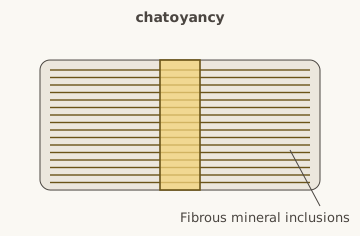
Fibrous mineral inclusions, rather than the columnar quartz crystals, are what generate tiger’s-eye’s chatoyancy.
- CIBJO definitions
- chatoyancy
Quality factors
Tiger’s Eye — quality factor (lustre): vitreous; greasy or waxy on the fracture; silicified asbestos may also show a silky luster.
GB/T 16553—2017
- Treatment state
- untreated
- Does this standard apply
- applies to this entry
- What this covers
- silicified jade (the whole class)
Source & check 2026-09-26
- Source
- GB/T 16553—2017 Gems — Testing (GB/T): §5.2.6 (locator checked 2026-09-26)
- Fact checked on
- 2026-09-26
Each row's “Source & check” expands to the full source; the date beside it is the fact check date.
This material (RI / SG midpoints): 1.548 / 2.67; Closest values: 1Agate 1.537 / 2.63, 2Shoushan Stone 1.56 / 2.7, 3Changhua Stone 1.56 / 2.6, 4Bamboo Coral 1.57 / 2.65, 5Synthetic Beryl 1.57 / 2.69
Show the full chart (330 registered materials)
Outside the full chart's range, drawn as triangles at the edge (RI / SG midpoints): Hematite 3.045/5.12, Synthetic Rutile 2.76/4.26, Rutile 2.753/4.23, Synthetic Moissanite 2.67/3.22
Testing and market
The CIBJO laboratory protocol covers Tiger’s Eye under “Quartz” (§6.1.65): see identification on the Quartz entry; the required tests are listed on the CIBJO laboratory protocol table for Quartz.
How far testing can go
Each row's “Source & check” expands to the full source; the date beside it is the fact check date.
Clause-level definitions
Tiger’s Eye has a direct definition in the CIBJO Gemmological Laboratories Book 2024 under the term Tiger’s-eye. The visible content of the definition is mineral species quartz, mineral or gem variety tiger’s-eye, with the CIBJO wording quoted in full under Clause-level definitions on this page. The cross-check shows it is defined directly by CIBJO, and no identically named English entry was found in this edition of the GB/T annex.
This table scrolls sideways on narrow screens.
| Term | Clause | Definition | Cross-check |
|---|---|---|---|
| Tiger’s-eye | 7.2.1.240 | Tiger’s-eye is a variety of quartz in which quartz replaced crocidolite (a form of asbestos) without disturbing the fibrous structure of the original crocidolite. Brownish yellow to brown to reddish brown, translucent to opaque | Defined directly by CIBJO; no identically named English entry was found in this edition of the GB/T annex. |
Evidence and sources
Authority basis and clause sources
Sources
- CIBJO – The World Jewellery Confederation. Gemmological Laboratories Book (Blue Book), Gemmological Commission 2024-1.
- CIBJO – The World Jewellery Confederation. The Gemstone Book (Blue Book), 2022.
- SAMR / SAC (China). GB/T 16552—2017 Gems — Nomenclature.
- AQSIQ / SAC (China). GB/T 34098—2017 Quartzose jade — Classification and nomenclature.
Further reading
Related entries and topic cluster
Parent entry and related pages on this site. Rows marked “Planned” are suggested new content and have no link yet.
Related-entry tree for Quartz on this site: 74 entries listed by this site's parent-entry links; synthetic, treated and similar entries carry their recorded state after the name; this page (Tiger’s Eye) is marked.
- Quartz
Sub-entries (57)
- Agate
Sub-entries (1)
- Amethyst
- Ametrine
- Aventurine Quartz
- Aventurine Quartz / Green Aventurine
- Banded Agate
- Black Agate
- Bloodstone / Heliotrope
- Blue Lace Agate
- Carnelian
- Chalcedony
Sub-entries (2)
- Chrysoprase
- Citrine
- Clear Quartz / Rock Crystal
- Coated Quartz
- Colourless to White Quartz (brand name: Azeztulite)
- Crazy Lace Agate
- Dendritic Agate
- Dyed Agate (Treated: dyed)
- Elestial Quartz / Skeletal Quartz
- Eye Agate
- Flower Agate / Cherry Blossom Agate
- Green Quartz
- High-clarity quartz with golden needle-like inclusions
- Included Quartz
- Jasper
Sub-entries (1)
- Madeira Citrine
- Malachite Agate
- Morion / very dark Smoky Quartz
- Moss Agate
- Moss Chalcedony
- Multi-inclusion Quartz
- Onyx (banded chalcedony)
- Phantom Quartz
- Prase
- Prasiolite / Green Quartz
- Quartz Cat’s-eye
- Quartz claimed to be from the Himalayas
- Quartz Crystal
- Quartz with dark needle-like inclusions
- Quartz with fine fibrous inclusions
- Quartz with flower-like inclusions
- Quartz with golden needle-like inclusions
- Quartz with green needle-like inclusions
- Quartzite Jade
- Quartzose Jade
- Red Agate
- Rock Crystal
- Rose Quartz
- Rutilated Quartz
- Sard
- Sardonyx
- Silicified Asbestos
Sub-entries (2)
- Hawk’s Eye
- Tiger’s Eye
Sub-entries (1)
- Smoky Quartz
- Smoky Quartz (brown variety)
- Strawberry Quartz
- Yellow-green Quartz
- Agate
This table scrolls sideways on narrow screens.
| Page | Content | Status |
|---|---|---|
| Browsing family | Quartz and chalcedony materials | Live |
| Treatments recorded for this material | Dyed, Filled / Fracture-filled (via parent material), Heated / Heat-treated, Bleached | Live |
| Related articles | To be added (placeholder) | Planned |
Who maintains this page
The material facts in the Tiger’s Eye entry are maintained by the LumaLark wiki and matched one by one to the standard clauses or institutional sources they cite: every fact carries its source (with a clause or page locator) and a check date, so it can be traced back to the original; clause-level definitions also carry a cross-check result. The entry exists so that buyers and sellers can check naming, disclosure and material facts item by item.