On this page
UnderstandWhat it is, what people ask, how far this page goes
Natural inorganic gem materials · Trade name: colour / appearance variety · Natural identity; treatment status unknown
Sunstone
Also known asAventurescent feldspar · Labradorite Sunstone (conditional name)
A feldspar gem name that describes appearance; it may be orthoclase or plagioclase. Its GB/T basic name is "Sunstone", and not all of it shows an aventurescence effect. This page compares how the major standards and institutions name it, what must be disclosed when selling it, whether it can be worn every day, how it is treated and identified, and which source each conclusion comes from.
Price, rarity and origin are outside the scope of this wiki.
What this page can answer
This page covers
- How Sunstone forms and what gives its colourFormation setting, process and timescale; where its colour and optical effects come from, each finding graded and sourced
- How to identify SunstoneHow far lab testing can go
- Treatments and enhancements of SunstoneThe enhancements and treatments the GB/T and JJA/AGL tables list
- Caring for and wearing SunstoneCleaning, heat, chemicals and light, as the cited sources give them
- Hardness, density and refractive index of SunstoneEach value with its source and check date
- Sunstone in English, Chinese and Japanese; national standard namesNames in four languages, the GB/T standard name and the suggested listing name, names in national standards; and: Which of GIA, FTC, CIBJO and Gem-A have a name for it on record, and do those agree?
- Listing and disclosing SunstoneThe listing name to use; what must be disclosed before sale
- Standard clauses that define SunstoneWhich clause defines it, each cross-checked
What we cannot conclude
- Whether one particular bead is natural, treated or synthetic — only a laboratory report can settle that.
- Geographic origin, unless an origin report accompanies the item.
- Price, rarity or investment value: this wiki covers naming and disclosure only.
Material research: formation, causes and history
What authoritative sources say about how this material forms, what causes its colour and optical effects, where its name comes from and how people have used it. Each statement carries an evidence grade and its sources; it describes the material in general, not any specific piece.
How it forms
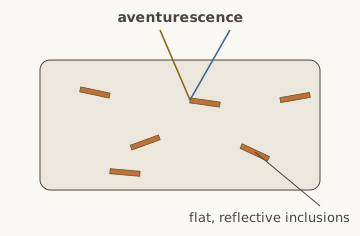
Sunstone again has two layers — formation and light show. The light show is aventurescence: selective reflection off flat, well-reflecting inclusions (sometimes called 'schiller'), so the sparkle is a reflection color rather than an interference color. In origin, the two inclusion types map to two settings. Copper platelet inclusions occur only in feldspar phenocrysts of certain basalts (e.g. the well-known Oregon sunstone), where platelets are oriented along feldspar cleavage planes (mostly (010)); because copper diffuses quickly in feldspar, the relatively fast cooling of volcanic rock (months to years for lava to cool from melting temperature) is necessary for copper to precipitate as metallic particles rather than diffuse out. Hematite sunstones occur mainly in granites or pegmatites.
Scope: Covers feldspars showing aventurescence from reflection by platy inclusions (copper or hematite sunstone); yellow feldspar with only a yellowish body colour and no sparkle does not fall under this mechanism.
Sources G&G Summer 2025 · GIA Sunstone Description
Where it forms
Feldspar phenocrysts in basaltic volcanic rock (lava) — copper sunstone (e.g. Oregon)
Sources G&G Summer 2025
Hematite-bearing sunstone hosted in granites and pegmatites.
Sources GIA Sunstone Description · G&G Summer 2025
How it forms, step by step
Feldspar crystallizes from the melt, with color/inclusion-forming elements such as copper or iron entering the lattice in solid solution or trace amounts.
On cooling, copper or iron oxides become oversaturated and precipitate as flat, platy inclusions oriented along feldspar cleavage planes (mostly (010)).
Because volcanic rock cools comparatively fast (months to years), copper precipitates as metallic (or colloidal) particles rather than diffusing out of the crystal — a rate that cannot be reproduced in the laboratory.
Light undergoes selective reflection off the flat, well-reflecting inclusion faces, producing the metallic-looking glitter — aventurescence.
Sources GIA Sunstone Description
Link to appearance
The intensity and color of the sparkle depend on inclusion size and type: small inclusions give a red/golden sheen over the bodycolor, larger ones give bright glitter; copper platelets are opaque so the schiller is reddish brown, while colloidal copper can impart red or blue-green bodycolor.
Sources GIA Sunstone Description · G&G Summer 2025
Timescale
The source states a timescale: basaltic lava takes months to years to cool from the melting temperature, and this relatively fast rate is key to forming copper sunstone.
Sources G&G Summer 2025
Related base materials
- Orthoclase: Orthoclase sunstone can occur
- Plagioclase (oligoclase/labradorite etc.): Plagioclase sunstone can occur, containing copper or hematite inclusions
Supporting findings
In copper sunstone, the copper platelets are found only within feldspar phenocrysts from particular basalts and lie parallel to the feldspar cleavage planes, chiefly (010).
Evidence grade AScope: Exemplified by Oregon sunstone; other localities such as Ethiopia differ in chemistry.
Relatively fast cooling of the volcanic rock (months to years) is necessary for copper to precipitate as metallic particles rather than diffuse out of the feldspar.
Evidence grade AScope: Refers to basaltic lava cooling rates; laboratory work has not yet reproduced strong aventurescence.
Recorded localities
Authoritative sources list the localities below; the list is not exhaustive.
Africa
- Afar Region, EthiopiaCopper-bearing sunstone
Asia
- Tamil Nadu, India
Sources GIA Sunstone Description
North America
- Ponderosa mine, Harney County, Oregon, United StatesCopper-bearing labradorite sunstone
- Dust Devil and Sunstone Butte mines, Plush area, Lake County, Oregon, United StatesCopper-bearing labradorite sunstone
These are localities recorded by authoritative sources, not an origin finding for any individual piece. The CIBJO Gemstone Book (2022, §4.2.3) says a place of origin names where a gem was mined or harvested, is a matter of opinion, does not imply a level of quality, and that cutting, processing or exporting centres must not be used to imply origin. See how far testing can go on this page, the origin determination guide and the overview of recorded localities.
Causes of colour and optical effects
Sunstone's phenomenon is aventurescence — a metallic-looking lustre that flat, reflective inclusions produce, often termed 'schiller'.
Evidence grade AScope: Concerns aventurescent sunstone; yellow/orange stones without glitter are outside this phenomenon.
Sources GIA Sunstone Description
The intensity of the sparkle depends on inclusion size: small inclusions create a red or golden sheen over the bodycolor, larger ones create bright glittery reflections.
Evidence grade AScope: A qualitative GIA description; inclusion mineralogy differs between localities.
Sources GIA Sunstone Description
The copper platelets are completely opaque, so the schiller is only the reddish-brown light reflected by the copper particles; colloidal copper adds red or blue-green bodycolor.
Evidence grade AScope: Applies to copper sunstone; hematite sunstone colors differently.
Other research findings
'Sunstone' refers to appearance rather than chemistry: both orthoclase and plagioclase have sunstone varieties, and hematite sunstones occur mainly in granites or pegmatites.
Evidence grade AScope: The trade name spans several feldspars; 'Tibetan sunstone' was involved in a treatment controversy.
Sources GIA Sunstone Description · G&G Summer 2025
Limits of this research
- Research status: Formation, occurrence or other material-specific findings found in authoritative sources
- 'Sunstone' is an appearance-based trade name covering several orthoclase and plagioclase varieties; mineral identity must be determined separately.
- The 2000s 'Tibetan sunstone / Tibetan andesine' material was involved in a copper-infusion treatment controversy; authority text warns such commercial material may be treated.
Methodology
- Origin determination and its limits
- Quality grading and value factors
- How gemmology became a technical discipline
Evidence grades
- A
- Standards bodies, government geological surveys, peer-reviewed research and museum records
- B
- Institutional educational material
- C
- Specialist databases or cautious readings
A statement is never graded above its strongest source.
This section is LumaLark's own factual restatement of public authoritative sources, credited item by item; it contains no verbatim excerpts, images or third-party logos.
DecideListing name, disclosure, care and treatments
- Suggested listing name
- Sunstone
GB/T 16552—2017 Table A.1 “Sunstone” · CIBJO Gemmological Laboratories Book 2024 §7.2.1.232 “Sunstone”
Construction or treatment status
Natural identity; treatment status unknown
Treatments recorded for this material: Filled / Fracture-filled (via parent material), Coated (via parent material), Diffusion-treated (via parent material), Irradiated (via parent material)
Related:Disclosure and cautions
This page cannot answer
Natural? · Origin · Price
A lab report settles these; this wiki covers naming and disclosure.
Related:What this page can answer
Answer at a glance
"Sunstone" is a market name rather than a mineral species name; before using it, verify: Industry-wide term that does not denote a single species.
What this means for you
Before buying, check the recommended listing name "Sunstone" and any disclosed treatments on this page, and ask the seller for a grading report if in doubt.
Known uncertainty
- This entry's exact material identity is not fully settled.
- See “Disclosure and cautions” above
- Last reviewed
- 2026-09-01
Trade-name ruling
- Industry-wide term that does not denote a single species.
- Suggested listing name
- Sunstone
Care and wear
Normal care for every gemstone (CIBJO Gemstone Book §6.1), in brief:
- Handle it gently.
- Store pieces apart when not worn, so they cannot scratch each other.
- Clean with warm soapy water and a soft brush.
- Use ultrasonic cleaners only with caution.
The §6.1 wording and the full list of §6.2 special-care letters cited on this page are on the general gem care page.
Care
care (cleaning)2 sources compared
Sunstone — care (cleaning): Some stones are susceptible to damage from ultrasonic cleaning. Do not expose them to ultrasonic cleaning.
CIBJO Gemstone Book 2022
CIBJO Gemstone Book §6.2:special-care code j
- Treatment state
- any treatment state
Source & check 2026-09-25
- Source
- CIBJO Blue Book — Official Gemstone Book (Coloured Stone Commission 2022) (CIBJO): §8 Annex C, Sunstone, p.52; §6.2 j (locator checked 2026-09-25)
- Fact checked on
- 2026-09-25
Sunstone — care (cleaning): Warm soapy water is always safe; avoid steam cleaning as well; feldspars are quickly attacked by hydrochloric acid, so avoid cleaning products that contain bleach.
GIA Gem Encyclopedia (care guide)
- Treatment state
- any treatment state
Source & check 2026-09-26
- Source
- GIA Gem Encyclopedia — Sunstone Care and Cleaning Guide: Section “Cleaning” (locator checked 2026-09-26)
- Fact checked on
- 2026-09-26
Sunstone — care (cleaning): The occasional fracture-filled stone should be cleaned only with warm soapy water
GIA Gem Encyclopedia (care guide)
- Treatment state
- treated
- Only after these treatments
- filling
Source & check 2026-09-26
- Source
- GIA Gem Encyclopedia — Sunstone Care and Cleaning Guide: Section “Cleaning” (locator checked 2026-09-26)
- Fact checked on
- 2026-09-26
Sunstone — care (heat): Heat exposure is not advised; its colour is stable in light and will not fade.
GIA Gem Encyclopedia (care guide)
- Treatment state
- any treatment state
Source & check 2026-09-26
- Source
- GIA Gem Encyclopedia — Sunstone Care and Cleaning Guide: Section “Stability” (locator checked 2026-09-26)
- Fact checked on
- 2026-09-26
care (wear)2 sources compared
Sunstone — care (wear): cleaves or fractures easily or is brittle (e.g. rubbed facet edges); wear with care.
CIBJO Gemstone Book 2022
CIBJO Gemstone Book §6.2:special-care code b
- Treatment state
- any treatment state
Source & check 2026-09-25
- Source
- CIBJO Blue Book — Official Gemstone Book (Coloured Stone Commission 2022) (CIBJO): §8 Annex C, Sunstone, p.52; §6.2 b (locator checked 2026-09-25)
- Fact checked on
- 2026-09-25
Sunstone — care (wear): Feldspars are soft (Mohs 6.5 to 7.2) with cleavage in two directions, giving poor toughness.
GIA Gem Encyclopedia (care guide)
- Treatment state
- any treatment state
Source & check 2026-09-26
- Source
- GIA Gem Encyclopedia — Sunstone Care and Cleaning Guide: Section “Hardness and Toughness” (locator checked 2026-09-26)
- Fact checked on
- 2026-09-26
Sunstone — care (setting): In a protective setting it makes excellent jewellery: pendants, earrings and pins rather than rings, which take more knocks.
GIA Gem Encyclopedia (care guide)
- Treatment state
- any treatment state
Source & check 2026-09-26
- Source
- GIA Gem Encyclopedia — Sunstone Care and Cleaning Guide: Section “Hardness and Toughness” (locator checked 2026-09-26)
- Fact checked on
- 2026-09-26
Each row's “Source & check” expands to the full source; the date beside it is the fact check date.
Common care questions and matching entries
CleaningCleaning Sunstone: the CIBJO Official Gemstone Book states for any treatment state that it must not be cleaned ultrasonically; the GIA Gem Encyclopedia states for any treatment state that warm soapy water is always safe and steam cleaning should also be avoided. ChemicalsOn chemicals, the GIA Gem Encyclopedia states for any treatment state that feldspars are quickly attacked by hydrochloric acid, so cleaning products containing bleach should also be avoided; it also states that the occasional fracture-filled Sunstone, with the treatment state treated and limited to filling, should be cleaned only with warm soapy water. Heat and lightOn heat and light, the GIA Gem Encyclopedia states for any treatment state that Sunstone should not be exposed to heat and that its colour is stable to light and will not fade. WearOn wear, the CIBJO Official Gemstone Book states for any treatment state that Sunstone breaks easily, so wear it with care; the GIA Gem Encyclopedia states for any treatment state that feldspars are fairly soft, at Mohs 6.5–7.2, with cleavage in two directions and poor toughness, and that set in styles that protect it, such as pendants, earrings and brooches, rather than rings exposed to knocks, Sunstone makes a fine jewellery gem.
This table scrolls sideways on narrow screens.
Care entries by treatment state
The same entries grouped by the treatment state each applies to; each links to its full wording and source. Letters are CIBJO special-care codes, explained on the gemstone care page.
any treatment state
- care (cleaning) §6.2 j
- Warm soapy water is always safe; avoid steam cleaning as well; feldspars are quickly attacked by hydrochloric acid, so avoid cleaning products that contain bleach
- Heat exposure is not advised; its colour is stable in light and will not fade
- cleaves or fractures easily or is brittle (e.g. rubbed facet edges); wear with care §6.2 b
- Feldspars are soft (Mohs 6.5 to 7.2) with cleavage in two directions, giving poor toughness
- In a protective setting it makes excellent jewellery: pendants, earrings and pins rather than rings, which take more knocks
treated (Only after these treatments: filling)
Treatments and identification leads
One row per treatment, with three standards side by side: how often it occurs and how stable it is (CIBJO), its category in GB/T 16552—2017 Table B.1 (this site's paraphrase) and how the JJA/AGL 2025 table lists it. Each CIBJO value links to its entry under “Testing and market”, where the wording and source are given in full.
This table scrolls sideways on narrow screens.
| Treatment | Market frequency (CIBJO) | Stability (CIBJO) | GB/T 16552 category | JJA/AGL listing | Identification leads |
|---|---|---|---|---|---|
| Filling | — | — | Graded — see §5.4.1, Table 1 | — | — |
| Coating | — | — | Treatment | — | — |
| Diffusion | — | — | Treatment | — | — |
| Irradiation | — | — | Treatment | — | — |
“—” means the cited source gives no value for that item, not “none”. Source: GB/T 16552—2017 Table B.1 (row for Feldspar); JJA/AGL 2025
Whether a treatment has to show in the name differs between the two rule sets (this site’s paraphrase):
- GB/T 16552—2017: a method classed as treatment has to be stated in the name itself — the method put before the name, or added in brackets after it; a method classed as optimization does not need to appear in the name, though one marked “Optimization (annotation required)” still has to be noted in the quality documents. Source: §5.4.2.1 a), b); §5.4.2.2 a)
- CIBJO Gemstone Book 2022: no longer splits treatments into ones that need specific disclosure and ones that need only general disclosure: every treatment is to be disclosed, and the seller tells the buyer which treatment was used and what special care it calls for. Source: §4.2.5 Note 2, §4.2.5.1, pp.14–15
What this table covers
What this page can give
- Registered treatments, their stability and how often they occur (see the table above)
- Identification leads for each treatment, for use when sending a stone for testing
VerifyNames, standards, technical facts, clauses and sources
Names
Besides Sunstone, the name register records "Aventurescent feldspar" and "Labradorite Sunstone", for which no restriction on use as a name is recorded (CIBJO Gemstone Book 2022 Annex 8 “Labradorite Sunstone”); 3 further names in non-Latin scripts are listed in the name register below (3 with no restriction recorded on use as a name).
Standard and listing namesThe Chinese formal name of Sunstone is given in GB/T 16552—2017 Table A.1, and the suggested listing name is also Sunstone. Names in four languagesThe Simplified and Traditional Chinese names are written the same, the English name is Sunstone, and there is a Japanese katakana name; the GSJ (Japan) formal name also gives a kanji form. National standard namesGermany (RAL) uses Sonnenstein and the European Union Sunstone. Trade and mineralogical namesCommon market names include several Chinese names along the lines of sun stone, golden sun and gold-spotted sun stone, and Aventurescent feldspar is a synonym; Labradorite Sunstone is recorded in the CIBJO Gemstone Book 2022, and this site records it as a market name matched only after conditions are confirmed. The mineralogical name describes feldspar with the appearance of sunstone, which may be orthoclase or plagioclase, including oligoclase or labradorite. Institution usageFor authority wording, GIA and CIBJO record Sunstone; the FTC text on file has no wording for this name, which has been checked; Gem-A wording is not yet checked. The English name shown for bodies without a recorded wording comes from the entry itself and does not represent their position.
Name register
Every name recorded for this entry, with how it is classified, whether it may be matched to this entry automatically, whether it may be used as a product name, and the clause it rests on.
This table scrolls sideways on narrow screens.
| Name | Type | Matching | Use as a name | Basis |
|---|---|---|---|---|
| no restriction recorded (5) | ||||
| Aventurescent feldsparEnglish | synonym | matched automatically | no restriction recorded | editorial ruling (no clause cited) |
| Labradorite SunstoneEnglish | market name | matched only once the condition is confirmed | no restriction recorded | CIBJO Gemstone Book 2022 Annex 8 “Labradorite Sunstone” |
| 太阳石Simplified Chinese | market name | matched automatically | no restriction recorded | editorial ruling (no clause cited) |
| 金太阳Simplified Chinese | market name | matched automatically | no restriction recorded | editorial ruling (no clause cited) |
| 金点太阳石Simplified Chinese | market name | matched automatically | no restriction recorded | editorial ruling (no clause cited); Note: The whole string is registered as one name; the shorter forms are registered separately and the prefix is not stripped. |
How each authority words this name: see Names › Authority wording.
- GSJ (Japan) formal name
- サンストーン/日長石
- Chinese formal name
- 日光石 (GB/T 16552—2017 Table A.1)
- Mineralogical name
- Feldspar showing sunstone appearance; may be orthoclase or plagioclase (including oligoclase/labradorite)
- Trade names and synonyms
- Aventurescent feldspar (synonym) · Labradorite Sunstone (market name; conditional name)
Four-language names
- 简体中文
- 日光石
- 繁體中文
- 日光石
- English
- Sunstone
- 日本語
- サンストーン
National and regional formal names
- Germany (RAL)
- Sonnenstein
- European Union
- Sunstone
See also: Misleading and prohibited trade names · Supplementary name index
Classification
- Origin
- Natural materials
- Material domain
- Natural inorganic gem materials
- Browsing family
- Feldspar materials
- Identity tier
- Trade name: colour / appearance variety
- Mineral chemical class
- Silicates
- Construction or treatment status
- Natural identity; treatment status unknown
Treatments listed by standards
GB/T Table B.1For Sunstone in GB/T 16552—2017 Annex B, Table B.1, this site applies the Feldspar entry, which lists filling, coating, diffusion and irradiation; filling is marked as graded, while coating, diffusion and irradiation are listed as treatments. JJA/AGL designationsThe JJA/AGL (Japan) 2025 table lists Sunstone under the species oligoclase, colour red, notes that an untreated tier is listed, and adds aventurescence as a note.
GB/T 16552-2017, Annex B, Table B.1
Under the “Feldspar” row of Table B.1: Filling Graded — see §5.4.1, Table 1; Coating Treatment; Diffusion Treatment; Irradiation Treatment. The full row, with the effect column, is on the Feldspar page.
What Table B.1 is, and how the “see 5.4.1” grades are defined: see the GB/T 16552: optimization vs treatment page.
JJA/AGL (Japan) table of principal gem names, 2025
This table scrolls sideways on narrow screens.
| Gem name | Species | Colour | Listed in the table | Notes |
|---|---|---|---|---|
| Sunstone | Oligoclase | red | an untreated tier is listed | aventurescence |
JJA/AGL definitions and nomenclature (2025 revision), table of principal gem names, p.15
How to read the JJA/AGL table: see the Gem treatments page.
What it is and how it's identified
The composition (phase) of Sunstone is registered as the feldspar group, and the crystal system as triclinic. Under the clauses for feldspar (the whole mineral group), the overall structure is crystalline, with tabular or short prismatic habit, commonly showing Carlsbad, polysynthetic and cross-hatched twinning, Mohs hardness 6–6.5, two sets of perfect cleavage, and optically anisotropic, biaxial, positive or negative. Sunstone's density is registered as 2.62–2.67 g/cm³, the cited clause giving 2.65 with an allowed deviation of +0.02/−0.03, from which the limits are derived; its refractive index is registered as 1.531–1.551, the cited clause giving 1.537–1.547 with an allowed deviation of +0.004/−0.006, from which the limits are derived; birefringence is registered as 0.007–0.01. Under the feldspar (whole mineral group) clauses, untreated sunstone usually shows no pleochroism and has a vitreous lustre; under the same clauses, iridescence, cat's-eye effect, star effect and aventurescence may all be seen. Magnification of untreated sunstone commonly shows platy inclusions with a metallic look, red or golden in colour.
Registered material facts
Each row carries its own source and check date and can be cited on its own; “—” means the cited source gives no value, not “none”.
Chemical composition, luminescence, UV-visible spectrum, infrared spectrum, magnification: these whole-class features are given in the cited clause for feldspar (the whole mineral group), so they are not repeated on the Sunstone page; see the material facts on the Feldspar entry.
Items below that name the class they cover give the cited clause’s value for that whole class, not a measurement of Sunstone (how to read class-level values).
Definition
Sunstone — composition (phase): feldspar group
CIBJO Gemmological Laboratories Book 2024
Source & check 2026-09-22
- Source
- Fact checked on
- 2026-09-22
Structure
Sunstone — structure (overall): crystalline
GB/T 16553—2017
- Does this standard apply
- applies to this entry
- What this covers
- feldspar (the whole mineral group)
Source & check 2026-09-26
- Source
- GB/T 16553—2017 Gems — Testing (GB/T): §5.1.17 (locator checked 2026-09-26)
- Fact checked on
- 2026-09-26
Sunstone — structure (crystal system): triclinic
GB/T 16553—2017
- Does this standard apply
- applies to this entry
Source & check 2026-09-26
- Source
- GB/T 16553—2017 Gems — Testing (GB/T): §5.1.17 Crystal system · Sunstone, labradorite (locator checked 2026-09-28)
- Fact checked on
- 2026-09-26
Sunstone — structure (crystal system): Moonstone and amazonite belong to the monoclinic or triclinic system; sunstone and labradorite are triclinic.
GB/T 16553—2017
- Does this standard apply
- applies to this entry
- What this covers
- feldspar (the whole mineral group)
Source & check 2026-09-26
- Source
- GB/T 16553—2017 Gems — Testing (GB/T): §5.1.17 (locator checked 2026-09-26)
- Fact checked on
- 2026-09-26
Sunstone — structure (crystal habit): Crystals are tabular or stubby prisms; Carlsbad, polysynthetic and gridiron (cross-hatched) twinning are common.
GB/T 16553—2017
- Does this standard apply
- applies to this entry
- What this covers
- feldspar (the whole mineral group)
Source & check 2026-09-26
- Source
- GB/T 16553—2017 Gems — Testing (GB/T): §5.1.17 (locator checked 2026-09-26)
- Fact checked on
- 2026-09-26
Durability
Sunstone — Mohs hardness: 6–6.5
GB/T 16553—2017
Reference points on this site: Talc 1–3, Fluorite 4, Apatite 5–5.5, Orthoclase 6–6.5, Topaz 8, Diamond 10 (Source: GB/T 16553—2017); Gypsum 1.5–2, Calcite 3, Quartz 7 (Source: Handbook of Mineralogy); Corundum 9 (Source: GIA Gem Encyclopedia (care guide))
- Does this standard apply
- applies to this entry
- What this covers
- feldspar (the whole mineral group)
Source & check 2026-09-21
- Source
- GB/T 16553—2017 Gems — Testing (GB/T): §5.1.17 (locator checked 2026-09-21)
- Fact checked on
- 2026-09-21
Sunstone — cleavage: two directions of perfect cleavage
GB/T 16553—2017
- Does this standard apply
- applies to this entry
- What this covers
- feldspar (the whole mineral group)
Source & check 2026-09-26
- Source
- GB/T 16553—2017 Gems — Testing (GB/T): §5.1.17 (locator checked 2026-09-26)
- Fact checked on
- 2026-09-26
Physical properties
Sunstone — density: 2.62–2.67 g/cm³
GB/T 16553—2017
- Does this standard apply
- applies to this entry
- Qualification
The clause we cite gives 2.65, with a stated tolerance of +0.02 / -0.03. The range shown here is worked out from that.
Source & check 2026-09-26
- Source
- GB/T 16553—2017 Gems — Testing (GB/T): §5.1.17 Density · Sunstone (locator checked 2026-09-28)
- Fact checked on
- 2026-09-26
Sunstone — density: 2.55–2.75 g/cm³
GB/T 16553—2017
- Does this standard apply
- applies to this entry
- What this covers
- feldspar (the whole mineral group)
- General note
- the clause has finer ranges
Source & check 2026-09-21
- Source
- GB/T 16553—2017 Gems — Testing (GB/T): §5.1.17 (locator checked 2026-09-21)
- Fact checked on
- 2026-09-21
Optical
Sunstone — optic character: biaxial and anisotropic; optic sign may be either positive or negative.
GB/T 16553—2017
- Does this standard apply
- applies to this entry
- What this covers
- feldspar (the whole mineral group)
Source & check 2026-09-26
- Source
- GB/T 16553—2017 Gems — Testing (GB/T): §5.1.17 (locator checked 2026-09-26)
- Fact checked on
- 2026-09-26
Sunstone — refractive index: 1.531–1.551
GB/T 16553—2017
- Does this standard apply
- applies to this entry
- Qualification
The clause we cite gives 1.537–1.547, with a stated tolerance of +0.004 / -0.006. The range shown here is worked out from that.
Source & check 2026-09-26
- Source
- GB/T 16553—2017 Gems — Testing (GB/T): §5.1.17 Refractive index · Sunstone (locator checked 2026-09-28)
- Fact checked on
- 2026-09-26
Sunstone — refractive index: 1.508–1.572
GB/T 16553—2017
- Does this standard apply
- applies to this entry
- What this covers
- feldspar (the whole mineral group)
- General note
- the clause has finer ranges
Source & check 2026-09-21
- Source
- GB/T 16553—2017 Gems — Testing (GB/T): §5.1.17 (locator checked 2026-09-21)
- Fact checked on
- 2026-09-21
Sunstone — birefringence: 0.007–0.01
GB/T 16553—2017
- Does this standard apply
- applies to this entry
Source & check 2026-09-26
- Source
- GB/T 16553—2017 Gems — Testing (GB/T): §5.1.17 Birefringence · Sunstone (locator checked 2026-09-28)
- Fact checked on
- 2026-09-26
Sunstone — birefringence: 0.005–0.01
GB/T 16553—2017
- Does this standard apply
- applies to this entry
- What this covers
- feldspar (the whole mineral group)
- General note
- the clause has finer ranges
Source & check 2026-09-21
- Source
- GB/T 16553—2017 Gems — Testing (GB/T): §5.1.17 (locator checked 2026-09-21)
- Fact checked on
- 2026-09-21
Sunstone — pleochroism: usually absent
GB/T 16553—2017
- Treatment state
- untreated
- Does this standard apply
- applies to this entry
- What this covers
- feldspar (the whole mineral group)
Source & check 2026-09-26
- Source
- GB/T 16553—2017 Gems — Testing (GB/T): §5.1.17 (locator checked 2026-09-26)
- Fact checked on
- 2026-09-26
Sunstone — optical effect (iridescence): seen
GB/T 16553—2017
- Does this standard apply
- applies to this entry
- What this covers
- feldspar (the whole mineral group)
Source & check 2026-09-26
- Source
- GB/T 16553—2017 Gems — Testing (GB/T): §5.1.17 (locator checked 2026-09-26)
- Fact checked on
- 2026-09-26
Sunstone — optical effect (chatoyancy): seen
GB/T 16553—2017
- Does this standard apply
- applies to this entry
- What this covers
- feldspar (the whole mineral group)
Source & check 2026-09-26
- Source
- GB/T 16553—2017 Gems — Testing (GB/T): §5.1.17 (locator checked 2026-09-26)
- Fact checked on
- 2026-09-26
Sunstone — optical effect (asterism): seen
GB/T 16553—2017
- Does this standard apply
- applies to this entry
- What this covers
- feldspar (the whole mineral group)
Source & check 2026-09-26
- Source
- GB/T 16553—2017 Gems — Testing (GB/T): §5.1.17 (locator checked 2026-09-26)
- Fact checked on
- 2026-09-26
Sunstone — optical effect (aventurescence): seen
GB/T 16553—2017
- Does this standard apply
- applies to this entry
- What this covers
- feldspar (the whole mineral group)
Source & check 2026-09-26
- Source
- GB/T 16553—2017 Gems — Testing (GB/T): §5.1.17 (locator checked 2026-09-26)
- Fact checked on
- 2026-09-26
Sunstone — magnification: commonly seen platy inclusions, red or golden, with a metallic look.
GB/T 16553—2017
- Treatment state
- untreated
- Does this standard apply
- applies to this entry
Source & check 2026-09-26
- Source
- GB/T 16553—2017 Gems — Testing (GB/T): §5.1.17 Magnification (locator checked 2026-09-28)
- Fact checked on
- 2026-09-26
body colour2 sources compared
Sunstone — body colour: ranges from yellow and orange-yellow to brown; the aventurescence flashes red or gold.
GB/T 16553—2017
- Treatment state
- untreated
- Does this standard apply
- applies to this entry
- Qualification
In chapter 5 of GB/T 16553—2017, the colour entries of Titanite / Sphene, Phenakite, Balin Stone and other variety clauses also name yellow or a yellowish colour.
- General note
- colour alone is not identity
Source & check 2026-09-26
- Source
- GB/T 16553—2017 Gems — Testing (GB/T): §5.1.17 Colour · Sunstone (locator checked 2026-09-28)
- Fact checked on
- 2026-09-26
Sunstone — body colour: commonly with an orange/brown background colour.
CIBJO Gemmological Laboratories Book 2024
- Treatment state
- untreated
- Qualification
In chapter 7 of the CIBJO Gemmological Laboratories Book, the colour descriptions of Citrine, Sard, Agate and other entries also name brown or a brownish colour.
- General note
- colour alone is not identity
Source & check 2026-09-26
- Source
- Fact checked on
- 2026-09-26
How the sources relate
- GB/T 16553—2017 and CIBJO Gemmological Laboratories Book 2024
Both mention orange and brown. GB/T 16553—2017 also lists yellow and gives the colour of the aventurescence (red or golden); the CIBJO Gemmological Laboratories Book says these are the usual background colours.
Sunstone's phenomenon is aventurescence — a metallic-looking lustre that flat, reflective inclusions produce, often termed 'schiller'.
- CIBJO definitions
- chatoyancy, asterism, aventurescence
Quality factors
Sunstone — quality factor (lustre): vitreous
GB/T 16553—2017
- Treatment state
- untreated
- Does this standard apply
- applies to this entry
- What this covers
- feldspar (the whole mineral group)
Source & check 2026-09-26
- Source
- GB/T 16553—2017 Gems — Testing (GB/T): §5.1.17 (locator checked 2026-09-26)
- Fact checked on
- 2026-09-26
Each row's “Source & check” expands to the full source; the date beside it is the fact check date.
This material (RI / SG midpoints): 1.54 / 2.65; Closest values: 1Charoite 1.554 / 2.66, 2Changhua Stone 1.56 / 2.6, 3Shoushan Stone 1.56 / 2.7, 4Balin Stone 1.56 / 2.55, 5Bamboo Coral 1.57 / 2.65
Show the full chart (330 registered materials)
Outside the full chart's range, drawn as triangles at the edge (RI / SG midpoints): Hematite 3.045/5.12, Synthetic Rutile 2.76/4.26, Rutile 2.753/4.23, Synthetic Moissanite 2.67/3.22
Testing and market
The CIBJO laboratory protocol covers Sunstone under “Feldspar” (§6.1.33): see identification on the Feldspar entry; the required tests are listed on the CIBJO laboratory protocol table for Feldspar.
How far testing can go
Each row's “Source & check” expands to the full source; the date beside it is the fact check date.
Clause-level definitions
Sunstone is defined directly in the Sunstone entry of CIBJO Gemmological Laboratories Book 2024, under the entry name Sunstone; the visible definition describes it as a variety of feldspar, commonly with an orange or brown body colour, showing "schiller". The cross-check result for the Sunstone clause of CIBJO Gemmological Laboratories Book 2024 is "defined directly by CIBJO; also present in the GB/T annex". CIBJO Gemmological Laboratories Book 2024 also has a Labradorite entry, whose definition only notes that the CIBJO wording is quoted in full under Clause-level definitions on this page; its cross-check result is "defined directly by CIBJO; also present in the GB/T annex".
This table scrolls sideways on narrow screens.
| Term | Clause | Definition | Cross-check |
|---|---|---|---|
| Labradorite | 7.2.1.126 | A plagioclase feldspar with an albite : anorthite molar ratio ranging from 30 : 70 to 50 : 50 Grey to nearly black, labradorescence causing interference colours at the surface, translucent to opaque; also colourless, green, yellow, orange to brown or brownish red, transparent to translucent | Defined directly by CIBJO; also present in the GB/T annex. |
| Sunstone | 7.2.1.232 | A variety of feldspar, commonly with an orange/brown background colour, that has ‘schiller’, due to small, highly reflective mineral inclusions (e.g., hematite, ilmenite, copper) that give it a flash and sparkle. Also called ‘Aventurine feldspar’ | Defined directly by CIBJO; also present in the GB/T annex. |
Evidence and sources
Authority basis and clause sources
Sources
- CIBJO – The World Jewellery Confederation. Gemmological Laboratories Book (Blue Book), Gemmological Commission 2024-1.
- CIBJO – The World Jewellery Confederation. The Gemstone Book (Blue Book), 2022.
- SAMR / SAC (China). GB/T 16552—2017 Gems — Nomenclature.
- GIA – Gemological Institute of America (United States). Gem Encyclopedia: Sunstone Description.
Further reading
Related entries and topic cluster
Parent entry and related pages on this site. Rows marked “Planned” are suggested new content and have no link yet.
Related-entry tree for Feldspar on this site: 13 entries listed by this site's parent-entry links; synthetic, treated and similar entries carry their recorded state after the name; this page (Sunstone) is marked.
This table scrolls sideways on narrow screens.
| Page | Content | Status |
|---|---|---|
| Browsing family | Feldspar materials | Live |
| Treatments recorded for this material | Filled / Fracture-filled (via parent material), Coated (via parent material), Diffusion-treated (via parent material), Irradiated (via parent material) | Live |
| Related articles | To be added (placeholder) | Planned |
Who maintains this page
The material facts in the Sunstone entry are maintained by the LumaLark wiki and matched one by one to the standard clauses or institutional sources they cite: every fact carries its source (with a clause or page locator) and a check date, so it can be traced back to the original; clause-level definitions also carry a cross-check result. The entry exists so that buyers and sellers can check naming, disclosure and material facts item by item.