On this page
UnderstandWhat it is, what people ask, how far this page goes
Natural inorganic gem materials · Mineral / gemstone variety · Natural identity; treatment status unknown
Labradorite
A variety name for a compositional range of plagioclase feldspar; its GB/T basic name is "Labradorite", and the IMA list does not include it as a separate mineral species. This page compares how the major standards and institutions name it, what must be disclosed when selling it, whether it can be worn every day, how it is treated and identified, and which source each conclusion comes from.
Price, rarity and origin are outside the scope of this wiki.
Questions people ask about Labradorite
Every sentence below is followed by the registered fact it rests on; answers add no new facts and promise no outcome.
Q1What causes labradorite's flash of colour?
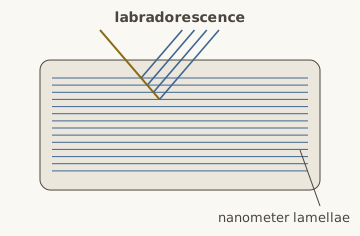
The flash, called labradorescence, is produced by interference of light in regularly repeating nanometre-scale layers of calcium-rich and sodium-rich feldspar, not by pigments or single inclusions.G&G Summer 2025The colour depends on the combined thickness of neighbouring layers: about 150 nm gives blue and more than 250 nm gives red, with the rest of the spectrum in between.G&G Summer 2025The darkness of the body colour, from iron oxide inclusions, decides whether the colour seems to sit at the surface or deeper inside.G&G Summer 2025
Q2How can you tell if labradorite is real?
CIBJO describes labradorite as grey to nearly black with labradorescence, though it also comes colourless, green, yellow, orange to brown or brownish red.CIBJO Gemmological Laboratories Book 2024No synthetic labradorite is commercially available.CIBJO Gemstone Book 2022Whether one particular bead is natural, treated or synthetic — only a laboratory report can settle that.What this page can answer
Q3Is labradorite durable enough for everyday wear?
It has two directions of perfect cleavage.GB/T 16553—2017CIBJO notes that it can cleave or fracture easily, so it should be worn with care.CIBJO Gemstone Book 2022In settings, prong and bezel call for caution, and flush, channel and pavé for extreme caution.Gems & Gemology 1987 (Martin)
Q4How should labradorite be cleaned?
Ultrasonic and steam cleaners should be avoided, and so should heat.Gems & Gemology 1987 (Martin)Heat may crack it or split it along its cleavage.Gems & Gemology 1987 (Martin)
Q5Does labradorite fade in the sun?
Sunlight and artificial light are rated relatively safe for labradorite, while heat in a display case calls for caution.Gems & Gemology 1987 (Martin)
Q6Is labradorite treated?
CIBJO's Gemstone Book records diffusion treatment of labradorite as common in the trade.CIBJO Gemstone Book 2022That diffusion treatment is recorded as stable.CIBJO Gemstone Book 2022Surface waxing is recorded as occasional.CIBJO Gemstone Book 2022
Q7What kind of feldspar is labradorite?
Labradorite is plagioclase feldspar with a composition between An50 and An70.G&G Summer 2025It crystallizes in the triclinic system.GB/T 16553—2017
Q8How does iridescent labradorite form?
It is found in deep-seated plutonic rocks that cooled extremely slowly or went through high-grade metamorphism, and crystals sometimes reach several decimetres.G&G Summer 2025During that slow cooling the feldspar unmixes in the solid state into alternating calcium-rich layers of about 70–200 nm and sodium-rich layers of about 50–100 nm.G&G Summer 2025
Q9Does labradorite have healing or spiritual powers?
There is no scientific evidence that labradorite has healing powers: the UK advertising regulators ASA and CAP state that they have not seen evidence that crystal therapy can treat medical conditions.ASA/CAP guidance (UK)
Q10What makes good-quality labradorite?
Labradorite is appreciated above all for its labradorescence, the broad flashes of colour that move across the stone, and the rare Finnish variety spectrolite is highly prized for richer, full-spectrum colours and stronger labradorescence.G&G in a Flash, Summer 2025
Sources cited in these answers ASA/CAP guidance (UK)
What this page can answer
This page covers
- How Labradorite forms and what gives its colourFormation setting, process and timescale; where its colour and optical effects come from, each finding graded and sourced
- How to identify LabradoriteHow far lab testing can go and whether a synthetic exists
- Treatments and enhancements of Labradorite2 registered treatments: status, stability, how common they are and identification leads
- Caring for and wearing LabradoriteCleaning, heat, chemicals and light, as the cited sources give them
- Hardness, density and refractive index of LabradoriteEach value with its source and check date
- Labradorite in English, Chinese and Japanese; national standard namesNames in four languages, the GB/T standard name and the suggested listing name, names in national standards; and: Which of GIA, FTC, CIBJO and Gem-A have a name for it on record, and do those agree?
- Listing and disclosing LabradoriteThe listing name to use; what must be disclosed before sale
- Standard clauses that define LabradoriteWhich clause defines it, each cross-checked
What we cannot conclude
- Whether one particular bead is natural, treated or synthetic — only a laboratory report can settle that.
- Geographic origin, unless an origin report accompanies the item.
- Price, rarity or investment value: this wiki covers naming and disclosure only.
Material research: formation, causes and history
What authoritative sources say about how this material forms, what causes its colour and optical effects, where its name comes from and how people have used it. Each statement carries an evidence grade and its sources; it describes the material in general, not any specific piece.
How it forms
- Dark-bodied labradorite (top: plan view; bottom: section)
- Iridescent color zones
- Where the section is cut (dashed)
- Magnified area (nanoscale, schematic)
- Exsolution lamellae (calcic and sodic alternating)
- Iron-oxide inclusions
- Incoming white light
- Iridescence (reflected light)
- Comparison: clear, almost inclusion-free labradorite (dashed frame)
If you reuse this animation, please credit LumaLark Wiki and link to this pageLicense: CC BY 4.0
Scene-by-scene transcript (7 scenes, with evidence grades and sources)
The caption of each scene in the animation above, with its evidence grade and sources.
Scene 1What labradorite is
Labradorite's formation and its light show are separate matters.
Labradorite denotes plagioclase with a composition between An50 and An70; iridescent feldspars fall into labradorite, peristerite and moonstone categories, and often carry additional aventurescence from iron oxide inclusions.
Evidence grade AScope: Compositional limits are petrological convention (An50–An70)
Scene 2Setting: plutonic rocks
Iridescent labradorite is found in plutonic rocks that experienced extremely slow cooling or high-grade metamorphism; crystals sometimes grow to several decimetres.
Scope: Covers the well-known plutonic occurrences such as Canada, Finland and Madagascar
Evidence grade AScene 3For example, anorthosite: extremely slow cooling
Plutonic rocks that experienced extremely slow cooling (e.g., anorthosite composed of iridescent labradorite)
The other setting: Plutonic rocks that experienced high-grade metamorphism
Scene 4Before unmixing: a homogeneous solid solution
Before exsolution, the calcic and sodic components of the plagioclase coexist as a homogeneous solid solution; the host plutonic rocks experienced extremely slow cooling or high-grade metamorphism.
Scene 5Very slow cooling: unmixing into lamellae
During extremely slow cooling the solid solution enters the miscibility gap and unmixes into alternating calcic and sodic nanometer-scale lamellae.
The Bøggild intergrowth forms by solid-state exsolution on slow cooling, comprising alternating calcic lamellae (~70–200 nm) and sodic lamellae (~50–100 nm).
Evidence grade AScope: Concerns exsolved plagioclase; the exact topology of the intergrowth is still not fully resolved.
Scene 6White light interferes in the periodic layers
White light entering these periodic layers undergoes thin-film and multilayer interference plus reflection, producing the directional iridescence known as labradorescence
Iridescent color correlates with the combined thickness of adjacent calcic and sodic lamellae: ~150 nm for blue, >250 nm for red, with a continuous spectrum between.
Evidence grade AScope: A qualitative to semi-quantitative relation; color zones within one crystal differ only slightly in composition.
Scene 7What you end up seeing
The iridescent color depends on lamellar thickness and composition, while bodycolor (darkness from iron oxide inclusions) determines whether the iridescence appears at the surface or deeper inside.
Timescale: The source does not give an absolute geological time span; it addresses the condition of extremely slow cooling rather than a numeric age.
In brief: Labradorite's formation and its light show are separate matters.
Full research record (formation summary, 4 formation steps, related base materials, 1 supporting finding)
Labradorite's formation and its light show are separate matters. It occurs in plutonic rocks that experienced extremely slow cooling or high-grade metamorphism: a plagioclase solid solution cools slowly into the miscibility gap and unmixes by solid-state exsolution into periodically alternating calcic and sodic nanometre-scale lamellae — the Bøggild intergrowth — with broader calcic lamellae of about 70–200 nm and narrower sodic lamellae of about 50–100 nm. White light entering these periodic layers undergoes thin-film and multilayer interference plus reflection, producing the directional iridescence known as labradorescence; its color tracks the combined thickness and composition of adjacent lamellae, so the mechanism is structural color rather than pigment.
Scope: Covers iridescent plagioclase (bulk crystal composition approx. An46–An60, slightly below the strict An50 lower limit of labradorite, yet still called iridescent labradorite in the source) with Bøggild intergrowth exsolution textures; does not apply to ordinary plagioclase without exsolution textures that is coloured only by inclusions.
Sources G&G Summer 2025
How it forms, step by step
Before exsolution, the calcic and sodic components of the plagioclase coexist as a homogeneous solid solution; the host plutonic rocks experienced extremely slow cooling or high-grade metamorphism.
During extremely slow cooling the solid solution enters the miscibility gap and unmixes into alternating calcic and sodic nanometer-scale lamellae.
Compared with exsolution textures in other minerals, the periodicity of the Bøggild intergrowth is very regular; within one crystal, the combined thickness of adjacent calcic/sodic lamellae (which sets the iridescent color) varies with composition.
When white light passes through or reflects off these periodic layers, thin-film and multilayer interference produces the directional iridescence (labradorescence).
Related base materials
- Plagioclase feldspar: Parent mineral group; labradorite is the plagioclase compositional variety of An50–An70
Supporting findings
Iridescent labradorite is found in plutonic rocks that experienced extremely slow cooling or high-grade metamorphism; crystals sometimes grow to several decimetres.
Evidence grade AScope: Covers the well-known plutonic occurrences such as Canada, Finland and Madagascar; not exhaustive of all commercial sources.
Recorded localities
Authoritative sources list the localities below; the list is not exhaustive.
Africa
- Madagascarthe Madagascar material is traded as “rainbow moonstone”
Sources GIA Moonstone Description · G&G Summer 2025
Europe
- Ylämaa, near Lappeenranta, FinlandGIA calls Finland the classic source of labradorite; the G&G 1990s locality table lists Ylämaa under feldspar
Sources GIA News (2017) · G&G Summer 2025 · Gems & Gemology Winter 2000
North America
- Labrador, Newfoundland and Labrador, CanadaGIA describes one adularescent labradorite as found mainly in Labrador; the mineral is named for Labrador, where it was first discovered
Sources GIA Moonstone Description · G&G Summer 2025 · GIA News (2017)
These are localities recorded by authoritative sources, not an origin finding for any individual piece. The CIBJO Gemstone Book (2022, §4.2.3) says a place of origin names where a gem was mined or harvested, is a matter of opinion, does not imply a level of quality, and that cutting, processing or exporting centres must not be used to imply origin. See how far testing can go on this page, the origin determination guide and the overview of recorded localities.
Causes of colour and optical effects
Labradorite's light show is produced by thin-film and multilayer interference at periodic calcic/sodic nanometer lamellae, not by pigments or single inclusions.
Evidence grade AScope: Applies to stones with the Bøggild intergrowth; plagioclase lacking it shows no labradorescence.
Other research findings
Labradorite denotes plagioclase with a composition between An50 and An70; iridescent feldspars fall into labradorite, peristerite and moonstone categories, and often carry additional aventurescence from iron oxide inclusions.
Evidence grade AScope: Compositional limits are petrological convention (An50–An70); trade names such as 'rainbow moonstone' cause confusion.
Labradorite is appreciated above all for its labradorescence, broad flashes of colour that move across the stone, and the rare Finnish variety spectrolite is highly prized for richer, full-spectrum colours and stronger labradorescence.
Evidence grade BScope: Draws on one journal's overview of phenomenal gems; the source gives no graded list of labradorite quality factors, and this is not a statement about the value of any piece.
Sources G&G in a Flash, Summer 2025
Limits of this research
- Research status: Formation, occurrence or other material-specific findings found in authoritative sources
- The authority text gives no absolute age for labradorite exsolution, only the condition of extremely slow cooling.
- The exact topology and per-lamella composition of the Bøggild intergrowth remain not fully resolved — an acknowledged research gap.
Methodology
- Origin determination and its limits
- Quality grading and value factors
- How gemmology became a technical discipline
Evidence grades
- A
- Standards bodies, government geological surveys, peer-reviewed research and museum records
- B
- Institutional educational material
- C
- Specialist databases or cautious readings
A statement is never graded above its strongest source.
This section is LumaLark's own factual restatement of public authoritative sources, credited item by item; it contains no verbatim excerpts, images or third-party logos.
DecideListing name, disclosure, care and treatments
- Suggested listing name
- Labradorite
GB/T 16552—2017 Table A.1 “Labradorite” · CIBJO Gemmological Laboratories Book 2024 §7.2.1.126 “Labradorite”
Construction or treatment status
Natural identity; treatment status unknown
Treatments recorded for this material: Filled / Fracture-filled (via parent material), Coated (via parent material), Diffusion-treated (via parent material), Irradiated (via parent material)
Related:Disclosure and cautions
This page cannot answer
Natural? · Origin · Price
A lab report settles these; this wiki covers naming and disclosure.
Related:What this page can answer
Answer at a glance
"Labradorite" is a market name rather than a mineral species name; before using it, verify: Industry-wide term that does not denote a single species.
Evidence
What this means for you
Before buying, check the recommended listing name "Labradorite" and any disclosed treatments on this page, and ask the seller for a grading report if in doubt.
Known uncertainty
- This entry's exact material identity is not fully settled.
- See “Disclosure and cautions” above
- Last reviewed
- 2026-09-01
Trade-name ruling
- Industry-wide term that does not denote a single species.
- Suggested listing name
- Labradorite
Care and wear
Normal care for every gemstone (CIBJO Gemstone Book §6.1), in brief:
- Handle it gently.
- Store pieces apart when not worn, so they cannot scratch each other.
- Clean with warm soapy water and a soft brush.
- Use ultrasonic cleaners only with caution.
The §6.1 wording and the full list of §6.2 special-care letters cited on this page are on the general gem care page.
Care
care (cleaning)2 sources compared
Labradorite — care (cleaning): Some stones are susceptible to damage from ultrasonic cleaning. Do not expose them to ultrasonic cleaning.
CIBJO Gemstone Book 2022
CIBJO Gemstone Book §6.2:special-care code j
- Treatment state
- any treatment state
Source & check 2026-09-25
- Source
- CIBJO Blue Book — Official Gemstone Book (Coloured Stone Commission 2022) (CIBJO): §8 Annex C, Labradorite, p.52; §6.2 j (locator checked 2026-09-25)
- Fact checked on
- 2026-09-25
Labradorite — care (cleaning): ultrasonic and steamer: avoid; note: avoid heat.
Gems & Gemology 1987 (Martin)
- Treatment state
- untreated
Source & check 2026-09-26
- Source
- Martin, “Gemstone Durability: Design to Display”, Gems & Gemology, Summer 1987: pp.66–67 fold-out chart, Feldspar (Moonstone & Labradorite) row, CLEANING column (locator checked 2026-09-26)
- Fact checked on
- 2026-09-26
Labradorite — care (chemicals): Treatments with dye, oil, resin, wax or plastic are not permanent; keep it away from all solvents (including dish-washing liquids), chemicals and heat.
CIBJO Gemstone Book 2022
CIBJO Gemstone Book §6.2:special-care code k
- Treatment state
- treated
- Only after these treatments
- surface waxing
Source & check 2026-09-25
- Source
- CIBJO Blue Book — Official Gemstone Book (Coloured Stone Commission 2022) (CIBJO): §8 Annex C, Labradorite, p.52; §6.2 k (locator checked 2026-09-25)
- Fact checked on
- 2026-09-25
Labradorite — care (wear): cleaves or fractures easily or is brittle (e.g. rubbed facet edges); wear with care.
CIBJO Gemstone Book 2022
CIBJO Gemstone Book §6.2:special-care code b
- Treatment state
- any treatment state
Source & check 2026-09-25
- Source
- CIBJO Blue Book — Official Gemstone Book (Coloured Stone Commission 2022) (CIBJO): §8 Annex C, Labradorite, p.52; §6.2 b (locator checked 2026-09-25)
- Fact checked on
- 2026-09-25
Labradorite — care (setting): prong and bezel: use caution; flush, channel and pavé: use extreme caution; note: perfect, easy cleavage in two directions.
Gems & Gemology 1987 (Martin)
- Treatment state
- untreated
Source & check 2026-09-26
- Source
- Martin, “Gemstone Durability: Design to Display”, Gems & Gemology, Summer 1987: pp.66–67 fold-out chart, Feldspar (Moonstone & Labradorite) row, SETTING column (locator checked 2026-09-26)
- Fact checked on
- 2026-09-26
Labradorite — care (repair): polishing: use extreme caution; jeweller's torch, pickle pot and thermal shock: avoid; note: avoid heat, which may crack or cleave it.
Gems & Gemology 1987 (Martin)
- Treatment state
- untreated
Source & check 2026-09-26
- Source
- Martin, “Gemstone Durability: Design to Display”, Gems & Gemology, Summer 1987: pp.66–67 fold-out chart, Feldspar (Moonstone & Labradorite) row, REPAIR column (locator checked 2026-09-26)
- Fact checked on
- 2026-09-26
Labradorite — care (display): sunlight and artificial light: relatively safe; heat in the display case: use caution.
Gems & Gemology 1987 (Martin)
- Treatment state
- untreated
Source & check 2026-09-26
- Source
- Martin, “Gemstone Durability: Design to Display”, Gems & Gemology, Summer 1987: pp.66–67 fold-out chart, Feldspar (Moonstone & Labradorite) row, DISPLAY column (locator checked 2026-09-26)
- Fact checked on
- 2026-09-26
Each row's “Source & check” expands to the full source; the date beside it is the fact check date.
Common care questions and matching entries
CleaningCare of Labradorite, by source: the CIBJO Blue Book — Official Gemstone Book (Coloured Stone Commission 2022, CIBJO) states that, regardless of treatment status, it should not be cleaned ultrasonically; for treated stones, in the case of surface waxing only, treatments with dye, oil, resin, wax or plastic are not permanent, so keep it away from all solvents (including all detergents), chemicals and heat; regardless of treatment status, it is prone to breaking, so wear it with care. Martin, Gem DurabilityMartin's Gemstone Durability: Design to Display (Gems & Gemology, Summer 1987) states that, when untreated, ultrasonic and steam cleaning should be avoided, as should heat; prong and bezel settings need caution, while tension, channel and pavé settings need extra caution, as it has perfect cleavage in two directions and splits easily; polishing needs extra caution, the torch, post-soldering pickle and thermal shock should be avoided, and heat should be avoided as it may crack or split along cleavage; daylight and artificial light are relatively safe, while heat in a display case needs caution.
This table scrolls sideways on narrow screens.
| Question | Matching entries |
|---|---|
| Can it go in an ultrasonic or steam cleaner? | care (cleaning); ultrasonic and steamer: avoid; note: avoid heat |
| Heat and thermal shock | polishing: use extreme caution; jeweller's torch, pickle pot and thermal shock: avoid; note: avoid heat, which may crack or cleave it |
| Light and display | sunlight and artificial light: relatively safe; heat in the display case: use caution |
| Contact with acids, alkalis and household chemicals | Treatments with dye, oil, resin, wax or plastic are not permanent; keep it away from all solvents (including dish-washing liquids), chemicals and heat |
| Wearing limits (knocks, settings) | cleaves or fractures easily or is brittle (e.g. rubbed facet edges); wear with care; prong and bezel: use caution; flush, channel and pavé: use extreme caution; note: perfect, easy cleavage in two directions |
Care entries by treatment state
The same entries grouped by the treatment state each applies to; each links to its full wording and source. Letters are CIBJO special-care codes, explained on the gemstone care page.
any treatment state
- care (cleaning) §6.2 j
- cleaves or fractures easily or is brittle (e.g. rubbed facet edges); wear with care §6.2 b
untreated
- ultrasonic and steamer: avoid; note: avoid heat
- prong and bezel: use caution; flush, channel and pavé: use extreme caution; note: perfect, easy cleavage in two directions
- polishing: use extreme caution; jeweller's torch, pickle pot and thermal shock: avoid; note: avoid heat, which may crack or cleave it
- sunlight and artificial light: relatively safe; heat in the display case: use caution
treated (Only after these treatments: surface waxing)
Treatments and identification leads
Registered treatmentsThe treatments registered for Labradorite are diffusion treatment and surface waxing, both with the status treated. Stability and frequencyDiffusion treatment is stable and occurs commonly; surface waxing is unstable and occurs occasionally. Values not givenThe identification leads and sources for both diffusion treatment and surface waxing are given as “—”, meaning the cited source gives no value, not “none”. Identification cluesThe identification leads for each treatment are for use when submitting stones for testing and discussing which tests to run. SyntheticsAccording to the registered entries, no synthetic Labradorite is available on the market.
This table scrolls sideways on narrow screens.
| Treatment | Market frequency (CIBJO) | Stability (CIBJO) | GB/T 16552 category | JJA/AGL listing | Identification leads |
|---|---|---|---|---|---|
| diffusion treatmentStatus: treated | commonly | stable | Treatment | — | — |
| surface waxingStatus: treated | occasionally | unstable | — | — | — |
| Filling | — | — | Graded — see §5.4.1, Table 1 | — | — |
| Coating | — | — | Treatment | — | — |
| Irradiation | — | — | Treatment | — | — |
Where each treatment acts (schematics): Diffusion-treated · Waxed
“—” means the cited source gives no value for that item, not “none”. Source: CIBJO Gemstone Book 2022; GB/T 16552—2017 Table B.1 (row for Feldspar); JJA/AGL 2025
Whether a treatment has to show in the name differs between the two rule sets (this site’s paraphrase):
- GB/T 16552—2017: a method classed as treatment has to be stated in the name itself — the method put before the name, or added in brackets after it; a method classed as optimization does not need to appear in the name, though one marked “Optimization (annotation required)” still has to be noted in the quality documents. Source: §5.4.2.1 a), b); §5.4.2.2 a)
- CIBJO Gemstone Book 2022: no longer splits treatments into ones that need specific disclosure and ones that need only general disclosure: every treatment is to be disclosed, and the seller tells the buyer which treatment was used and what special care it calls for. Source: §4.2.5 Note 2, §4.2.5.1, pp.14–15
What this table covers
What this page can give
- Registered treatments, their stability and how often they occur (see the table above)
- Identification leads for each treatment, for use when sending a stone for testing
VerifyNames, standards, technical facts, clauses and sources
Names
Besides Labradorite, the name register records "Spectrolite", for which no restriction on use as a name is recorded; 2 further names in non-Latin scripts are listed in the name register below (2 with no restriction recorded on use as a name).
Standard and listing namesThe GB/T 16552—2017 formal name for Labradorite is set out in Table A.1; a separate Chinese market name (“flash stone”) is also used, and product descriptions give both names together. The suggested listing name is Labradorite, matching GB/T 16552—2017 Table A.1 and the “Labradorite” on record in the CIBJO Gemmological Laboratories Book 2024. Names in four languagesThe four-language names cover Simplified Chinese, Traditional Chinese, English (Labradorite) and Japanese (the GSJ (Japan) formal name). Candidate search termsThe Japanese transliteration recorded in the JJA/AGL gem name handbook 2025 and the narrower English name Spectrolite are both used only as candidate search terms. Trade and mineralogical namesThe mineralogical name is Labradorite, a plagioclase feldspar. National standard namesGermany (RAL) writes Labradorit and the European Union writes Labradorite. Institution usageOn authority wording, CIBJO has “Labradorite” on record, the FTC text on file has no wording for this name (checked), and the wording of GIA and Gem-A is unchecked; where a body has no record, the entry's own English name is shown, which does not represent that body's position.
Name register
Every name recorded for this entry, with how it is classified, whether it may be matched to this entry automatically, whether it may be used as a product name, and the clause it rests on.
This table scrolls sideways on narrow screens.
| Name | Type | Matching | Use as a name | Basis |
|---|---|---|---|---|
| no restriction recorded (3) | ||||
| SpectroliteEnglish | narrower name (variety or subtype) | search candidate only | no restriction recorded | editorial ruling (no clause cited) |
| ラブラドーライトJapanese | transliteration | search candidate only | no restriction recorded | JJA/AGL Gemstone Nomenclature 2025 p.15 |
| 闪光石Simplified Chinese | market name | matched automatically | no restriction recorded | editorial ruling (no clause cited); Note: Market product name; product descriptions themselves pair it with labradorite. |
How each authority words this name: see Names › Authority wording.
- GSJ (Japan) formal name
- ラブラドライト/曹灰長石
- Chinese formal name
- 拉长石 (GB/T 16552—2017 Table A.1)
- Mineralogical name
- Labradorite, plagioclase feldspar
- Trade names and synonyms
- Spectrolite (narrower name (variety or subtype); conditional name)
Four-language names
- 简体中文
- 拉长石
- 繁體中文
- 拉長石
- English
- Labradorite
- 日本語
- ラブラドライト/曹灰長石
National and regional formal names
- Germany (RAL)
- Labradorit
- European Union
- Labradorite
See also: Misleading and prohibited trade names · Supplementary name index
Classification
- Origin
- Natural materials
- Material domain
- Natural inorganic gem materials
- Browsing family
- Feldspar materials
- Identity tier
- Mineral / gemstone variety
- Mineral chemical class
- Silicates
- Construction or treatment status
- Natural identity; treatment status unknown
Treatments listed by standards
GB/T Table B.1In GB/T 16552—2017 Annex B, Table B.1, Labradorite is assigned the Feldspar row: filling is defined by grade, and coating, diffusion and irradiation are all recorded as treatments. The notes to Table B.1 and the definitions of the filling grades are on the Gem treatments page. JJA/AGL designationsIn the 2025 nomenclature of the JJA/AGL (Japan), the species name for the gem Labradorite is labradorite, with colours recorded as grey, brown, yellow and colourless, and as colourless and bluish grey, each noting that a “no treatment” category is listed in the table; the colourless and bluish-grey entry carries a note on labradorescence. How to read the JJA/AGL table is explained on the Gem treatments page.
GB/T 16552-2017, Annex B, Table B.1
Under the “Feldspar” row of Table B.1: Filling Graded — see §5.4.1, Table 1; Coating Treatment; Diffusion Treatment; Irradiation Treatment. The full row, with the effect column, is on the Feldspar page.
What Table B.1 is, and how the “see 5.4.1” grades are defined: see the GB/T 16552: optimization vs treatment page.
JJA/AGL (Japan) table of principal gem names, 2025
This table scrolls sideways on narrow screens.
| Gem name | Species | Colour | Listed in the table | Notes |
|---|---|---|---|---|
| Labradorite | Labradorite | grey, brown, yellow, colourless | an untreated tier is listed | |
| Labradorite | Labradorite | colourless, bluish grey | an untreated tier is listed | labradorescence |
JJA/AGL definitions and nomenclature (2025 revision), table of principal gem names, p.15
How to read the JJA/AGL table: see the Gem treatments page.
What it is and how it's identified
Among the material facts for Labradorite, composition is recorded for plagioclase (the whole series), between NaAlSi3O8 and CaAl2Si2O8; the crystal system is triclinic; structure, crystal habit, Mohs hardness, cleavage, optic character and optical effects are recorded for feldspar (the whole mineral group): crystalline, tabular or short prismatic, commonly with Carlsbad, polysynthetic and cross-hatched twinning; Mohs hardness 6–6.5; perfect cleavage in two directions; anisotropic, biaxial, positive or negative; and iridescence, chatoyancy, asterism and aventurescence may all be seen. Density takes the overall value 2.55–2.75 g/cm³ for feldspar (the whole mineral group) and is recorded as 2.65–2.75 g/cm³ for Labradorite, derived from the clause value 2.70 with tolerance ±0.05; refractive index takes the overall value 1.508–1.572 for feldspar (the whole mineral group) and is recorded as 1.554–1.573 for Labradorite, derived from the clause value 1.559–1.568 with tolerance ±0.005; birefringence takes the overall value 0.005–0.01 for feldspar (the whole mineral group) and is recorded as 0.009 for Labradorite, a typical value rather than an absolute limit.
Registered material facts
Each row carries its own source and check date and can be cited on its own; “—” means the cited source gives no value, not “none”.
Chemical composition, luminescence, UV-visible spectrum, infrared spectrum, magnification: these whole-class features are given in the cited clause for feldspar (the whole mineral group), so they are not repeated on the Labradorite page; see the material facts on the Feldspar entry.
Items below that name the class they cover give the cited clause’s value for that whole class, not a measurement of Labradorite (how to read class-level values).
Definition
Labradorite — composition (chemistry): plagioclase: NaAlSi₃O₈–CaAl₂Si₂O₈.
GB/T 16553—2017
- Does this standard apply
- applies to this entry
- What this covers
- plagioclase (the whole series)
Source & check 2026-09-26
- Source
- GB/T 16553—2017 Gems — Testing (GB/T): §5.1.17 Chemical composition · Plagioclase (locator checked 2026-09-28)
- Fact checked on
- 2026-09-26
Structure
Labradorite — structure (overall): crystalline
GB/T 16553—2017
- Does this standard apply
- applies to this entry
- What this covers
- feldspar (the whole mineral group)
Source & check 2026-09-26
- Source
- GB/T 16553—2017 Gems — Testing (GB/T): §5.1.17 (locator checked 2026-09-26)
- Fact checked on
- 2026-09-26
Labradorite — structure (crystal system): Moonstone and amazonite belong to the monoclinic or triclinic system; sunstone and labradorite are triclinic.
GB/T 16553—2017
- Does this standard apply
- applies to this entry
- What this covers
- feldspar (the whole mineral group)
Source & check 2026-09-26
- Source
- GB/T 16553—2017 Gems — Testing (GB/T): §5.1.17 (locator checked 2026-09-26)
- Fact checked on
- 2026-09-26
Labradorite — structure (crystal system): triclinic
GB/T 16553—2017
- Does this standard apply
- applies to this entry
Source & check 2026-09-26
- Source
- GB/T 16553—2017 Gems — Testing (GB/T): §5.1.17 Crystal system · Sunstone, labradorite (locator checked 2026-09-28)
- Fact checked on
- 2026-09-26
Labradorite — structure (crystal habit): Crystals are tabular or stubby prisms; Carlsbad, polysynthetic and gridiron (cross-hatched) twinning are common.
GB/T 16553—2017
- Does this standard apply
- applies to this entry
- What this covers
- feldspar (the whole mineral group)
Source & check 2026-09-26
- Source
- GB/T 16553—2017 Gems — Testing (GB/T): §5.1.17 (locator checked 2026-09-26)
- Fact checked on
- 2026-09-26
Durability
Labradorite — Mohs hardness: 6–6.5
GB/T 16553—2017
Reference points on this site: Talc 1–3, Fluorite 4, Apatite 5–5.5, Orthoclase 6–6.5, Topaz 8, Diamond 10 (Source: GB/T 16553—2017); Gypsum 1.5–2, Calcite 3, Quartz 7 (Source: Handbook of Mineralogy); Corundum 9 (Source: GIA Gem Encyclopedia (care guide))
- Does this standard apply
- applies to this entry
- What this covers
- feldspar (the whole mineral group)
Source & check 2026-09-21
- Source
- GB/T 16553—2017 Gems — Testing (GB/T): §5.1.17 (locator checked 2026-09-21)
- Fact checked on
- 2026-09-21
Labradorite — cleavage: two directions of perfect cleavage
GB/T 16553—2017
- Does this standard apply
- applies to this entry
- What this covers
- feldspar (the whole mineral group)
Source & check 2026-09-26
- Source
- GB/T 16553—2017 Gems — Testing (GB/T): §5.1.17 (locator checked 2026-09-26)
- Fact checked on
- 2026-09-26
For Labradorite, the stability of diffusion treatment is “stable”.
CIBJO Gemstone Book 2022
- Treatment state
- treated
- Treatment
- diffusion treatment
- Qualification
This says how well the treatment holds up, not how durable Labradorite itself is.
- General note
- no durability verdict here
Source & check 2026-09-22
- Source
- Fact checked on
- 2026-09-22
For Labradorite, the stability of surface waxing is “unstable”.
CIBJO Gemstone Book 2022
- Treatment state
- treated
- Treatment
- surface waxing
- Qualification
This says how well the treatment holds up, not how durable Labradorite itself is.
- General note
- no durability verdict here
Source & check 2026-09-25
- Source
- Fact checked on
- 2026-09-25
Physical properties
Labradorite — density: 2.55–2.75 g/cm³
GB/T 16553—2017
- Does this standard apply
- applies to this entry
- What this covers
- feldspar (the whole mineral group)
- General note
- the clause has finer ranges
Source & check 2026-09-21
- Source
- GB/T 16553—2017 Gems — Testing (GB/T): §5.1.17 (locator checked 2026-09-21)
- Fact checked on
- 2026-09-21
Labradorite — density: 2.65–2.75 g/cm³
GB/T 16553—2017
- Does this standard apply
- applies to this entry
- Qualification
The clause we cite gives 2.70, with a stated tolerance of ±0.05. The range shown here is worked out from that.
Source & check 2026-09-26
- Source
- GB/T 16553—2017 Gems — Testing (GB/T): §5.1.17 Density · Labradorite (locator checked 2026-09-28)
- Fact checked on
- 2026-09-26
Optical
Labradorite — optic character: biaxial and anisotropic; optic sign may be either positive or negative.
GB/T 16553—2017
- Does this standard apply
- applies to this entry
- What this covers
- feldspar (the whole mineral group)
Source & check 2026-09-26
- Source
- GB/T 16553—2017 Gems — Testing (GB/T): §5.1.17 (locator checked 2026-09-26)
- Fact checked on
- 2026-09-26
Labradorite — refractive index: 1.508–1.572
GB/T 16553—2017
- Does this standard apply
- applies to this entry
- What this covers
- feldspar (the whole mineral group)
- General note
- the clause has finer ranges
Source & check 2026-09-21
- Source
- GB/T 16553—2017 Gems — Testing (GB/T): §5.1.17 (locator checked 2026-09-21)
- Fact checked on
- 2026-09-21
Labradorite — refractive index: 1.554–1.573
GB/T 16553—2017
- Does this standard apply
- applies to this entry
- Qualification
The clause we cite gives 1.559–1.568, with a stated tolerance of ±0.005. The range shown here is worked out from that.
Source & check 2026-09-26
- Source
- GB/T 16553—2017 Gems — Testing (GB/T): §5.1.17 Refractive index · Labradorite (locator checked 2026-09-28)
- Fact checked on
- 2026-09-26
Labradorite — birefringence: 0.005–0.01
GB/T 16553—2017
- Does this standard apply
- applies to this entry
- What this covers
- feldspar (the whole mineral group)
- General note
- the clause has finer ranges
Source & check 2026-09-21
- Source
- GB/T 16553—2017 Gems — Testing (GB/T): §5.1.17 (locator checked 2026-09-21)
- Fact checked on
- 2026-09-21
Labradorite — birefringence: 0.009
GB/T 16553—2017
- Does this standard apply
- applies to this entry
- Qualification
The clause we cite gives this as a commonly observed value. It is a common value, not an absolute limit.
Source & check 2026-09-26
- Source
- GB/T 16553—2017 Gems — Testing (GB/T): §5.1.17 Birefringence · Labradorite (locator checked 2026-09-28)
- Fact checked on
- 2026-09-26
Labradorite — transparency: translucent to opaque; also colourless, green, yellow, orange to brown or brownish red, transparent to translucent.
CIBJO Gemmological Laboratories Book 2024
Source & check 2026-09-22
- Source
- Fact checked on
- 2026-09-22
Labradorite — pleochroism: usually absent
GB/T 16553—2017
- Treatment state
- untreated
- Does this standard apply
- applies to this entry
- What this covers
- feldspar (the whole mineral group)
Source & check 2026-09-26
- Source
- GB/T 16553—2017 Gems — Testing (GB/T): §5.1.17 (locator checked 2026-09-26)
- Fact checked on
- 2026-09-26
Labradorite — optical effect (iridescence): seen
GB/T 16553—2017
- Does this standard apply
- applies to this entry
- What this covers
- feldspar (the whole mineral group)
Source & check 2026-09-26
- Source
- GB/T 16553—2017 Gems — Testing (GB/T): §5.1.17 (locator checked 2026-09-26)
- Fact checked on
- 2026-09-26
Labradorite — optical effect (chatoyancy): seen
GB/T 16553—2017
- Does this standard apply
- applies to this entry
- What this covers
- feldspar (the whole mineral group)
Source & check 2026-09-26
- Source
- GB/T 16553—2017 Gems — Testing (GB/T): §5.1.17 (locator checked 2026-09-26)
- Fact checked on
- 2026-09-26
Labradorite — optical effect (asterism): seen
GB/T 16553—2017
- Does this standard apply
- applies to this entry
- What this covers
- feldspar (the whole mineral group)
Source & check 2026-09-26
- Source
- GB/T 16553—2017 Gems — Testing (GB/T): §5.1.17 (locator checked 2026-09-26)
- Fact checked on
- 2026-09-26
Labradorite — optical effect (aventurescence): seen
GB/T 16553—2017
- Does this standard apply
- applies to this entry
- What this covers
- feldspar (the whole mineral group)
Source & check 2026-09-26
- Source
- GB/T 16553—2017 Gems — Testing (GB/T): §5.1.17 (locator checked 2026-09-26)
- Fact checked on
- 2026-09-26
Labradorite — optical effect (labradorescence): labradorescence.
CIBJO Gemmological Laboratories Book 2024
Source & check 2026-09-22
- Source
- Fact checked on
- 2026-09-22
Labradorite — magnification: commonly seen twin striations
GB/T 16553—2017
- Treatment state
- untreated
- Does this standard apply
- applies to this entry
Source & check 2026-09-26
- Source
- GB/T 16553—2017 Gems — Testing (GB/T): §5.1.17 Magnification (locator checked 2026-09-28)
- Fact checked on
- 2026-09-26
body colour2 sources compared
Labradorite — body colour: Grey to nearly black, labradorescence causing interference colours at the surface, translucent to opaque; also colourless, green, yellow, orange to brown or brownish red, transparent to translucent.
CIBJO Gemmological Laboratories Book 2024
- Treatment state
- untreated
- Qualification
In chapter 7 of the CIBJO Gemmological Laboratories Book, the colour descriptions of Diamond, Jadeite, Moonstone and other entries also name grey or a greyish colour.
- General note
- colour alone is not identity
Source & check 2026-09-26
- Source
- Fact checked on
- 2026-09-26
Labradorite — body colour: grey to greyish yellow, orange to brown, brownish red, green and other colours; may show iridescence.
GB/T 16553—2017
- Treatment state
- untreated
- Does this standard apply
- applies to this entry
- Qualification
In chapter 5 of GB/T 16553—2017, the colour entries of Quartzite Jade, Brucite, Alexandrite and other variety clauses also name grey or a greyish colour.
- General note
- colour alone is not identity
Source & check 2026-09-26
- Source
- GB/T 16553—2017 Gems — Testing (GB/T): §5.1.17 Colour · Labradorite (locator checked 2026-09-28)
- Fact checked on
- 2026-09-26
How the sources relate
- CIBJO Gemmological Laboratories Book 2024 and GB/T 16553—2017
Both list grey, green, orange to brown and brownish red, and both mention the play of colour (labradorescence). GB/T 16553—2017 also lists greyish yellow; the CIBJO Gemmological Laboratories Book adds grey to nearly black, colourless and yellow.
Labradorite's light show is produced by thin-film and multilayer interference at periodic calcic/sodic nanometer lamellae, not by pigments or single inclusions.
- CIBJO definitions
- chatoyancy, asterism, aventurescence, labradorescence
Quality factors
Labradorite — quality factor (lustre): vitreous
GB/T 16553—2017
- Treatment state
- untreated
- Does this standard apply
- applies to this entry
- What this covers
- feldspar (the whole mineral group)
Source & check 2026-09-26
- Source
- GB/T 16553—2017 Gems — Testing (GB/T): §5.1.17 (locator checked 2026-09-26)
- Fact checked on
- 2026-09-26
Each row's “Source & check” expands to the full source; the date beside it is the fact check date.
This material (RI / SG midpoints): 1.54 / 2.65; Closest values: 1Charoite 1.554 / 2.66, 2Changhua Stone 1.56 / 2.6, 3Shoushan Stone 1.56 / 2.7, 4Balin Stone 1.56 / 2.55, 5Bamboo Coral 1.57 / 2.65
Show the full chart (330 registered materials)
Outside the full chart's range, drawn as triangles at the edge (RI / SG midpoints): Hematite 3.045/5.12, Synthetic Rutile 2.76/4.26, Rutile 2.753/4.23, Synthetic Moissanite 2.67/3.22
Testing and market
The CIBJO laboratory protocol covers Labradorite under Feldspar; the identification content corresponds to the identification part of the Feldspar entry, and the list of required tests is on the laboratory testing page. As to how far testing can go, no synthetic counterpart of Labradorite is commercially available. In Labradorite on the market, diffusion is common and surface waxing is occasional; both diffusion and surface waxing count as treated.
The CIBJO laboratory protocol covers Labradorite under “Feldspar” (§6.1.34): see identification on the Feldspar entry; the required tests are listed on the CIBJO laboratory protocol table for Feldspar.
How far testing can go
Labradorite — synthetic counterpart on the market: No synthetic counterpart of this material is commercially available
CIBJO Gemstone Book 2022
- Treatment state
- any treatment state
Source & check 2026-09-22
- Source
- Fact checked on
- 2026-09-22
For Labradorite in trade, the reported frequency of diffusion treatment is “commonly”.
CIBJO Gemstone Book 2022
- Treatment state
- treated
- Treatment
- diffusion treatment
Source & check 2026-09-22
- Source
- Fact checked on
- 2026-09-22
For Labradorite in trade, the reported frequency of surface waxing is “occasionally”.
CIBJO Gemstone Book 2022
- Treatment state
- treated
- Treatment
- surface waxing
Source & check 2026-09-25
- Source
- Fact checked on
- 2026-09-25
Each row's “Source & check” expands to the full source; the date beside it is the fact check date.
Clause-level definitions
The subordinate name Spectrolite under Labradorite is defined directly in the CIBJO Gemmological Laboratories Book 2024, described as grey to almost black, with interference colours on the surface caused by labradorescence, translucent to opaque; this definition corresponds to Spectrolite under labradorite, not to labradorite as a whole. Cross-check result: defined directly by CIBJO; the same English name was not found directly in the GB/T annex of this edition.
This table scrolls sideways on narrow screens.
| Term | Clause | Definition | Cross-check |
|---|---|---|---|
| Spectrolite | 7.2.1.222 | grey to nearly black, labradorescence causing interference colours at the surface, translucent to opaque | Defined directly by CIBJO; no identically named English entry was found in this edition of the GB/T annex. |
Evidence and sources
Authority basis and clause sources
Sources
Further reading
Related entries and topic cluster
Parent entry and related pages on this site. Rows marked “Planned” are suggested new content and have no link yet.
Related-entry tree for Feldspar on this site: 13 entries listed by this site's parent-entry links; synthetic, treated and similar entries carry their recorded state after the name; this page (Labradorite) is marked.
This table scrolls sideways on narrow screens.
| Page | Content | Status |
|---|---|---|
| Browsing family | Feldspar materials | Live |
| Treatments recorded for this material | Filled / Fracture-filled (via parent material), Coated (via parent material), Diffusion-treated (via parent material), Irradiated (via parent material) | Live |
| Related articles | To be added (placeholder) | Planned |
Who maintains this page
The material facts in the Labradorite entry are maintained by the LumaLark wiki and matched one by one to the standard clauses or institutional sources they cite: every fact carries its source (with a clause or page locator) and a check date, so it can be traced back to the original; clause-level definitions also carry a cross-check result. The entry exists so that buyers and sellers can check naming, disclosure and material facts item by item.