On this page
UnderstandWhat it is, what people ask, how far this page goes
Natural inorganic gem materials · Mineral / gemstone variety · Natural identity; treatment status unknown
Star Sapphire
A sapphire showing the star effect. Synthetic stars must be named Synthetic Star Sapphire, and stars produced by diffusion are a treatment and must be disclosed as such. This page compares how the major standards and institutions name it, what must be disclosed when selling it, whether it can be worn every day, how it is treated and identified, and which source each conclusion comes from.
Price, rarity and origin are outside the scope of this wiki.
What this page can answer
This page covers
- How Star Sapphire forms and what gives its colourFormation setting, process and timescale; where its colour and optical effects come from, each finding graded and sourced
- How to identify Star SapphireIdentification points from the research literature; how far lab testing can go and whether a synthetic exists
- Treatments and enhancements of Star Sapphire2 registered treatments: status, stability, how common they are and identification leads
- Caring for and wearing Star SapphireCleaning, heat, chemicals and light, as the cited sources give them; durability indicators and wearing advice
- Hardness, density and refractive index of Star SapphireEach value with its source and check date
- Star Sapphire in English, Chinese and Japanese; national standard namesNames in four languages, the GB/T standard name and the suggested listing name; and: Which of GIA, FTC, CIBJO and Gem-A have a name for it on record, and do those agree?
- Listing and disclosing Star SapphireThe listing name to use; what must be disclosed before sale
- Standard clauses that define Star SapphireWhich clause defines it, each cross-checked
What we cannot conclude
- Whether one particular bead is natural, treated or synthetic — only a laboratory report can settle that.
- Geographic origin, unless an origin report accompanies the item.
- Price, rarity or investment value: this wiki covers naming and disclosure only.
Material research: formation, causes and history
What authoritative sources say about how this material forms, what causes its colour and optical effects, where its name comes from and how people have used it. Each statement carries an evidence grade and its sources; it describes the material in general, not any specific piece.
How it forms
Numbers in curly braces, such as {111}, are crystallographic face symbols (Miller indices): each marks a set of crystal faces or cleavage planes. They are reproduced as written in the cited source.
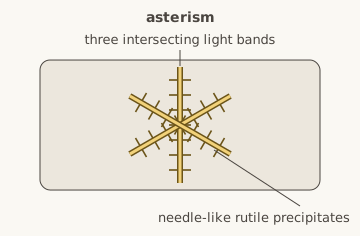
Star sapphire is sapphire—blue corundum—that shows asterism: on a cabochon beneath a point source of light, a star of light bands appears (six rays, rarely twelve) and follows the light as it moves. This star comes not from any separate mineral but from needle-shaped rutile (TiO2) inclusions aligned to particular crystallographic directions within the crystal; these scatter and reflect incoming light and so produce three crossing bands. The body colour of the sapphire is due to the Fe2+–Ti4+ colour centre, which absorbs strongly in the yellow and red, letting blue through. The rutile needles occupy the corundum's basal plane (0001), each set aligned along the a {1120} direction of the second-order hexagonal prism (the three <1010> directions), crossing at roughly 60°. Sapphire is believed to crystallize from highly evolved, alkali-rich, silica-poor magma.
Scope: Applies to explaining the origin of asterism in natural star sapphire (scattering/reflection from oriented needle-like inclusions) and the origin of the blue colour of the host sapphire; does not address synthetic star sapphire (see the synthetic entries).
Sources G&G Fall 2017 · G&G Spring 2020 · G&G Fall 2019
- Synthetic Star Sapphires and Rubies Produced by Wiede’s Carbidwerk, Freyung, Germany (Gems & Gemology, Fall 2017, Vol. 53, No. 3)
- A Quantitative Description of the Causes of Color in Corundum (Gems & Gemology, Spring 2020, Vol. 56, No. 1)
- Mineral Inclusions in Ruby and Sapphire from the Bo Welu Gem Deposit in Chanthaburi, Thailand (Gems & Gemology, Fall 2019, Vol. 55, No. 3)
Where it forms
Highly evolved, alkali-rich, silica-poor magma (syenitic): sapphire is thought to have crystallized from such evolved magma.
Sources G&G Fall 2019
Deep mantle / lower crust: alkaline magmatic systems linked to deep partial-melting sources.
Sources G&G Fall 2019
Basaltic magma and placers: crystals carried rapidly to the surface by basaltic magma and later concentrated in alluvial placers.
Sources G&G Fall 2019
How it forms, step by step
Corundum crystallizes from highly evolved, alkali-rich, silica-poor magma, and color centers such as Fe2+-Ti4+ enter the lattice.
Titanium is hosted as oriented needle-like rutile (TiO2) inclusions in the basal plane (0001) of the corundum.
The needle-shaped inclusions occur as three sets, each aligned along the a {1120} direction of the second-order hexagonal prism, with mutual intersections at roughly 60°.
The crystal is brought to the surface by basaltic magma and fashioned as a cabochon; the oriented needles scatter and reflect light to produce a six-rayed star.
Sources G&G Fall 2017 · G&G Fall 2019
Link to appearance
The blue body color comes from absorption of yellow–red light by the Fe2+-Ti4+ color center; the oriented rutile needles scatter and reflect light to give a six-rayed star that moves with the light source.
Sources G&G Fall 2017 · G&G Spring 2020
Timescale
The available authoritative sources give no growth duration or absolute age for natural star sapphire; they discuss basaltic sapphire forming at depth and rising with magma.
Sources G&G Fall 2019
Supporting findings
In both natural and synthetic corundum, rutile needles occupy the basal plane as three sets, each aligned along the a {1120} direction of the second-order hexagonal prism (the three <1010> directions).
Evidence grade AScope: A crystallographic orientation conclusion for the needles.
The suite of mineral inclusions present in Bo Welu blue sapphire points to growth from a highly evolved, alkali-rich, silica-poor magma of syenitic character.
Evidence grade BScope: Based on the single Bo Welu basaltic deposit in Thailand; not representative of all sapphire localities.
Recorded localities
Authoritative sources list the localities below; the list is not exhaustive.
Asia
- Basalt-related deposits, eastern ThailandBlack star sapphire; other deposits rarely match the Thai stones in size, quality and abundance
Sources Gems & Gemology Summer 2018
- Bang Kha Cha, Chanthaburi Province, ThailandChanthaburi city is a trading hub; the mining locality is Bang Kha Cha
Sources Gems & Gemology Summer 2018
Oceania
- AustraliaBlack star sapphire
Sources Gems & Gemology Summer 2018 · Gems & Gemology Fall 1985
These are localities recorded by authoritative sources, not an origin finding for any individual piece. The CIBJO Gemstone Book (2022, §4.2.3) says a place of origin names where a gem was mined or harvested, is a matter of opinion, does not imply a level of quality, and that cutting, processing or exporting centres must not be used to imply origin. See how far testing can go on this page, the origin determination guide and the overview of recorded localities.
Causes of colour and optical effects
The six-rayed star is formed by needle-like rutile precipitates that scatter and reflect incident light, producing three intersecting light bands.
Evidence grade AScope: The mechanism comes from study of needle-like precipitates in asteriated corundum (common to natural and synthetic).
The blue of sapphire comes from the Fe2+–Ti4+ pair, which takes in light strongly across the yellow and red parts of the spectrum, so that blue is what passes through.
Evidence grade AScope: An authoritative quantitative conclusion on corundum color; applies to Fe-Ti-colored blue sapphire.
How it is identified
A star sapphire's asterism is eye-catching but is not proof of natural origin; natural, synthetic and treated star corundum are told apart by laboratory work. Laboratories combine several lines of evidence: magnification of inclusions and growth features; routine tests such as refractive index, specific gravity and polariscope behaviour; ultraviolet fluorescence; and spectroscopy (for example FTIR, UV-Vis-NIR and Raman). Trace-element chemistry measured by EDXRF or LA-ICP-MS helps separate natural from synthetic corundum and, compared with a reference collection, may point to a geographic origin; glass-filled fractures and coatings are caught by clues such as anomalous luster, gas bubbles, X-ray radiography, and FTIR or EDXRF signatures. Origin calls can remain inconclusive, so the finding should be issued by a qualified gem laboratory.
Evidence grade AScope: Applies where natural, synthetic and treated corundum, and geographic origin, must be assessed; no self-administered criteria are given.
Sources G&G Summer 1998 · G&G Winter 2019 · G&G Fall 2019 +2
- Separating Natural and Synthetic Rubies on the Basis of Trace-Element Chemistry (Gems & Gemology, Summer 1998, Vol. 34, No. 2)
- Geographic Origin Determination of Ruby (Gems & Gemology, Winter 2019, Vol. 55, No. 4)
- Cobalt-Coated Sapphire (Lab Notes, Gems & Gemology, Fall 2019, Vol. 55, No. 3)
- Translucent Ruby Filled with Zinc Glass (Lab Notes, Gems & Gemology, Fall 2023, Vol. 59, No. 3)
- Bismuth Glass-Filled Burmese Star Ruby (Lab Notes, Gems & Gemology, Spring 2020, Vol. 56, No. 1)
Origin labels for star sapphire (Sri Lanka, Myanmar, or China, for instance) are often used to support a premium, yet origin cannot be inferred from appearance or name. Origin determination is a comparison against reference databases of known localities: a laboratory measures trace-element suites by LA-ICP-MS and weighs inclusion features such as rutile silk, clouds, and growth zoning against specimens of documented provenance. The judgement is relative - the characteristic ranges of different localities overlap, deposits with no reference material cannot be assigned, and a single deposit is internally variable; heating and other treatments alter the measurable features, so treatment status must be settled first, and an individual stone may therefore return an "inconclusive" result. An origin call must be issued by an accredited laboratory for a specific specimen, and "consistent with a locality" is not the same as "mined there".
Evidence grade AScope: Origin cannot be inferred from appearance or name; conclusions are probabilistic and must be issued by an accredited laboratory for a specific specimen; no self-test criteria are given here.
Other research findings
Whether natural or synthetic, ruby and sapphire may undergo heat treatment to strengthen asterism, to take away asterism or silk, and to enhance, introduce or reduce colour.
Evidence grade AScope: A general statement on heat-treatment effects by an industry authority; no specific process parameters.
Limits of this research
- Research status: Formation, occurrence or other material-specific findings found in authoritative sources
- The asterism mechanism comes from study of oriented rutile needles common to natural and synthetic material; the cited sources do not distinguish primary versus exsolution origin in natural sapphire.
- The alkali-rich magma crystallization environment comes from a single Thai deposit study and is not representative of all localities.
- No absolute timescale for natural star sapphire is given by the cited sources.
Methodology
- Origin determination and its limits
- Quality grading and value factors
- How gemmology became a technical discipline
Evidence grades
- A
- Standards bodies, government geological surveys, peer-reviewed research and museum records
- B
- Institutional educational material
- C
- Specialist databases or cautious readings
A statement is never graded above its strongest source.
This section is LumaLark's own factual restatement of public authoritative sources, credited item by item; it contains no verbatim excerpts, images or third-party logos.
DecideListing name, disclosure, care and treatments
- Suggested listing name
- Star Sapphire
GB/T 16552—2017 5.3.2 · IMA Mineral List 2026-07 “Corundum”
Construction or treatment status
Natural identity; treatment status unknown
Treatments recorded for this material: Heated / Heat-treated, Dyed, Filled / Fracture-filled, Diffusion-treated, Irradiated (via parent material)
Related:Disclosure and cautions
This page cannot answer
Natural? · Origin · Price
A lab report settles these; this wiki covers naming and disclosure.
Related:What this page can answer
Answer at a glance
Synthetic star material must be named synthetic star sapphire; asterism produced by diffusion is a treatment, not a synthetic, and must be disclosed as such (for example diffusion sapphire, sapphire (diffusion) or sapphire (treated)).
Evidence
- GB/T · 5.3.2
What this means for you
Before buying, check the recommended listing name "Star Sapphire" and any disclosed treatments on this page, and ask the seller for a grading report if in doubt.
Known uncertainty
- Last reviewed
- 2026-09-01
Care and wear
Normal care for every gemstone (CIBJO Gemstone Book §6.1), in brief:
- Handle it gently.
- Store pieces apart when not worn, so they cannot scratch each other.
- Clean with warm soapy water and a soft brush.
- Use ultrasonic cleaners only with caution.
The §6.1 wording and the full list of §6.2 special-care letters cited on this page are on the general gem care page.
The item-by-item care advice that the GIA Care and Cleaning Guide gives for the whole class, and so for Star Sapphire, is set out in full under care on the Sapphire entry.
Care
Star Sapphire — care (cleaning): oiled or dyed stones: avoid solvents.
Gems & Gemology 1987 (Martin)
- Treatment state
- treated
- Only after these treatments
- dyeing, fissure filling with oil
Source & check 2026-09-26
- Source
- Martin, “Gemstone Durability: Design to Display”, Gems & Gemology, Summer 1987: pp.66–67 fold-out chart, Star Ruby & Sapphire row, CLEANING column (locator checked 2026-09-26)
- Fact checked on
- 2026-09-26
Star Sapphire — care (cleaning): ultrasonic and steamer: avoid; note: polishing compound can get into inclusions or fractures that reach the surface.
Gems & Gemology 1987 (Martin)
- Treatment state
- untreated
Source & check 2026-09-26
- Source
- Martin, “Gemstone Durability: Design to Display”, Gems & Gemology, Summer 1987: pp.66–67 fold-out chart, Star Ruby & Sapphire row, CLEANING column (locator checked 2026-09-26)
- Fact checked on
- 2026-09-26
Star Sapphire — care (re-cutting): Stones with superficial colour and surface layers are not suitable for re-cutting or re-polishing.
CIBJO Gemstone Book 2022
CIBJO Gemstone Book §6.2:special-care code m
- Treatment state
- treated
- Colours covered
- star sapphire in colours other than blue
- Only after these treatments
- diffusion treatment
Source & check 2026-09-25
- Source
- Fact checked on
- 2026-09-25
Star Sapphire — care (re-cutting): Stones with superficial colour and surface layers are not suitable for re-cutting or re-polishing.
CIBJO Gemstone Book 2022
CIBJO Gemstone Book §6.2:special-care code m
- Treatment state
- treated
- Colours covered
- blue star sapphire only
- Only after these treatments
- diffusion treatment
Source & check 2026-09-25
- Source
- Fact checked on
- 2026-09-25
Star Sapphire — care (setting): prong, bezel, flush, channel and pavé: relatively safe; note: stones with pronounced twinning, fractures or many inclusions need extra care.
Gems & Gemology 1987 (Martin)
- Treatment state
- untreated
Source & check 2026-09-26
- Source
- Martin, “Gemstone Durability: Design to Display”, Gems & Gemology, Summer 1987: pp.66–67 fold-out chart, Star Ruby & Sapphire row, SETTING column (locator checked 2026-09-26)
- Fact checked on
- 2026-09-26
Star Sapphire — care (repair): oiled or dyed stones: avoid heat and take care in polishing.
Gems & Gemology 1987 (Martin)
- Treatment state
- treated
- Only after these treatments
- dyeing, fissure filling with oil
Source & check 2026-09-26
- Source
- Martin, “Gemstone Durability: Design to Display”, Gems & Gemology, Summer 1987: pp.66–67 fold-out chart, Star Ruby & Sapphire row, REPAIR column (locator checked 2026-09-26)
- Fact checked on
- 2026-09-26
Star Sapphire — care (repair): pickle pot and polishing: relatively safe; thermal shock: use caution; jeweller's torch: avoid; note: avoid extreme heat, which may alter colour; borax-bearing soldering flux or pickle can etch the surface.
Gems & Gemology 1987 (Martin)
- Treatment state
- untreated
Source & check 2026-09-26
- Source
- Martin, “Gemstone Durability: Design to Display”, Gems & Gemology, Summer 1987: pp.66–67 fold-out chart, Star Ruby & Sapphire row, REPAIR column (locator checked 2026-09-26)
- Fact checked on
- 2026-09-26
Star Sapphire — care (display): heat in the display case, sunlight and artificial light: relatively safe.
Gems & Gemology 1987 (Martin)
- Treatment state
- untreated
Source & check 2026-09-26
- Source
- Martin, “Gemstone Durability: Design to Display”, Gems & Gemology, Summer 1987: pp.66–67 fold-out chart, Star Ruby & Sapphire row, DISPLAY column (locator checked 2026-09-26)
- Fact checked on
- 2026-09-26
Each row's “Source & check” expands to the full source; the date beside it is the fact check date.
Common care questions and matching entries
CleaningCleaning Star Sapphire: according to Martin's Gemstone Durability: Design to Display (Gems & Gemology, Summer 1987), stones that are dyed or have oil-filled fractures should be kept away from solvents; for untreated stones, ultrasonic and steam cleaning should be avoided. Heat and repair: the same Martin source also states that dyed stones or stones with oil-filled fractures should be kept away from heat and polished with care; for untreated stones, post-soldering pickling solution and polishing are relatively safe, but thermal shock calls for caution and the jeweller's torch should be avoided; extreme heat should also be avoided, as it may change the colour; borax-containing flux or pickling solution may etch the surface. Light and display: for untreated stones, heat, daylight and artificial light in display cases are relatively safe. Wear and setting: for untreated stones, prong, bezel, tension, channel and pavé settings are relatively safe, though stones with well-developed twinning, fractures or many inclusions need particular care. The CIBJO Blue Book — Official Gemstone Book (Coloured Stone Commission 2022) states that diffusion-treated stones with surface-layer colouring or a surface layer are not suitable for recutting or repolishing, applying separately to blue star sapphire only and to star sapphire of colours other than blue.
This table scrolls sideways on narrow screens.
Care entries by treatment state
The same entries grouped by the treatment state each applies to; each links to its full wording and source. Letters are CIBJO special-care codes, explained on the gemstone care page.
untreated
- ultrasonic and steamer: avoid; note: polishing compound can get into inclusions or fractures that reach the surface
- prong, bezel, flush, channel and pavé: relatively safe; note: stones with pronounced twinning, fractures or many inclusions need extra care
- pickle pot and polishing: relatively safe; thermal shock: use caution; jeweller's torch: avoid; note: avoid extreme heat, which may alter colour; borax-bearing soldering flux or pickle can etch the surface
- heat in the display case, sunlight and artificial light: relatively safe
treated (Only after these treatments: dyeing, fissure filling with oil)
treated (Only after these treatments: diffusion treatment)
- star sapphire in colours other than blue: care (re-cutting) §6.2 m
- blue star sapphire only: care (re-cutting) §6.2 m
Durability and wearing
Toughness
Excellent
Sources GIA Gem Encyclopedia (care guide)
Treatments and identification leads
Registered treatmentsThe treatments registered for Star Sapphire are heating and diffusion. Stability and frequencyHeating has the status treated, a stable effect and occasional market prevalence; diffusion has the status treated, with identification leads and a source given. Identification cluesThe identification lead for diffusion is that in diffusion-treated Star Sapphire the star rays are thin and straight, and cloud-like clusters of white dots can be seen in the surface layer. Values not givenThe identification leads and source for heating, and the stability and prevalence of diffusion, are entered as “—” in the register, meaning the cited source gives no value, not “none”.
This table scrolls sideways on narrow screens.
| Treatment | Market frequency (CIBJO) | Stability (CIBJO) | GB/T 16552 category | JJA/AGL listing | Identification leads |
|---|---|---|---|---|---|
| heatingColours covered: star sapphire in colours other than blueStatus: treated | occasionally | stable | — | — | — |
| diffusion treatmentStatus: treated | — | — | Treatment | diffusion heat treatment (any colour) | See identification leads |
| Heating | — | — | Optimization | — | — |
| Dyeing | — | — | Treatment | — | — |
| Filling | — | — | Graded — see §5.4.1, Table 1 | — | — |
| Irradiation | — | — | Treatment | — | — |
| heating | — | — | — | heating (any colour) | — |
| impregnation with a colourless agent (oil or resin) | — | — | — | impregnation with a colourless agent (oil or resin) (any colour) | — |
| colouring (JJA category 7, includes dyeing) | — | — | — | colouring (JJA category 7, includes dyeing) (any colour) | — |
| lead-glass impregnation | — | — | — | lead-glass impregnation (asterism + lead glass (as written in the colour column)) | — |
Where each treatment acts (schematics): Heated / Heat-treated · Diffusion-treated
“—” means the cited source gives no value for that item, not “none”. Source: CIBJO Gemstone Book 2022 · GB/T 16553—2017; GB/T 16552—2017 Table B.1 (row for Sapphire); JJA/AGL 2025
Whether a treatment has to show in the name differs between the two rule sets (this site’s paraphrase):
- GB/T 16552—2017: a method classed as treatment has to be stated in the name itself — the method put before the name, or added in brackets after it; a method classed as optimization does not need to appear in the name, though one marked “Optimization (annotation required)” still has to be noted in the quality documents. Source: §5.4.2.1 a), b); §5.4.2.2 a)
- CIBJO Gemstone Book 2022: no longer splits treatments into ones that need specific disclosure and ones that need only general disclosure: every treatment is to be disclosed, and the seller tells the buyer which treatment was used and what special care it calls for. Source: §4.2.5 Note 2, §4.2.5.1, pp.14–15
What this table covers
What this page can give
- Registered treatments, their stability and how often they occur (see the table above)
- Identification leads for each treatment, for use when sending a stone for testing
How lab reports word it
Report wording for Star Sapphire is set out under report wording on the Corundum entry.
VerifyNames, standards, technical facts, clauses and sources
Names
Standard and listing namesStar Sapphire is formed under the naming rules of GB/T 16552—2017 with the basic name sapphire, and Star Sapphire is not listed separately in the standard; the suggested listing name is Star Sapphire. Names in four languagesNames are registered in four languages: Simplified Chinese, Traditional Chinese, English (Star Sapphire) and Japanese. Trade and mineralogical namesThe mineralogical name describes Star Sapphire as corundum showing asterism, usually as six-rayed stars. Institution usageOn authority wording, CIBJO records Star Sapphire (CIBJO Gemmological Laboratories Book 2024); the FTC text on file has no wording for this name (checked); GIA and Gem-A are unchecked. Bodies without a recorded wording show the entry's own English name, which does not represent their position. Japanese namesA Japanese name is shown as the GSJ (Japan) formal name, but the wording used by the GSJ for it is not yet verified by this site, and what is shown is the entry's own Japanese name.
- GSJ (Japan) formal name
- スター・サファイア (not yet checked for this body — the entry's own Japanese name is shown)
- Name built by the GB/T naming rules (not listed as such)
- 星光蓝宝石 (GB/T 16552—2017 §5.3.2; basic name 蓝宝石)
- Mineralogical name
- Sapphire (corundum) displaying asterism (usually 6-rayed)
Four-language names
- 简体中文
- 星光蓝宝石
- 繁體中文
- 星光藍寶石
- English
- Star Sapphire
- 日本語
- スター・サファイア
See also: Misleading and prohibited trade names · Supplementary name index
Classification
- Origin
- Natural materials
- Material domain
- Natural inorganic gem materials
- Browsing family
- Oxide minerals
- Identity tier
- Mineral / gemstone variety
- Mineral chemical class
- Oxides / hydroxides
- Construction or treatment status
- Natural identity; treatment status unknown
Treatments listed by standards
GB/T Table B.1Star Sapphire is registered by this site applying the “Sapphire” row of GB/T 16552—2017, Annex B, Table B.1: heating is listed as an optimization; dyeing as a treatment; filling as graded, with the grades defined on the Gem treatments page; diffusion as a treatment; irradiation as a treatment. What Table B.1 is is explained on the Gem treatments page, and the full row, with the effect column, is on the Sapphire page. JJA/AGL designationsThe table of principal gem names in the JJA/AGL (Japan) definitions and nomenclature of gemstones and ornamental materials, November 2025 revision, lists the relevant entry under “Star Ruby / [colour] Star Sapphire”: species corundum, colour any, with heating (heat treatment), diffusion heating (diffusion treatment), impregnation with a colourless agent (oil or resin) (filling) and colouring (including dyeing) (dyeing) recorded; it also lists “Star Ruby/Star Sapphire + Lead Glass” under the species Corundum+lead glass, with the colour given as star plus lead glass (so written in the original), lead-glass impregnation classed as filling, and the name written as “Star Ruby / Star Sapphire + lead glass”. The original does not name Star Sapphire itself; how to read the JJA/AGL table is explained on the Gem treatments page.
GB/T 16552-2017, Annex B, Table B.1
Under the “Sapphire” row of Table B.1: Heating Optimization; Dyeing Treatment; Filling Graded — see §5.4.1, Table 1; Diffusion Treatment; Irradiation Treatment. The full row, with the effect column, is on the Sapphire page.
What Table B.1 is, and how the “see 5.4.1” grades are defined: see the GB/T 16552: optimization vs treatment page.
JJA/AGL (Japan) table of principal gem names, 2025
This table scrolls sideways on narrow screens.
| Gem name | Species | Colour | Listed in the table | Notes |
|---|---|---|---|---|
| Star Ruby / [colour] Star Sapphire | Corundum | any colour | heating (Heated / Heat-treated); diffusion heat treatment (Diffusion-treated); impregnation with a colourless agent (oil or resin) (Filled / Fracture-filled); colouring (JJA category 7, includes dyeing) (Dyed) | listed under “Star Ruby / [colour] Star Sapphire” in the table; this page is related (the source does not name it); asterism; adding the colour variety is optional |
| Star Ruby/Star Sapphire + Lead Glass | Corundum+lead glass | asterism + lead glass (as written in the colour column) | lead-glass impregnation (Filled / Fracture-filled) | listed under “Star Ruby/Star Sapphire + Lead Glass” in the table; this page is related (the source does not name it); asterism; named “star ruby / star sapphire + lead glass” |
JJA/AGL definitions and nomenclature (2025 revision), table of principal gem names, p.12, 13
How to read the JJA/AGL table: see the Gem treatments page.
What it is and how it's identified
The phase of Star Sapphire is corundum, and the CIBJO Gemmological Laboratories Book records the asterism and colour-change effect of Star Sapphire directly. The data GB/T 16553—2017 gives for sapphire as a whole (all colours and origins) include: crystalline structure, trigonal system; Mohs hardness 9; no cleavage, though stones with well-developed twinning may show three directions of parting; density 3.95–4.1 g/cm³ (clause value 4.00 with a tolerance of +0.10, −0.05, from which the limits are derived); optic character anisotropic, uniaxial, negative; refractive index 1.757–1.779 (clause value 1.762–1.770 with a tolerance of +0.009, −0.005, from which the limits are derived); birefringence 0.008–0.01; asterism visible, commonly a six-rayed star; and, when untreated, vitreous to subadamantine lustre. Where Star Sapphire has been heat treated and is a colour other than blue, the stability of heat treatment is stable; this qualification concerns whether the effect of the treatment is stable, not whether Star Sapphire itself is durable, and no complete conclusion on durability has been reached.
Registered material facts
Each row carries its own source and check date and can be cited on its own; “—” means the cited source gives no value, not “none”.
Chemical composition, luminescence, UV-visible spectrum, infrared spectrum, magnification: these whole-class features are given in the cited clause for sapphire as a whole (all colours and origins), so they are not repeated on the Star Sapphire page; see the material facts on the Sapphire entry.
Items below that name the class they cover give the cited clause’s value for that whole class, not a measurement of Star Sapphire (how to read class-level values).
Definition
Star Sapphire — composition (phase): corundum
CIBJO Gemmological Laboratories Book 2024
Source & check 2026-09-22
- Source
- Fact checked on
- 2026-09-22
Structure
Star Sapphire — structure (overall): crystalline
GB/T 16553—2017
- Does this standard apply
- applies to this entry
- What this covers
- sapphire as a whole (all colours and origins)
Source & check 2026-09-26
- Source
- GB/T 16553—2017 Gems — Testing (GB/T): §5.1.3 (locator checked 2026-09-26)
- Fact checked on
- 2026-09-26
Star Sapphire — structure (crystal system): trigonal
GB/T 16553—2017
- Does this standard apply
- applies to this entry
- What this covers
- sapphire as a whole (all colours and origins)
Source & check 2026-09-26
- Source
- GB/T 16553—2017 Gems — Testing (GB/T): §5.1.3 (locator checked 2026-09-26)
- Fact checked on
- 2026-09-26
Star Sapphire — structure (crystal habit): hexagonal prisms or barrel shapes, occasionally tabular or bladed.
GB/T 16553—2017
- Does this standard apply
- applies to this entry
- What this covers
- sapphire as a whole (all colours and origins)
Source & check 2026-09-26
- Source
- GB/T 16553—2017 Gems — Testing (GB/T): §5.1.3 (locator checked 2026-09-26)
- Fact checked on
- 2026-09-26
Durability
Star Sapphire — Mohs hardness: 9
GB/T 16553—2017
Reference points on this site: Talc 1–3, Fluorite 4, Apatite 5–5.5, Orthoclase 6–6.5, Topaz 8, Diamond 10 (Source: GB/T 16553—2017); Gypsum 1.5–2, Calcite 3, Quartz 7 (Source: Handbook of Mineralogy); Corundum 9 (Source: GIA Gem Encyclopedia (care guide))
- Does this standard apply
- applies to this entry
- What this covers
- sapphire as a whole (all colours and origins)
Source & check 2026-09-26
- Source
- GB/T 16553—2017 Gems — Testing (GB/T): §5.1.3 (locator checked 2026-09-26)
- Fact checked on
- 2026-09-26
Star Sapphire — cleavage: no cleavage; stones with well-developed twinning may show parting in three directions.
GB/T 16553—2017
- Does this standard apply
- applies to this entry
- What this covers
- sapphire as a whole (all colours and origins)
Source & check 2026-09-26
- Source
- GB/T 16553—2017 Gems — Testing (GB/T): §5.1.3 (locator checked 2026-09-26)
- Fact checked on
- 2026-09-26
For Star Sapphire, the stability of heating is “stable”.
CIBJO Gemstone Book 2022
- Treatment state
- treated
- Treatment
- heating
- Colours covered
- star sapphire in colours other than blue
- Qualification
This says how well the treatment holds up, not how durable Star Sapphire itself is.
- General note
- no durability verdict here
Source & check 2026-09-25
- Source
- Fact checked on
- 2026-09-25
Physical properties
Star Sapphire — density: 3.95–4.1 g/cm³
GB/T 16553—2017
- Does this standard apply
- applies to this entry
- What this covers
- sapphire as a whole (all colours and origins)
- Qualification
The clause we cite gives 4.00, with a stated tolerance of +0.10 / -0.05. The range shown here is worked out from that.
Source & check 2026-09-26
- Source
- GB/T 16553—2017 Gems — Testing (GB/T): §5.1.3 (locator checked 2026-09-26)
- Fact checked on
- 2026-09-26
Optical
Star Sapphire — optic character: uniaxial, optically negative (anisotropic)
GB/T 16553—2017
- Does this standard apply
- applies to this entry
- What this covers
- sapphire as a whole (all colours and origins)
Source & check 2026-09-26
- Source
- GB/T 16553—2017 Gems — Testing (GB/T): §5.1.3 (locator checked 2026-09-26)
- Fact checked on
- 2026-09-26
Star Sapphire — refractive index: 1.757–1.779
GB/T 16553—2017
- Does this standard apply
- applies to this entry
- What this covers
- sapphire as a whole (all colours and origins)
- Qualification
The clause we cite gives 1.762–1.770, with a stated tolerance of +0.009 / -0.005. The range shown here is worked out from that.
Source & check 2026-09-26
- Source
- GB/T 16553—2017 Gems — Testing (GB/T): §5.1.3 (locator checked 2026-09-26)
- Fact checked on
- 2026-09-26
Star Sapphire — birefringence: 0.008–0.01
GB/T 16553—2017
- Does this standard apply
- applies to this entry
- What this covers
- sapphire as a whole (all colours and origins)
Source & check 2026-09-26
- Source
- GB/T 16553—2017 Gems — Testing (GB/T): §5.1.3 (locator checked 2026-09-26)
- Fact checked on
- 2026-09-26
Star Sapphire — pleochroism: strong, and varying with color: blue shows blue and green-blue; green shows green and yellow-green; yellow shows yellow and orange-yellow; orange shows orange and orange-red; pink shows pink and pink-red; purple shows purple and purple-red.
GB/T 16553—2017
- Treatment state
- untreated
- Does this standard apply
- applies to this entry
- What this covers
- sapphire as a whole (all colours and origins)
Source & check 2026-09-26
- Source
- GB/T 16553—2017 Gems — Testing (GB/T): §5.1.3 (locator checked 2026-09-26)
- Fact checked on
- 2026-09-26
optical effect (asterism)2 sources compared
Star Sapphire — optical effect (asterism): seen; commonly a six-rayed star
GB/T 16553—2017
- Does this standard apply
- applies to this entry
- What this covers
- sapphire as a whole (all colours and origins)
Source & check 2026-09-26
- Source
- GB/T 16553—2017 Gems — Testing (GB/T): §5.1.3 (locator checked 2026-09-26)
- Fact checked on
- 2026-09-26
Star Sapphire — optical effect (asterism): asterism.
CIBJO Gemmological Laboratories Book 2024
Source & check 2026-09-22
- Source
- Fact checked on
- 2026-09-22
Star Sapphire — optical effect (colour change): seen
GB/T 16553—2017
- Does this standard apply
- applies to this entry
- What this covers
- sapphire as a whole (all colours and origins)
Source & check 2026-09-26
- Source
- GB/T 16553—2017 Gems — Testing (GB/T): §5.1.3 (locator checked 2026-09-26)
- Fact checked on
- 2026-09-26
Star Sapphire — body colour: blue when the name sapphire is used alone; other colours usually take a colour prefix.
CIBJO Gemmological Laboratories Book 2024
- Treatment state
- untreated
- Qualification
In chapter 7 of the CIBJO Gemmological Laboratories Book, the colour descriptions of Haüyne, Lazurite, Maxixe Beryl and other entries also name blue or a bluish colour.
- General note
- colour alone is not identity
Source & check 2026-09-26
- Source
- Fact checked on
- 2026-09-26
The six-rayed star is formed by needle-like rutile precipitates that scatter and reflect incident light, producing three intersecting light bands.
- CIBJO definitions
- asterism, colour change
Quality factors
Star Sapphire — quality factor (lustre): vitreous to subadamantine
GB/T 16553—2017
- Treatment state
- untreated
- Does this standard apply
- applies to this entry
- What this covers
- sapphire as a whole (all colours and origins)
Source & check 2026-09-26
- Source
- GB/T 16553—2017 Gems — Testing (GB/T): §5.1.3 (locator checked 2026-09-26)
- Fact checked on
- 2026-09-26
Each row's “Source & check” expands to the full source; the date beside it is the fact check date.
This material (RI / SG midpoints): 1.768 / 4.03; Closest values: 1Rhodolite 1.755 / 3.9, 2Almandine 1.79 / 3.9, 3Grossular 1.745 / 3.9, 4Tsavorite 1.74 / 3.9, 5Spessartine 1.802 / 3.9
Show the full chart (330 registered materials)
Outside the full chart's range, drawn as triangles at the edge (RI / SG midpoints): Hematite 3.045/5.12, Synthetic Rutile 2.76/4.26, Rutile 2.753/4.23, Synthetic Moissanite 2.67/3.22
Testing and market
Diffusion-treated Star Sapphire can be recognised by star rays that are thin and straight and by flocculent clouds of white dots visible in the surface layer; GB/T 16553—2017 gives this identification lead for diffusion, while serving only as a reference for the Star Sapphire entry and not governing it directly. The CIBJO laboratory protocol places Star Sapphire under the sapphire entry; identification methods and the list of required methods are respectively in the identification part of the Sapphire entry and on the laboratory testing page. On the market, synthetic blue Star Sapphire is common, and synthetics of non-blue Star Sapphire are also on the market; among non-blue Star Sapphire, heating occurs occasionally.
The CIBJO laboratory protocol covers Star Sapphire under “Sapphire” (§6.1.69): see identification on the Sapphire entry; the required tests are listed on the CIBJO laboratory protocol table for Sapphire.
How far testing can go
Star Sapphire that has undergone diffusion treatment can be identified by the following features: In diffusion-treated star sapphire the star lines are fine and straight, and a flocculent layer of white dots can be seen in the surface layer.
GB/T 16553—2017
- Treatment state
- treated
- Does this standard apply
- can be followed as a reference only
- Treatment
- diffusion treatment
Source & check 2026-09-26
- Source
- GB/T 16553—2017 Gems — Testing (GB/T): §5.1.3 (diffusion) (locator checked 2026-09-26)
- Fact checked on
- 2026-09-26
Star Sapphire — synthetic counterpart on the market: Synthetic counterparts of this material are common in the trade
CIBJO Gemstone Book 2022
- Treatment state
- any treatment state
- Colours covered
- blue star sapphire only
Source & check 2026-09-25
- Source
- Fact checked on
- 2026-09-25
Star Sapphire — synthetic counterpart on the market: A synthetic counterpart of this material is commercially available
CIBJO Gemstone Book 2022
- Treatment state
- any treatment state
- Colours covered
- star sapphire in colours other than blue
Source & check 2026-09-25
- Source
- Fact checked on
- 2026-09-25
For Star Sapphire in trade, the reported frequency of heating is “occasionally”.
CIBJO Gemstone Book 2022
- Treatment state
- treated
- Treatment
- heating
- Colours covered
- star sapphire in colours other than blue
Source & check 2026-09-25
- Source
- Fact checked on
- 2026-09-25
Each row's “Source & check” expands to the full source; the date beside it is the fact check date.
Clause-level definitions
Star Sapphire is defined directly in the CIBJO Gemmological Laboratories Book 2024 under the term Star sapphire. The record gives the mineral species as corundum and the mineral/gem variety as Star sapphire, with the CIBJO wording quoted in full under Clause-level definitions on this page. The cross-check result is defined directly by CIBJO, with no English term of the same name found directly in the GB/T annex of this edition.
This table scrolls sideways on narrow screens.
| Term | Clause | Definition | Cross-check |
|---|---|---|---|
| Star sapphire | 7.2.1.230 | Sapphire showing asterism (usually a six-ray star, sometimes a twelve-ray star) The term ‘sapphire’ alone refers to blue. All other colours typically have a colour prefix | Defined directly by CIBJO; no identically named English entry was found in this edition of the GB/T annex. |
Evidence and sources
Authority basis and clause sources
Sources
- CIBJO – The World Jewellery Confederation. Gemmological Laboratories Book (Blue Book), Gemmological Commission 2024-1.
- CIBJO – The World Jewellery Confederation. The Gemstone Book (Blue Book), 2022.
- SAMR / SAC (China). GB/T 16552—2017 Gems — Nomenclature.
- RRUFF Project, in partnership with the IMA – International Mineralogical Association. IMA Mineral List.
- Geological Survey of Japan, AIST (Japan). Museum mineral specimens, browse by classification.
Further reading
Related entries and topic cluster
Parent entry and related pages on this site. Rows marked “Planned” are suggested new content and have no link yet.
Related-entry tree for Corundum on this site: 18 entries listed by this site's parent-entry links; synthetic, treated and similar entries carry their recorded state after the name; this page (Star Sapphire) is marked.
- Corundum
Sub-entries (13)
- Colour-change Sapphire
- Green Sapphire
- Orange Sapphire
- Padparadscha Sapphire
- Pink Sapphire
- Purple Sapphire
- Ruby
Sub-entries (2)
- Lead-Glass-Filled Ruby
- Synthetic Ruby (Synthetic product)
- Sapphire
Sub-entries (2)
- Beryllium-Diffused Sapphire
- Synthetic Sapphire (Synthetic product)
- Star Ruby
- Star Sapphire
- Synthetic Corundum (Synthetic product)
- White Sapphire
- Yellow Sapphire
This table scrolls sideways on narrow screens.
| Page | Content | Status |
|---|---|---|
| Browsing family | Oxide minerals | Live |
| Treatments recorded for this material | Heated / Heat-treated, Dyed, Filled / Fracture-filled, Diffusion-treated, Irradiated (via parent material) | Live |
| Related articles | To be added (placeholder) | Planned |
Who maintains this page
The material facts in the Star Sapphire entry are maintained by the LumaLark wiki and matched one by one to the standard clauses or institutional sources they cite: every fact carries its source (with a clause or page locator) and a check date, so it can be traced back to the original; clause-level definitions also carry a cross-check result. The entry exists so that buyers and sellers can check naming, disclosure and material facts item by item.