On this page
UnderstandWhat it is, what people ask, how far this page goes
Natural inorganic gem materials · Natural amorphous gem material / mineraloid · Natural identity; treatment status unknown
Opal
Also known asOolitic opal
A hydrous amorphous silica gem material whose basic name in GB/T 16552-2017 Table A.2 is "Opal". Natural, synthetic, assembled and imitation opal must be distinguished. This page compares how the major standards and institutions name it, what must be disclosed when selling it, whether it can be worn every day, how it is treated and identified, and which source each conclusion comes from.
Price, rarity and origin are outside the scope of this wiki.
Questions people ask about Opal
Every sentence below is followed by the registered fact it rests on; answers add no new facts and promise no outcome.
Q1How is natural opal told apart from synthetic or imitation opal?
Not by eye: natural, synthetic and imitation opal can look very much alike, and the unaided eye cannot reliably separate them.G&G Fall 1987A laboratory has to test composition and internal structure, such as whether water is present and what structural features occur, using microscopy and instruments.G&G Fall 1987Synthetic opal is commercially available.CIBJO Gemstone Book 2022Assembled opals also exist: opal too thin to be sturdy is backed with black onyx, plastic or natural matrix as a doublet, and triplets add a clear cap of rock crystal, plastic, glass or synthetic corundum.GIA Introduction to Imitation GemsWhether one particular bead is natural, treated or synthetic — only a laboratory report can settle that.What this page can answer
Q2What causes the flashes of colour in opal?
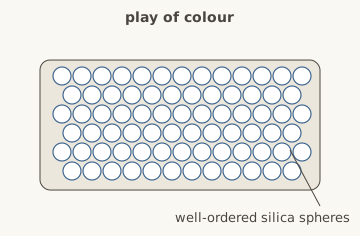
Diffraction: play-of-colour in precious opal comes from visible light diffracting off silica spheres of one size arranged in an orderly way.G&G Fall 2013The colour seen depends on the sphere size: roughly 0.1 micron gives violet and about 0.2 microns gives red.G&G Fall 2013Play-of-colour opal with a white body colour may be called white opal, one with a dark body colour black opal, and orange to red opal fire opal.GB/T 16553—2017
Q3Can opal get wet, and how should you clean it?
Warm soapy water is the only safe way to clean opal.GIA Gem Encyclopedia (care guide)It is porous, so it should be kept away from coloured liquids, and it must not be cleaned ultrasonically.CIBJO Gemstone Book 2022Steam cleaning should be avoided as well.Gems & Gemology 1987 (Martin)Hydrofluoric acid and caustic alkaline solutions attack it.GIA Gem Encyclopedia (care guide)Some opal, called hydrophane, is porous enough to absorb liquids so that its look and even its weight change; it can come from any locality, but Ethiopian deposits yield an unusually high proportion, and in one laboratory test immersed slices gained weight and became more transparent.LMHC Information Sheet #13 · G&G Spring 2016
Q4Is opal durable enough for an everyday ring?
Only with care: opal's hardness varies from Mohs 5 to 6.5 and its toughness from very poor to fair, so it is fine for jewellery but should be worn carefully to avoid scratches and breaks.GIA Gem Encyclopedia (care guide)It chips and cracks easily.CIBJO Gemstone Book 2022Prong and bezel settings call for caution, and flush, channel and pavé are best avoided.Gems & Gemology 1987 (Martin)
Q5Why can opal crack, cloud or lose its colour?
Opal will craze if it loses water, so it should be kept away from heat and dry air and from sudden temperature changes.CIBJO Gemstone Book 2022Heat from intense light can cause a network of fine cracks called crazing.GIA Gem Encyclopedia (care guide)For display, case heat and sunlight are best avoided and artificial light calls for caution, because heat and strong light speed up dehydration.Gems & Gemology 1987 (Martin)Heat can turn opal white or brown and destroy its play-of-colour.Gems & Gemology 1987 (Martin)
Q6How does opal form?
Opal is hydrated silica that is amorphous or only poorly crystallized, produced when a silica gel solidifies.G&G Fall 2013In places such as Australia's outback, seasonal rain seeps into underground rock and carries dissolved silica downward.GIA Opal DescriptionDuring dry periods much of the water evaporates, leaving solid silica in cracks and between layers of sedimentary rock, forming opal.GIA Opal DescriptionIn Ethiopia, opal forms in cavities of weathered volcanic ignimbrite, where silica gel partly fills the cavity.G&G Fall 2013The sources give no numeric age or absolute timescale for opal formation.GIA Opal Description · G&G Fall 2013
Q7Is opal treated, filled or dyed?
Yes: some opal is filled with injected colourless plastic, which gives a low density and shows in infrared spectra.GB/T 16553—2017In dyed opal, magnification shows the colour unevenly distributed, mostly as fine particles in fissures, between grains or in surface hollows.GB/T 16553—2017For dyed, filled or impregnated opal, CIBJO notes that such treatments are not permanent and that the stone should be kept away from all solvents, including dish-washing liquids, as well as chemicals and heat.CIBJO Gemstone Book 2022Whether one particular bead is natural, treated or synthetic — only a laboratory report can settle that.What this page can answer
Q8What makes a good-quality opal?
According to GIA, opal quality has three main aspects: colour (background colour and play-of-colour), pattern (the arrangement of the play-of-colour) and clarity (transparency and inclusions).GIA Gem EncyclopediaWhatever its colours, play-of-colour must be vivid to rate highly.GIA Gem EncyclopediaTraditionally red is considered the best prominent play-of-colour, orange the next, followed by green; for pattern, connoisseurs prefer large, closely arranged patches of colour to tiny, scattered dots.GIA Gem Encyclopedia
Q9What does opal symbolize, and does it have healing powers?
There is no scientific evidence that opal has healing powers: the UK advertising regulators ASA and CAP state that they have not seen evidence that crystal therapy can treat medical conditions.ASA/CAP guidance (UK)Its recorded cultural role is as the October birthstone: Jewelers of America and Japan's JJA list it for October, and the U.K. National Association of Jewellers lists it as traditional for October.Cultural records
Sources cited in these answers ASA/CAP guidance (UK)
What this page can answer
This page covers
- How Opal forms and what gives its colourFormation setting, process and timescale; where its colour and optical effects come from, each finding graded and sourced
- How to identify OpalIdentification points from the research literature; how far lab testing can go and whether a synthetic exists
- Treatments and enhancements of Opal4 registered treatments: status, stability, how common they are and identification leads
- Caring for and wearing OpalCleaning, heat, chemicals and light, as the cited sources give them; durability indicators and wearing advice
- Hardness, density and refractive index of OpalEach value with its source and check date
- Opal in English, Chinese and Japanese; national standard namesNames in four languages, the GB/T standard name and the suggested listing name, names in national standards; and: Which of GIA, FTC, CIBJO and Gem-A have a name for it on record, and do those agree?
- Listing and disclosing OpalThe listing name to use; what must be disclosed before sale
- Standard clauses that define OpalWhich clause defines it, each cross-checked
What we cannot conclude
- Whether one particular bead is natural, treated or synthetic — only a laboratory report can settle that.
- Geographic origin, unless an origin report accompanies the item.
- Price, rarity or investment value: this wiki covers naming and disclosure only.
Material research: formation, causes and history
What authoritative sources say about how this material forms, what causes its colour and optical effects, where its name comes from and how people have used it. Each statement carries an evidence grade and its sources; it describes the material in general, not any specific piece.
How it forms
Opal is hydrated silica that is amorphous or only poorly crystallized, produced when a silica gel solidifies. In areas such as Australia's outback, rain that falls seasonally penetrates underground rock, transporting dissolved silica downward; when dry spells arrive much of that water evaporates, and solid silica remains in cracks and between the layers of sedimentary rock underground. Sub-microscopic silica spheres arranged on a regular grid constitute precious opal, and their arrangement yields play-of-color. Certain Ethiopian opals, through deposition, polygonization, remobilization and interstitial filling, also develop vertical columnar 'digit' structures.
Scope: Applies to the formation of natural opal in sedimentary and volcaniclastic host-rock environments; the specific observational data for the columnar (digit) structure model come mainly from Ethiopian opal and should not be applied directly to other localities.
Sources GIA Opal Description · G&G Fall 2013
Where it forms
Australia's semi-desert outback: seasonal rains and ancient underground sedimentary rock, with silica precipitating in cracks and between layers.
Sources GIA Opal Description
Cavities in weathered ignimbritic volcanic host rock in Ethiopia, where silica gel partially fills the cavity and develops vertical columnar structures.
Sources G&G Fall 2013
How it forms, step by step
Rain falls seasonally and seeps into underground rock; the dissolved silica it carries—silicon and oxygen combined—moves downward.
Sources GIA Opal Description
During dry periods much of the water evaporates, leaving solid silica deposits in cracks and between layers of sedimentary rock, forming opal.
Sources GIA Opal Description
The silica gel solidifies through dehydration and cementation into amorphous hydrated silica, i.e. solid opal.
Sources G&G Fall 2013
In some Ethiopian opals, silica spheres sediment into vertical columnar structures that later polygonize into juxtaposed sub-grains.
Sources G&G Fall 2013
A later silica-poor fluid remobilizes the columns by erosion along grain boundaries, rounding them, after which new silica deposits between them and solidifies.
Sources G&G Fall 2013
Link to appearance
In precious opal, play-of-color results from visible light diffracting off monosized, well-ordered silica spheres; the hue observed depends on sphere size—roughly 0.1 micron gives violet, while about 0.2 microns gives red.
Sources G&G Fall 2013
Timescale
The cited sources describe opal formation through alternating seasonal rains and dry periods and precipitation between sedimentary layers, but give no numeric age or absolute timescale for opal formation.
Sources GIA Opal Description · G&G Fall 2013
Related base materials
- Silica-bearing fluid (silica gel): Opal forms by the consolidation of hydrous silica gel; silica gel is its direct precursor material
Supporting findings
Opal forms when silica dissolved by seasonal rains precipitates in cracks and between layers of underground sedimentary rock.
Evidence grade AScope: Describes opal formation in the Australian sedimentary setting; other genetic types are not covered by this source.
Sources GIA Opal Description
In Ethiopian opals, digit structures develop in partially filled cavities, the columns being vertical with rounded ends pointing upward.
Evidence grade AScope: The observations are mainly for Ethiopian opal; the source notes such structures are rare in other deposits.
Sources G&G Fall 2013
Digit structures form in sequence through sphere deposition into columns, polygonization, remobilization and rounding, interstitial filling, and dehydration solidification.
Evidence grade AScope: This stepwise model addresses digits in play-of-color opal; the source notes some samples preserve only part of the sequence.
Sources G&G Fall 2013
Recorded localities
Authoritative sources list the localities below; the list is not exhaustive.
Africa
- Wegel Tena, Wollo, EthiopiaG&G: Ethiopia a major producer since the 2008 discovery
Sources GIA Gem Encyclopedia · G&G Fall 2013
- Shewa, Ethiopia
Sources GIA Gem Encyclopedia · G&G Fall 2013
- Madagascar
Sources GIA Gem Encyclopedia
Asia
- Indonesia
Sources GIA Gem Encyclopedia
- Türkiye
Sources GIA Gem Encyclopedia
Europe
- Červenica-Dubník, SlovakiaG&G: once active then vacated, now being revived; formerly called Hungarian opal
Sources G&G Winter 2023
North America
- Querétaro, Mexicoknown for fire opal (GIA spells it Querétero)
Sources GIA Gem Encyclopedia
- Mexico
Sources GIA Gem Encyclopedia
- Honduras
Sources GIA Gem Encyclopedia
- United States
Sources GIA Gem Encyclopedia
South America
- Brazil
Sources GIA Gem Encyclopedia
- Peru
Sources GIA Gem Encyclopedia
Oceania
- AustraliaGIA calls Australia's fields the most productive in the world
Sources GIA Gem Encyclopedia
- Lightning Ridge, New South Wales, Australia
Sources GIA Opal Description · GIA Gem Encyclopedia
- Coober Pedy, South Australia, Australia
Sources GIA Opal Description
- Mintabie, South Australia, Australia
Sources GIA Opal Description
- Andamooka, South Australia, Australia
Sources GIA Gem Encyclopedia
- White Cliffs, New South Wales, Australia
Sources GIA Gem Encyclopedia
- Queensland, AustraliaGIA states boulder opal comes only from Queensland
Sources GIA Gem Encyclopedia
These are localities recorded by authoritative sources, not an origin finding for any individual piece. The CIBJO Gemstone Book (2022, §4.2.3) says a place of origin names where a gem was mined or harvested, is a matter of opinion, does not imply a level of quality, and that cutting, processing or exporting centres must not be used to imply origin. See how far testing can go on this page, the origin determination guide and the overview of recorded localities.
Causes of colour and optical effects
Diffraction of visible light by monosized, well-ordered silica spheres is what generates play-of-color in precious opal.
Evidence grade AScope: Applies to regularly packed silica spheres; common opal with irregular packing shows no play-of-color.
Sources G&G Fall 2013
How it is identified
Natural, synthetic and imitation opal can look very much alike, and the unaided eye cannot reliably separate them. A laboratory must test composition and internal structure—for example whether water is present and what structural features occur—using microscopy and instrumental analysis; the finding must come from an accredited body.
Evidence grade AScope: Separating natural, synthetic and imitation opal is done in a laboratory and decided by an accredited body.
Opal doublets and triplets are assembled stones. Natural opal sometimes occurs in layers too thin to be sturdy enough for jewellery, so it is reinforced: black onyx, plastic or natural matrix have served as the bottom layer of opal doublet or triplet cabochons, and opal triplets are capped with a transparent dome of rock crystal, plastic, glass or synthetic corundum.
Evidence grade AScope: Describes identification features reported by a laboratory or educational source; it is not a test that a reader can rely on, and any single piece can only be identified by a gemmological laboratory.
Sources GIA Introduction to Imitation Gems
Other research findings
Opal is hydrated silica that is amorphous or only poorly crystallized, produced when a silica gel solidifies.
Evidence grade AScope: This compositional definition rests on a review statement about opal genesis within a peer-reviewed article.
Sources G&G Fall 2013
Opal quality has three main aspects: colour (background colour and play-of-colour), pattern (the arrangement of the play-of-colour) and clarity (transparency and inclusions). Whatever its colours, play-of-colour must be vivid to rate highly.
Evidence grade BScope: Quality factors as described by one educational source; not a grading standard and not a statement about the value of any piece.
Sources GIA Gem Encyclopedia
Traditionally red is considered the best prominent play-of-colour, orange the next, followed by green; for pattern, connoisseurs prefer large, closely arranged patches of colour to tiny, scattered dots.
Evidence grade BScope: Quality factors as described by one educational source; not a grading standard and not a statement about the value of any piece.
Sources GIA Gem Encyclopedia
Hydrophane opal is opal porous enough to absorb liquids to the point that its appearance, and potentially its weight, changes. Such opal can come from any locality, but deposits in Ethiopia yield an unusually high proportion of it. In a laboratory test on hydrophane opal slices, immersion in water caused obvious weight gain and made the slices more transparent.
Evidence grade AScope: Explains why some opal changes in water, as described by a laboratory harmonisation body and one laboratory note; it is not a test to perform at home (the laboratory procedure notes that immersion can crack the stone) and does not say whether any particular opal is hydrophane.
Sources LMHC Information Sheet #13 · G&G Spring 2016
Limits of this research
- Research status: Formation, occurrence or other material-specific findings found in authoritative sources
- The cited sources give no numeric age or absolute timescale for opal formation.
- The digit-formation model addresses Ethiopian play-of-color opal; the source states these structures are rare in other deposits.
Methodology
- Origin determination and its limits
- Quality grading and value factors
- How gemmology became a technical discipline
Evidence grades
- A
- Standards bodies, government geological surveys, peer-reviewed research and museum records
- B
- Institutional educational material
- C
- Specialist databases or cautious readings
A statement is never graded above its strongest source.
This section is LumaLark's own factual restatement of public authoritative sources, credited item by item; it contains no verbatim excerpts, images or third-party logos.
DecideListing name, disclosure, care and treatments
- Suggested listing name
- Opal
GB/T 16552—2017 Table A.2 “Opal” · IMA Mineral List 2026-07 “Opal”
Construction or treatment status
Natural identity; treatment status unknown
Treatments recorded for this material: Coated, Filled / Fracture-filled, Dyed, Impregnated
Related:Disclosure and cautions
This page cannot answer
Natural? · Origin · Price
A lab report settles these; this wiki covers naming and disclosure.
Related:What this page can answer
Answer at a glance
Opal is often subjected to coating. Under GB/T 16552-2017, coating counts as a treatment and must be stated in the name (§5.4.2.2 a). Do not assume it is unenhanced.
Evidence
- GB/T · Table A.2, row 欧泊 (Opal)
What this means for you
Before buying, check the recommended listing name "Opal" and any disclosed treatments on this page, and ask the seller for a grading report if in doubt.
Known uncertainty
- See “Disclosure and cautions” above
- Disclosure rules for the treatments above can change as authorities update their standards; re-check before relying on this page.
- Last reviewed
- 2026-09-01
Care and wear
Normal care for every gemstone (CIBJO Gemstone Book §6.1), in brief:
- Handle it gently.
- Store pieces apart when not worn, so they cannot scratch each other.
- Clean with warm soapy water and a soft brush.
- Use ultrasonic cleaners only with caution.
The §6.1 wording and the full list of §6.2 special-care letters cited on this page are on the general gem care page.
Care
care (cleaning)2 sources compared
Opal — care (cleaning): Warm soapy water is the only safe way to clean it
GIA Gem Encyclopedia (care guide)
- Treatment state
- any treatment state
Source & check 2026-09-26
- Source
- GIA Gem Encyclopedia — Opal Care and Cleaning Guide: Section “Cleaning” (locator checked 2026-09-26)
- Fact checked on
- 2026-09-26
Opal — care (cleaning): ultrasonic and steamer: avoid; note: avoid thermal shock.
Gems & Gemology 1987 (Martin)
- Treatment state
- untreated
Source & check 2026-09-26
- Source
- Martin, “Gemstone Durability: Design to Display”, Gems & Gemology, Summer 1987: pp.66–67 fold-out chart, Opal row, CLEANING column (locator checked 2026-09-26)
- Fact checked on
- 2026-09-26
Opal — care (light): Heat from intense light can cause a network of fine cracks (crazing)
GIA Gem Encyclopedia (care guide)
- Treatment state
- any treatment state
Source & check 2026-09-26
- Source
- GIA Gem Encyclopedia — Opal Care and Cleaning Guide: Section “Stability” (locator checked 2026-09-26)
- Fact checked on
- 2026-09-26
care (chemicals)2 sources compared
Opal — care (chemicals): Hydrofluoric acid and caustic alkaline solutions attack it
GIA Gem Encyclopedia (care guide)
- Treatment state
- any treatment state
Source & check 2026-09-26
- Source
- GIA Gem Encyclopedia — Opal Care and Cleaning Guide: Section “Stability” (locator checked 2026-09-26)
- Fact checked on
- 2026-09-26
Opal — care (chemicals): Treatments with dye, oil, resin, wax or plastic are not permanent; keep it away from all solvents (including dish-washing liquids), chemicals and heat.
CIBJO Gemstone Book 2022
CIBJO Gemstone Book §6.2:special-care code k
- Treatment state
- treated
- Only after these treatments
- dyeing, filling, impregnation
Source & check 2026-09-26
- Source
- CIBJO Blue Book — Official Gemstone Book (Coloured Stone Commission 2022) (CIBJO): §8 Annex C, Opal, p.62-66; §6.2 k (locator checked 2026-09-26)
- Fact checked on
- 2026-09-26
Opal — care (wear): Hardness varies with composition and formation (Mohs 5 to 6.5) and toughness ranges from very poor to fair: fine for jewellery, but wear it carefully to avoid scratches and breaks.
GIA Gem Encyclopedia (care guide)
- Treatment state
- any treatment state
Source & check 2026-09-26
- Source
- GIA Gem Encyclopedia — Opal Care and Cleaning Guide: Section “Hardness and toughness” (locator checked 2026-09-26)
- Fact checked on
- 2026-09-26
Opal — care (special care): cat's-eye opal impregnated with colourless resin to improve durability and appearance: special care (SC); avoid heat and ultrasonic cleaning.
AGTA Gemstone Information Manual, 17th ed.
- Treatment state
- treated
- Only after these treatments
- impregnation
Source & check 2026-09-26
- Source
- AGTA Gemstone Information Manual, 17th edition (August 2026) (AGTA): p.XII, Gemstone Information Chart, Opal Cat’s Eye I, CARE REQUIRED / SPECIAL ADVICE (locator checked 2026-09-28)
- Fact checked on
- 2026-09-26
Opal — care (setting): prong and bezel: use caution; flush, channel and pavé: avoid.
Gems & Gemology 1987 (Martin)
- Treatment state
- untreated
Source & check 2026-09-26
- Source
- Martin, “Gemstone Durability: Design to Display”, Gems & Gemology, Summer 1987: pp.66–67 fold-out chart, Opal row, SETTING column (locator checked 2026-09-26)
- Fact checked on
- 2026-09-26
Opal — care (repair): polishing: use caution; jeweller's torch, pickle pot and thermal shock: avoid; note: heat turns it white or brown and kills the play-of-colour; thermal shock causes cracking, crazing and fracture.
Gems & Gemology 1987 (Martin)
- Treatment state
- untreated
Source & check 2026-09-26
- Source
- Martin, “Gemstone Durability: Design to Display”, Gems & Gemology, Summer 1987: pp.66–67 fold-out chart, Opal row, REPAIR column (locator checked 2026-09-26)
- Fact checked on
- 2026-09-26
Opal — care (display): artificial light: use caution; heat in the display case and sunlight: avoid; note: heat and strong light speed up dehydration, leading to crazing or fracture.
Gems & Gemology 1987 (Martin)
- Treatment state
- untreated
Source & check 2026-09-26
- Source
- Martin, “Gemstone Durability: Design to Display”, Gems & Gemology, Summer 1987: pp.66–67 fold-out chart, Opal row, DISPLAY column (locator checked 2026-09-26)
- Fact checked on
- 2026-09-26
Each row's “Source & check” expands to the full source; the date beside it is the fact check date.
Common care questions and matching entries
CleaningCare of Opal: GIA states that, in any treatment state, the only safe cleaning method is warm soapy water; on chemicals, in any treatment state, Opal is attacked by hydrofluoric acid and caustic alkaline solutions; on heat and light, in any treatment state, heat from strong light can cause a network of fine cracks (crazing) in Opal; on wear, in any treatment state, hardness varies with composition and formation conditions (Mohs 5–6.5) and toughness is very poor to fair, so it is suitable for jewellery but must be worn with care to avoid scratching or breaking. Martin, Gem DurabilityMartin's Gemstone Durability: Design to Display states that, on cleaning, ultrasonic cleaning, steam cleaning and thermal shock should be avoided for untreated Opal; on repair, the torch and post-soldering pickling solution should be avoided for untreated Opal, as heat can turn it white or brown and destroy its play-of-colour; on display, for untreated Opal, artificial light calls for caution and display-case heat and daylight should be avoided. CIBJOThe CIBJO Blue Book (Official Gemstone Book, Coloured Stone Commission 2022) states that, on chemicals, treated Opal, and specifically dyed, filled or impregnated Opal, should be kept away from all solvents (including all kinds of detergent), chemicals and high temperatures.
This table scrolls sideways on narrow screens.
Care entries by treatment state
The same entries grouped by the treatment state each applies to; each links to its full wording and source. Letters are CIBJO special-care codes, explained on the gemstone care page.
any treatment state
- Warm soapy water is the only safe way to clean it
- Heat from intense light can cause a network of fine cracks (crazing)
- Hydrofluoric acid and caustic alkaline solutions attack it
- Hardness varies with composition and formation (Mohs 5 to 6.5) and toughness ranges from very poor to fair: fine for jewellery, but wear it carefully to avoid scratches and breaks
untreated
- ultrasonic and steamer: avoid; note: avoid thermal shock
- prong and bezel: use caution; flush, channel and pavé: avoid
- polishing: use caution; jeweller's torch, pickle pot and thermal shock: avoid; note: heat turns it white or brown and kills the play-of-colour; thermal shock causes cracking, crazing and fracture
- artificial light: use caution; heat in the display case and sunlight: avoid; note: heat and strong light speed up dehydration, leading to crazing or fracture
treated (Only after these treatments: dyeing, filling, impregnation)
treated (Only after these treatments: impregnation)
Durability and wearing
Toughness
Toughness very poor to fair
Sources GIA Gem Encyclopedia (care guide)
Treatments and identification leads
Registered treatmentsThe treatments recorded for Opal are irradiation, filling, coating and dyeing. Values not givenIrradiation has the status treated, stability not stable and prevalence rare, with identification leads and source both marked “—”. Filling and coating have the status treated, and dyeing the status colour-treated; the stability and prevalence of filling, coating and dyeing are all marked “—”. The lead for filling is impregnation with colourless plastic and a low density, with characteristic filler absorption bands in the infrared spectrum; for coating, abnormal surface lustre and local peeling of the coating under a loupe, possible anomalous refractive index readings, and characteristic peaks of the coating in infrared and Raman spectra; for dyeing, uneven colour distribution, often as tiny particles gathered in fractures, grain boundaries or surface pits. A record of “—” means the source gives no value, not “none”.
This table scrolls sideways on narrow screens.
| Treatment | Market frequency (CIBJO) | Stability (CIBJO) | GB/T 16552 category | JJA/AGL listing | Identification leads |
|---|---|---|---|---|---|
| irradiationStatus: treated | rarely | unstable | — | — | — |
| fillingStatus: treated | — | — | Graded — see §5.4.1, Table 1 | — | See identification leads |
| coatingStatus: treated | — | — | Treatment | — | See identification leads |
| dyeingStatus: colour treated | — | — | Treatment | — | See identification leads |
| impregnation with a colourless agent | — | — | — | impregnation with a colourless agent | — |
Where each treatment acts (schematics): Irradiated · Filled / Fracture-filled · Coated · Dyed
“—” means the cited source gives no value for that item, not “none”. Source: CIBJO Gemstone Book 2022 · GB/T 16553—2017; GB/T 16552—2017 Table B.1; JJA/AGL 2025
Whether a treatment has to show in the name differs between the two rule sets (this site’s paraphrase):
- GB/T 16552—2017: a method classed as treatment has to be stated in the name itself — the method put before the name, or added in brackets after it; a method classed as optimization does not need to appear in the name, though one marked “Optimization (annotation required)” still has to be noted in the quality documents. Source: §5.4.2.1 a), b); §5.4.2.2 a)
- CIBJO Gemstone Book 2022: no longer splits treatments into ones that need specific disclosure and ones that need only general disclosure: every treatment is to be disclosed, and the seller tells the buyer which treatment was used and what special care it calls for. Source: §4.2.5 Note 2, §4.2.5.1, pp.14–15
What this table covers
What this page can give
- Registered treatments, their stability and how often they occur (see the table above)
- Identification leads for each treatment, for use when sending a stone for testing
How lab reports word it
Report wording for Opal is set out under report wording on the Hydrophane Opal entry.
VerifyNames, standards, technical facts, clauses and sources
Names
Besides Opal, the name register records "Oolitic opal", for which no restriction on use as a name is recorded (CIBJO Gemmological Laboratories Book 2024 §7.2.1.161 “Oolitic opal”).
Standard and listing namesThe Chinese formal name for Opal comes from GB/T 16552—2017 Table A.2, and the suggested listing name is Opal. Names in four languagesNames are given in Simplified Chinese, Traditional Chinese, English (Opal) and Japanese; the GSJ (Japan) formal name is the Japanese term tanpakuseki (opal). Trade and mineralogical namesThe mineralogical name is natural opal, hydrous amorphous silica. Institution usageOn authority wording, GIA, FTC and CIBJO list Opal; Gem-A is unchecked, and bodies without a recorded wording show the entry's own English name, which does not represent their position. Qualifiers stripped from the headline names: FTC's concern disclosure of treatments and the naming of synthetics and imitations, and CIBJO's require disclosure when treated, synthetic or assembled. National standard namesNational and regional formal names: Germany (RAL) and the European Union both use Opal; France (DGCCRF) uses Opale, noting that origin and treatment must be disclosed; Australia (GAA) uses Opal, and the Australian Opal Code requires disclosure of type, origin and treatment.
Name register
Every name recorded for this entry, with how it is classified, whether it may be matched to this entry automatically, whether it may be used as a product name, and the clause it rests on.
This table scrolls sideways on narrow screens.
| Name | Type | Matching | Use as a name | Basis |
|---|---|---|---|---|
| no restriction recorded (1) | ||||
| Oolitic opalEnglish | narrower name (variety or subtype) | matched automatically | no restriction recorded | CIBJO Gemmological Laboratories Book 2024 §7.2.1.161 “Oolitic opal” |
How each authority words this name: see Names › Authority wording.
- GSJ (Japan) formal name
- 蛋白石(オパール、タンパクセキ)
- Chinese formal name
- 欧泊 (GB/T 16552—2017 Table A.2)
- Mineralogical name
- Natural opal; hydrated amorphous silica
- Trade names and synonyms
- Oolitic opal (narrower name (variety or subtype))
Four-language names
- 简体中文
- 欧泊
- 繁體中文
- 歐泊
- English
- Opal
- 日本語
- オパール/蛋白石
National and regional formal names
- Germany (RAL)
- Opal
- European Union
- Opal
- France (DGCCRF)
- Opale; DGCCRF: origine et traitement à divulguer
- Australia (GAA)
- Opal; Australian Opal Code: disclose type, origin, treatment
Qualifiers stripped from the headline name
See also: Misleading and prohibited trade names · Supplementary name index
Classification
- Origin
- Natural materials
- Material domain
- Natural inorganic gem materials
- Browsing family
- Opal and natural amorphous silica materials
- Identity tier
- Natural amorphous gem material / mineraloid
- Mineral chemical class
- Not applicable
- Construction or treatment status
- Natural identity; treatment status unknown
Treatments listed by standards
GB/T Table B.1In the opal row of GB/T 16552—2017 Annex B Table B.1, filling for Opal improves or changes durability and appearance, with its category defined by grade, the grade definitions being on the treatments page; dyeing improves appearance and is classed as a treatment; coating improves or changes appearance such as lustre and colour and is classed as a treatment. JJA/AGL designationsThe Japanese JJA/AGL table also lists Water Opal under the species opal, colourless, impregnated with a clarifying agent (impregnation), with a note on play-of-colour; the JJA/AGL entries come from the main gemstone nomenclature table of the 2025 revision of the Definitions and Nomenclature of Gemstones and Ornamental Materials.
GB/T 16552-2017, Annex B, Table B.1
Table B.1, row “Opal” (p.16):
This table scrolls sideways on narrow screens.
| Method | Effect | Category |
|---|---|---|
| Filling | Improves or changes durability and appearance | Graded — see §5.4.1, Table 1 |
| Dyeing | Improves appearance | Treatment |
| Coating | Improves or changes lustre, colour and other aspects of appearance | Treatment |
What Table B.1 is, and how the “see 5.4.1” grades are defined: see the GB/T 16552: optimization vs treatment page.
JJA/AGL (Japan) table of principal gem names, 2025
This table scrolls sideways on narrow screens.
| Gem name | Species | Colour | Listed in the table | Notes |
|---|---|---|---|---|
| Water Opal | Opal | colourless | an untreated tier is listed; impregnation with a colourless agent (Impregnated) | play of colour; no dedicated entry on this site; shown on the broader entry |
JJA/AGL definitions and nomenclature (2025 revision), table of principal gem names, p.9
How to read the JJA/AGL table: see the Gem treatments page.
What it is and how it's identified
Registered material facts for Opal: chemical composition is SiO2·nH2O, the phase is opal, the structure is amorphous, and the IMA nomenclature status is G, grandfathered (described before the IMA existed and generally regarded as a valid species). GB/T 16553—2017 gives Opal a Mohs hardness of 5–6, and the GIA Gem Encyclopedia gives 5–6.5; cleavage is none. Density is 1.25–2.23 g/cm³, derived by this site from the cited clause's value of 2.15 and its tolerance of +0.08/−0.90. Refractive index is 1.37–1.47, derived by this site from the cited clause's value of 1.450 and its tolerance of +0.020/−0.080; this site notes that the clause has finer sub-ranges and the overall value is taken. Optical character is isotropic, with anomalous extinction often seen in fire opal; birefringence is none, and untreated Opal shows no pleochroism. Among optical effects, play-of-colour can be seen, and chatoyancy can be seen but is rare. Untreated Opal has a vitreous to resinous lustre.
Registered material facts
Each row carries its own source and check date and can be cited on its own; “—” means the cited source gives no value, not “none”.
Definition
Opal — nomenclature status: IMA status G: grandfathered (described before the IMA existed, and generally regarded as a valid species).
CIBJO Gemmological Laboratories Book 2024
Source & check 2026-09-22
- Source
- Fact checked on
- 2026-09-22
Opal — composition (chemistry): SiO2 · nH2O
GB/T 16553—2017
- Does this standard apply
- applies to this entry
Source & check 2026-09-21
- Source
- GB/T 16553—2017 Gems — Testing (GB/T): §5.2.3 (locator checked 2026-09-21)
- Fact checked on
- 2026-09-21
Opal — composition (phase): opal
CIBJO Gemmological Laboratories Book 2024
Source & check 2026-09-22
- Source
- Fact checked on
- 2026-09-22
Structure
Opal — structure (overall): amorphous (not crystalline)
GB/T 16553—2017
- Does this standard apply
- applies to this entry
Source & check 2026-09-21
- Source
- GB/T 16553—2017 Gems — Testing (GB/T): §5.2.3 (locator checked 2026-09-21)
- Fact checked on
- 2026-09-21
Durability
Mohs hardness2 sources compared
Reference points on this site: Talc 1–3, Fluorite 4, Apatite 5–5.5, Orthoclase 6–6.5, Topaz 8, Diamond 10 (Source: GB/T 16553—2017); Gypsum 1.5–2, Calcite 3, Quartz 7 (Source: Handbook of Mineralogy); Corundum 9 (Source: GIA Gem Encyclopedia (care guide))
Opal — Mohs hardness: 5–6
GB/T 16553—2017
- Does this standard apply
- applies to this entry
Source & check 2026-09-26
- Source
- GB/T 16553—2017 Gems — Testing (GB/T): §5.2.3 (locator checked 2026-09-26)
- Fact checked on
- 2026-09-26
Opal — Mohs hardness: 5–6.5
GIA Opal
Source & check 2026-09-20
- Source
- GIA Gem Encyclopedia — Opal (Gemological Institute of America): Section “FACTS”, “Mohs Hardness” (locator checked 2026-09-28)
- Fact checked on
- 2026-09-20
Opal — cleavage: none
GB/T 16553—2017
- Does this standard apply
- applies to this entry
Source & check 2026-09-21
- Source
- GB/T 16553—2017 Gems — Testing (GB/T): §5.2.3 (locator checked 2026-09-21)
- Fact checked on
- 2026-09-21
Opal — stability: chips and cracks easily; porous, so keep it away from coloured liquids; will craze if it loses water, so keep it away from heat and dry air; avoid sudden temperature changes; no ultrasonic cleaning.
CIBJO Gemstone Book 2022
CIBJO Gemstone Book §6.2:special-care code b, special-care code c, special-care code d, special-care code e, special-care code j
- Treatment state
- untreated
- Qualification
In the source these care requirements sit on each opal variety row (black, white, fire and so on) and the species header row is blank; every listed variety row carries the same set, so we give it here under the general name.
Source & check 2026-09-21
- Source
- Fact checked on
- 2026-09-21
For Opal, the stability of irradiation is “unstable”.
CIBJO Gemstone Book 2022
- Treatment state
- treated
- Treatment
- irradiation
Source & check 2026-09-22
- Source
- Fact checked on
- 2026-09-22
Physical properties
Opal — density: 1.25–2.23 g/cm³
GB/T 16553—2017
- Does this standard apply
- applies to this entry
- Qualification
The clause we cite gives 2.15, with a stated tolerance of +0.08 / -0.90. The range shown here is worked out from that.
Source & check 2026-09-21
- Source
- GB/T 16553—2017 Gems — Testing (GB/T): §5.2.3 (locator checked 2026-09-21)
- Fact checked on
- 2026-09-21
Optical
Opal — optic character: isotropic; fire opal commonly shows anomalous extinction.
GB/T 16553—2017
- Does this standard apply
- applies to this entry
Source & check 2026-09-21
- Source
- GB/T 16553—2017 Gems — Testing (GB/T): §5.2.3 (locator checked 2026-09-21)
- Fact checked on
- 2026-09-21
Opal — refractive index: 1.37–1.47
GB/T 16553—2017
- Does this standard apply
- applies to this entry
- Qualification
The clause we cite gives 1.450, with a stated tolerance of +0.020 / -0.080. The range shown here is worked out from that.
- General note
- the clause has finer ranges
Source & check 2026-09-21
- Source
- GB/T 16553—2017 Gems — Testing (GB/T): §5.2.3 (locator checked 2026-09-21)
- Fact checked on
- 2026-09-21
Opal — birefringence: none
GB/T 16553—2017
- Does this standard apply
- applies to this entry
Source & check 2026-09-21
- Source
- GB/T 16553—2017 Gems — Testing (GB/T): §5.2.3 (locator checked 2026-09-21)
- Fact checked on
- 2026-09-21
Opal — pleochroism: none
GB/T 16553—2017
- Treatment state
- untreated
- Does this standard apply
- applies to this entry
Source & check 2026-09-21
- Source
- GB/T 16553—2017 Gems — Testing (GB/T): §5.2.3 (locator checked 2026-09-21)
- Fact checked on
- 2026-09-21
Opal — fluorescence (overall): black or white body colour: none to moderate, white to light blue; green, yellow; may be phosphorescent; black opal of other body colour: none to strong, green, yellow-green; may be phosphorescent; fire opal: none to moderate, green-brown; may be phosphorescent.
GB/T 16553—2017
UV fluorescencewhitelight bluenone–moderate, black or white body colourgreenyellowblack or white body colourgreenyellow-greennone–strong, black opal of other body colourgreen-brownnone–moderate, fire opalDots are illustrative colours built from the colour names, not measured values
- Treatment state
- untreated
- Does this standard apply
- applies to this entry
Source & check 2026-09-21
- Source
- GB/T 16553—2017 Gems — Testing (GB/T): §5.2.3 (locator checked 2026-09-21)
- Fact checked on
- 2026-09-21
Opal — spectrum (UV-visible): green opal: 660 nm absorption peak; 470 nm absorption peak; others non-characteristic.
GB/T 16553—2017
- Does this standard apply
- applies to this entry
Source & check 2026-09-21
- Source
- GB/T 16553—2017 Gems — Testing (GB/T): §5.2.3 (locator checked 2026-09-21)
- Fact checked on
- 2026-09-21
Opal — spectrum (infrared): The mid-IR spectrum shows the band pattern typical of opal
GB/T 16553—2017
- Does this standard apply
- applies to this entry
Source & check 2026-09-21
- Source
- GB/T 16553—2017 Gems — Testing (GB/T): §5.2.3 (locator checked 2026-09-21)
- Fact checked on
- 2026-09-21
Opal — optical effect (play of colour): seen
GB/T 16553—2017
- Does this standard apply
- applies to this entry
Source & check 2026-09-21
- Source
- GB/T 16553—2017 Gems — Testing (GB/T): §5.2.3 (locator checked 2026-09-21)
- Fact checked on
- 2026-09-21
Opal — optical effect (chatoyancy): seen; rare
GB/T 16553—2017
- Does this standard apply
- applies to this entry
Source & check 2026-09-21
- Source
- GB/T 16553—2017 Gems — Testing (GB/T): §5.2.3 (locator checked 2026-09-21)
- Fact checked on
- 2026-09-21
Opal — magnification: colour patches with irregular, flaky outlines whose edges are flat and rather blurred, silky-looking surface, mineral inclusions.
GB/T 16553—2017
- Treatment state
- untreated
- Does this standard apply
- applies to this entry
Source & check 2026-09-21
- Source
- GB/T 16553—2017 Gems — Testing (GB/T): §5.2.3 (locator checked 2026-09-21)
- Fact checked on
- 2026-09-21
body colour2 sources compared
Opal — body colour: Body colour varies. Play-of-colour opal with a white body colour may be called white opal; opal with a black, dark grey, blue, green, brown or other dark body colour may be called black opal; orange, orange-red and red opal may be called fire opal.
GB/T 16553—2017
- Treatment state
- untreated
- Does this standard apply
- applies to this entry
- Qualification
The colours GB/T 16553—2017 lists for Synthetic Opal overlap with this entry: both give only “all body colours”.
- General note
- colour alone is not identity
Source & check 2026-09-26
- Source
- GB/T 16553—2017 Gems — Testing (GB/T): §5.2.3 (locator checked 2026-09-26)
- Fact checked on
- 2026-09-26
Opal — body colour: white, grey, black, virtually any body colour.
CIBJO Gemmological Laboratories Book 2024
- Treatment state
- untreated
- Qualification
In chapter 7 of the CIBJO Gemmological Laboratories Book, the colour descriptions of Howlite, Snowflake Obsidian, Onyx and other entries also name white or a whitish colour.
- General note
- colour alone is not identity
Source & check 2026-09-22
- Source
- Fact checked on
- 2026-09-22
How the sources relate
- GB/T 16553—2017 and CIBJO Gemmological Laboratories Book 2024
Both say opal can have virtually any body colour (the CIBJO Gemmological Laboratories Book names white, grey and black). GB/T 16553—2017 adds that, by body colour, it may be called white opal, black opal or fire opal.
Diffraction of visible light by monosized, well-ordered silica spheres is what generates play-of-color in precious opal.
- CIBJO definitions
- play of colour, chatoyancy
Quality factors
Opal — quality factor (lustre): vitreous to resinous
GB/T 16553—2017
- Treatment state
- untreated
- Does this standard apply
- applies to this entry
Source & check 2026-09-21
- Source
- GB/T 16553—2017 Gems — Testing (GB/T): §5.2.3 (locator checked 2026-09-21)
- Fact checked on
- 2026-09-21
Each row's “Source & check” expands to the full source; the date beside it is the fact check date.
This material (RI / SG midpoints): 1.42 / 1.74; Closest values: 1Synthetic Opal 1.45 / 2.08, 2Mammoth Ivory 1.53 / 1.75, 3Ivory 1.535 / 1.85, 4Hackmanite 1.483 / 2.27, 5Chrysocolla 1.516 / 2.2
Show the full chart (330 registered materials)
Outside the full chart's range, drawn as triangles at the edge (RI / SG midpoints): Hematite 3.045/5.12, Synthetic Rutile 2.76/4.26, Rutile 2.753/4.23, Synthetic Moissanite 2.67/3.22
Testing and market
The tests the CIBJO laboratory protocol requires for this material, and what each method means, are in the protocol table on the laboratory testing page: §6.1.56.
How far testing can go
Opal that has undergone filling can be identified by the following features: Colourless plastic is injected and the density is low; infrared spectra show characteristic absorption bands of the filler.
GB/T 16553—2017
- Treatment state
- treated
- Does this standard apply
- can be followed as a reference only
- Treatment
- filling
Source & check 2026-09-21
- Source
- GB/T 16553—2017 Gems — Testing (GB/T): §5.2.3 (filling) (locator checked 2026-09-21)
- Fact checked on
- 2026-09-21
Opal that has undergone coating can be identified by the following features: Under magnification the surface luster is abnormal and the film can be seen peeling off in places; refractive index readings may be abnormal; infrared and Raman spectra show characteristic peaks of the film.
GB/T 16553—2017
- Treatment state
- treated
- Does this standard apply
- can be followed as a reference only
- Treatment
- coating
Source & check 2026-09-21
- Source
- GB/T 16553—2017 Gems — Testing (GB/T): §5.2.3 (coating) (locator checked 2026-09-21)
- Fact checked on
- 2026-09-21
Opal that has undergone dyeing can be identified by the following features: Under magnification the colour is unevenly distributed, mostly as fine particles concentrated in fissures, between grains or in surface hollows.
GB/T 16553—2017
- Treatment state
- colour treated
- Does this standard apply
- can be followed as a reference only
- Treatment
- dyeing
Source & check 2026-09-21
- Source
- GB/T 16553—2017 Gems — Testing (GB/T): §5.2.3 (dyeing) (locator checked 2026-09-21)
- Fact checked on
- 2026-09-21
Opal — synthetic counterpart on the market: A synthetic counterpart of this material is commercially available
CIBJO Gemstone Book 2022
- Treatment state
- any treatment state
Source & check 2026-09-25
- Source
- Fact checked on
- 2026-09-25
For Opal in trade, the reported frequency of irradiation is “rarely”.
CIBJO Gemstone Book 2022
- Treatment state
- treated
- Treatment
- irradiation
Source & check 2026-09-22
- Source
- Fact checked on
- 2026-09-22
Opal — what the CIBJO laboratory protocol says to watch for: sugar and smoke treatments, dye, impregnation, synthetics.
CIBJO Gemmological Laboratories Book 2024
- Treatment state
- any treatment state
Source & check 2026-09-26
- Source
- Fact checked on
- 2026-09-26
Opal — notes on test methods in the CIBJO laboratory protocol:
| Test method | What the protocol notes for it |
|---|---|
| Phenomena: | Play of colour, Cat’s-eye (rare), Star (rare); |
| UV-Visible(-NIR) spectroscopy: | If dye is suspected |
CIBJO Gemmological Laboratories Book 2024
- Treatment state
- any treatment state
Source & check 2026-09-26
- Source
- Fact checked on
- 2026-09-26
Each row's “Source & check” expands to the full source; the date beside it is the fact check date.
Clause-level definitions
Opal has direct definitions in the CIBJO Gemmological Laboratories Book 2024. The row under the term Oolitic opal defines it as play of colour occurring together with numerous black or brown spherical inclusions; the cross-check shows it is defined directly by CIBJO, and no identically named English entry was found in this edition of the GB/T annex. The row under the term Opal registers it as mineral species opal, IMA status G, and the CIBJO wording is quoted in full under Clause-level definitions on this page; the cross-check shows it is defined directly by CIBJO and also appears in the GB/T annex. The IMA Mineral List also lists Opal, recording SiO2·nH2O and IMA status G, cross-checked against RRUFF and the IMA master mineral list, using public domain data.
This table scrolls sideways on narrow screens.
| Term | Clause | Definition | Cross-check |
|---|---|---|---|
| Oolitic opal | 7.2.1.161 | Oolitic opal shows play-of-colour in combination with numerous black or brown spherical inclusions that have the appearance of fish eggs (roe) and are scattered throughout the stone | Defined directly by CIBJO; no identically named English entry was found in this edition of the GB/T annex. |
| Opal | 7.2.1.162 | white, grey, black, virtually any body colour, play-of-colour is often present. May show chatoyancy | Defined directly by CIBJO; also present in the GB/T annex. |
| Opal | IMA Mineral List entry | Opal SiO2·nH2O G ? | Cross-checked against the RRUFF/IMA master mineral list (public domain data). |
Evidence and sources
Authority basis and clause sources
Sources
- CIBJO – The World Jewellery Confederation. Gemmological Laboratories Book (Blue Book), Gemmological Commission 2024-1.
- CIBJO – The World Jewellery Confederation. The Gemstone Book (Blue Book), 2022.
- SAMR / SAC (China). GB/T 16552—2017 Gems — Nomenclature.
- RRUFF Project, in partnership with the IMA – International Mineralogical Association. IMA Mineral List.
- Geological Survey of Japan, AIST (Japan). Museum mineral specimens, browse by classification.
Further reading
Recorded cultural contexts
The U.S. Jewelers of America roster lists Opal for October; the U.K. National Association of Jewellers chart lists Opal as traditional for October; and Japan's JJA 2021 revised roster lists Opal for October. This records trade-association convention only; it does not establish material identity, natural origin, treatment, provenance, or effect.
This table scrolls sideways on narrow screens.
| Publisher or holder | Region | From / period | Source and locator |
|---|---|---|---|
| Jewelers of America | United States | 1912 to the present | Jewelers of America, “Birthstone Jewelry” (web page, consulted 2026-08-22) Birthstone roster table, October row: Opal |
| Japan Jewellery Association | Japan | from 20 December 2021 | Tanjoseki (Japanese birthstone roster, Japan Jewellery Association page; revision of 20 December 2021) 2021 revised birthstone roster, October row: Opal |
| National Association of Jewellers | United Kingdom | — | National Association of Jewellers, “Zodiac Birthstones Jewellery: Star Signs, Gemstones and Their Meaning” (web page, consulted 2026-08-22) Zodiac birthstone chart, October row: Opal (Traditional) |
Related entries and topic cluster
Parent entry and related pages on this site. Rows marked “Planned” are suggested new content and have no link yet.
Related-entry tree for Opal on this site: 17 entries listed by this site's parent-entry links; synthetic, treated and similar entries carry their recorded state after the name; this page (Opal) is marked.
- Opal
This table scrolls sideways on narrow screens.
| Page | Content | Status |
|---|---|---|
| Browsing family | Opal and natural amorphous silica materials | Live |
| Treatments recorded for this material | Coated, Filled / Fracture-filled, Dyed, Impregnated | Live |
| Related articles | To be added (placeholder) | Planned |
Who maintains this page
The material facts in the Opal entry are maintained by the LumaLark wiki and matched one by one to the standard clauses or institutional sources they cite: every fact carries its source (with a clause or page locator) and a check date, so it can be traced back to the original; clause-level definitions also carry a cross-check result. The entry exists so that buyers and sellers can check naming, disclosure and material facts item by item.