On this page
UnderstandWhat it is, what people ask, how far this page goes
Natural organic and biogenic materials · Organic or biogenic material · Cultured formation; treatments recorded separately
Akoya Cultured Pearl
Also known asAkoya pearl (not to be used as a name) · Japanese pearl (conditional name)
Cultured pearls from the Pinctada fucata martensii pearl oyster, with a classic white tone; all commercial Akoya pearls are cultured. Also known as Japanese pearl. This page compares how the major standards and institutions name it, what must be disclosed when selling it, whether it can be worn every day, how it is treated and identified, and which source each conclusion comes from.
Price, rarity and origin are outside the scope of this wiki.
What this page can answer
This page covers
- How Akoya Cultured Pearl forms and what gives its colourFormation setting, process and timescale, each finding graded and sourced
- How to identify Akoya Cultured PearlIdentification points from the research literature; how far lab testing can go
- Treatments and enhancements of Akoya Cultured PearlThe enhancements and treatments the GB/T and JJA/AGL tables list
- Caring for and wearing Akoya Cultured PearlCleaning, heat, chemicals and light, as the cited sources give them
- Hardness, density and refractive index of Akoya Cultured PearlEach value with its source and check date
- Akoya Cultured Pearl in English, Chinese and Japanese; national standard namesNames in four languages, the GB/T standard name and the suggested listing name, names in national standards; and: Which of GIA, FTC, CIBJO and Gem-A have a name for it on record, and do those agree?
- Listing and disclosing Akoya Cultured PearlThe listing name to use; what must be disclosed before sale
What we cannot conclude
- Whether one particular bead is natural, treated or synthetic — only a laboratory report can settle that.
- Geographic origin, unless an origin report accompanies the item.
- Price, rarity or investment value: this wiki covers naming and disclosure only.
Material research: formation, causes and history
What authoritative sources say about how this material forms, what causes its colour and optical effects, where its name comes from and how people have used it. Each statement carries an evidence grade and its sources; it describes the material in general, not any specific piece.
How it forms
Layers, outside to centre:
- nacre
- bead nucleus
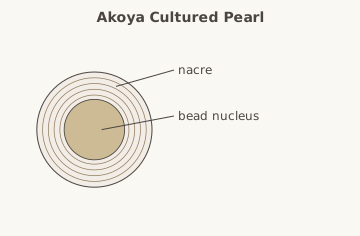
Akoya cultured pearls are bead cultured pearls grown in the Akoya pearl oyster, Pinctada fucata martensii. In Western markets they rank as the best-known sea-grown cultured pearl, traditionally white or cream and especially used for single-strand necklaces, and are produced in both Japan and China. Cultivation follows the general saltwater bead-culture process: a technician implants mantle tissue (saibo) together with a bead into the host, the epithelium forms a cultured pearl sac, and nacre is deposited. Note that no source dedicated to Akoya pearl formation is available here; the mechanism is given from the general saltwater bead-culture process, and mollusc-specific nacre thickness, growth duration and colour causes are not provided by the available sources.
Scope: Applies to explaining the host mollusc species, main producing areas and classic colours of Akoya cultured pearls; the pearl-forming mechanism is given according to the general procedure for beaded saltwater culturing, as sources specific to the Akoya oyster are lacking.
Sources GIA Pearl Description · GIA Pearl Description (Chinese edition) · G&G Fall 2021 +1
- Pearl Description
- Pearl Description (GIA Gem Encyclopedia, Simplified Chinese edition)
- Internal Structures of Known Pinctada maxima Pearls: Cultured Pearls from Operated Marine Mollusks (Gems & Gemology, Fall 2021, Vol. 57, No. 3)
- Gemological Characteristics of Saltwater Cultured Pearls Produced After Xenotransplantation (Gems & Gemology, Spring 2013, Vol. 49, No. 1)
Where it forms
Marine farms; the host is the Akoya pearl oyster Pinctada fucata (martensii).
Sources GIA Pearl Description · GIA Pearl Description (Chinese edition) · G&G Fall 2021 +1
- Pearl Description
- Pearl Description (GIA Gem Encyclopedia, Simplified Chinese edition)
- Internal Structures of Known Pinctada maxima Pearls: Cultured Pearls from Operated Marine Mollusks (Gems & Gemology, Fall 2021, Vol. 57, No. 3)
- Gemological Characteristics of Saltwater Cultured Pearls Produced After Xenotransplantation (Gems & Gemology, Spring 2013, Vol. 49, No. 1)
Japan and China are the main producing countries.
Sources GIA Pearl Description · GIA Pearl Description (Chinese edition) · G&G Fall 2021 +1
- Pearl Description
- Pearl Description (GIA Gem Encyclopedia, Simplified Chinese edition)
- Internal Structures of Known Pinctada maxima Pearls: Cultured Pearls from Operated Marine Mollusks (Gems & Gemology, Fall 2021, Vol. 57, No. 3)
- Gemological Characteristics of Saltwater Cultured Pearls Produced After Xenotransplantation (Gems & Gemology, Spring 2013, Vol. 49, No. 1)
In the host mollusc's gonad, within a cultured pearl sac formed by implanted mantle epithelium.
Sources GIA Pearl Description · GIA Pearl Description (Chinese edition) · G&G Fall 2021 +1
- Pearl Description
- Pearl Description (GIA Gem Encyclopedia, Simplified Chinese edition)
- Internal Structures of Known Pinctada maxima Pearls: Cultured Pearls from Operated Marine Mollusks (Gems & Gemology, Fall 2021, Vol. 57, No. 3)
- Gemological Characteristics of Saltwater Cultured Pearls Produced After Xenotransplantation (Gems & Gemology, Spring 2013, Vol. 49, No. 1)
How it forms, step by step
Mantle tissue (saibo) is taken from a donor and a bead nucleus is prepared.
Sources GIA Pearl Description · GIA Pearl Description (Chinese edition) · G&G Fall 2021 +1
- Pearl Description
- Pearl Description (GIA Gem Encyclopedia, Simplified Chinese edition)
- Internal Structures of Known Pinctada maxima Pearls: Cultured Pearls from Operated Marine Mollusks (Gems & Gemology, Fall 2021, Vol. 57, No. 3)
- Gemological Characteristics of Saltwater Cultured Pearls Produced After Xenotransplantation (Gems & Gemology, Spring 2013, Vol. 49, No. 1)
The bead and mantle tissue are implanted into the Akoya host oyster.
Sources GIA Pearl Description · GIA Pearl Description (Chinese edition) · G&G Fall 2021 +1
- Pearl Description
- Pearl Description (GIA Gem Encyclopedia, Simplified Chinese edition)
- Internal Structures of Known Pinctada maxima Pearls: Cultured Pearls from Operated Marine Mollusks (Gems & Gemology, Fall 2021, Vol. 57, No. 3)
- Gemological Characteristics of Saltwater Cultured Pearls Produced After Xenotransplantation (Gems & Gemology, Spring 2013, Vol. 49, No. 1)
The mantle epithelium forms a cultured pearl sac and deposits nacre onto the bead.
Sources GIA Pearl Description · GIA Pearl Description (Chinese edition) · G&G Fall 2021 +1
- Pearl Description
- Pearl Description (GIA Gem Encyclopedia, Simplified Chinese edition)
- Internal Structures of Known Pinctada maxima Pearls: Cultured Pearls from Operated Marine Mollusks (Gems & Gemology, Fall 2021, Vol. 57, No. 3)
- Gemological Characteristics of Saltwater Cultured Pearls Produced After Xenotransplantation (Gems & Gemology, Spring 2013, Vol. 49, No. 1)
The classically white or cream Akoya cultured pearl forms (mechanism from the general saltwater bead-culture process; no Akoya-specific source).
Sources GIA Pearl Description · GIA Pearl Description (Chinese edition) · G&G Fall 2021 +1
- Pearl Description
- Pearl Description (GIA Gem Encyclopedia, Simplified Chinese edition)
- Internal Structures of Known Pinctada maxima Pearls: Cultured Pearls from Operated Marine Mollusks (Gems & Gemology, Fall 2021, Vol. 57, No. 3)
- Gemological Characteristics of Saltwater Cultured Pearls Produced After Xenotransplantation (Gems & Gemology, Spring 2013, Vol. 49, No. 1)
Link to appearance
Akoya cultured pearls are classically white or cream and are widely used for single-strand necklaces; the colour description comes from the GIA encyclopedia, which gives no causal mechanism.
Sources CIBJO Pearl Book 2024 · G&G Fall 2021 · GIA Pearl Description (Chinese edition) +1
Timescale
The available sources give no nacre-thickness or growth-duration data for Akoya cultured pearls.
Sources GIA Pearl Description
Related base materials
- Cultured pearl: cultured-pearl-type-by-mollusc | Cultured pearl category defined by the host mollusc (the Akoya pearl oyster, Pinctada fucata martensii)
Supporting findings
Akoya cultured pearls are produced in Japan as well as China.
Evidence grade AScope: Origin overview; no specific regions or production statistics.
Sources GIA Pearl Description · GIA Pearl Description (Chinese edition)
The formation mechanism of Akoya cultured pearls follows the general saltwater bead-culture process (implanting a bead and mantle tissue); lacking an Akoya-specific source, this is inferred by analogy and carries lower evidence strength.
Evidence grade CScope: No Akoya-specific source; the mechanism is inferred from the general saltwater culture process of other Pinctada species.
Sources G&G Fall 2021 · G&G Spring 2013
Recorded localities
This is an organic material; its localities are the harvest or culture areas (waters or species ranges) recorded by authoritative sources.
Asia
- Japan
Sources CIBJO Pearl Book 2024 · GIA Pearl Description
- CIBJO Blue Book — Pearl Book (Pearl Commission 2024-1)
- Pearl Description
- China
Sources CIBJO Pearl Book 2024 · GIA Pearl Description
- CIBJO Blue Book — Pearl Book (Pearl Commission 2024-1)
- Pearl Description
Oceania
- Eastern coast of New South Wales, AustraliaSince about 1999
Sources CIBJO Pearl Book 2024 · Gems & Gemology Winter 2017
- CIBJO Blue Book — Pearl Book (Pearl Commission 2024-1)
- Akoya Cultured Pearl Farming in Eastern Australia (G&G Winter 2017)
These are localities recorded by authoritative sources, not an origin finding for any individual piece. The CIBJO Gemstone Book (2022, §4.2.3) says a place of origin names where a gem was mined or harvested, is a matter of opinion, does not imply a level of quality, and that cutting, processing or exporting centres must not be used to imply origin. See how far testing can go on this page, the origin determination guide and the overview of recorded localities.
How it is identified
Akoya cultured pearls are often treated to enhance appearance, and they can resemble natural pearls, other cultured pearls, and imitations, so the eye cannot tell whether they are cultured or treated. Determination relies on laboratory testing such as real-time X-radiography, real-time microradiography for nacre thickness, UV-visible reflectance spectroscopy, X-ray fluorescence, and computed micro-tomography (μCT). Pearl category and any detectable treatment must be judged by an accredited laboratory, and this entry provides no self-test threshold.
Evidence grade AScope: Appearance is insufficient to decide cultured or treated status; determination requires testing by an accredited laboratory, and this entry gives no self-test threshold.
Sources GIA: How GIA Identifies Pearls · CIBJO Pearl Book 2024
Other research findings
The Akoya pearl oyster — Pinctada fucata (martensii) — serves as host for Akoya cultured pearls.
Evidence grade AScope: The mollusc's scientific name is supported by GIA sources; there is no Akoya-specific formation source.
Sources CIBJO Pearl Book 2024 · G&G Fall 2021 · GIA Pearl Description (Chinese edition) +1
Akoya cultured pearls are the most familiar saltwater cultured pearl in Western markets, classically white or cream, widely used for single-strand necklaces.
Evidence grade AScope: Market/appearance description, not a formation or composition claim.
Sources GIA Pearl Description · GIA Pearl Description (Chinese edition)
Pearl quality is usually assessed through lustre, nacre thickness, surface, shape, colour and matching (GIA summarises the pearl value factors as seven: size, shape, colour, nacre, lustre, surface and matching). Akoya cultured pearls are known for a sharp, bright mirror-like lustre and have relatively thin nacre, so nacre thickness and durability draw particular attention in evaluation. The market generally prizes a bright interference-colour lustre, a clean surface, a round shape, and close matching of size and colour (often with pink, gold or green overtones) within a strand. Category and any treatment must be determined by an accredited laboratory through testing.
Evidence grade AScope: This describes the pearl quality characteristics the market generally prizes; it is not a grade for any specific specimen and is neither price nor investment advice; pearl category (natural or cultured) and any treatment must be determined by an accredited laboratory on the specific specimen.
Sources GIA: How GIA Identifies Pearls · CIBJO Pearl Book 2024
Limits of this research
- Research status: Formation, occurrence or other material-specific findings found in authoritative sources
- No Akoya-specific formation source: the mechanism is inferred from the general saltwater bead-culture process and marked C.
- No nacre-thickness, growth-duration or colour-cause data for Akoya pearls; none borrowed from other molluscs.
- The white/cream description comes from the GIA encyclopedia, which gives no causal mechanism.
- CIBJO Pearl Book 2024 (5.6) defines an Akoya cultured pearl only as a beaded cultured pearl produced in Pinctada fucata (martensii); it does not cover the formation mechanism.
Methodology
- Origin determination and its limits
- Quality grading and value factors
- How gemmology became a technical discipline
Evidence grades
- A
- Standards bodies, government geological surveys, peer-reviewed research and museum records
- B
- Institutional educational material
- C
- Specialist databases or cautious readings
A statement is never graded above its strongest source.
This section is LumaLark's own factual restatement of public authoritative sources, credited item by item; it contains no verbatim excerpts, images or third-party logos.
DecideListing name, disclosure, care and treatments
- Suggested listing name
- Akoya Cultured Pearl
16 CFR Part 23 §23.20(b), §23.26(a)
Construction or treatment status
Cultured formation; treatments recorded separately
Treatments recorded for this material: Bleached (via parent material), Dyed (via parent material), Irradiated (via parent material)
Related:Disclosure and cautions
This page cannot answer
Natural? · Origin · Price
A lab report settles these; this wiki covers naming and disclosure.
Related:What this page can answer
Answer at a glance
Akoya Cultured Pearl is Cultured pearl from the Pinctada fucata martensii oyster; classic white pearl; use "Akoya Cultured Pearl" for listings, and disclose any known treatments.
Evidence
What this means for you
Before buying, check the recommended listing name "Akoya Cultured Pearl" and any disclosed treatments on this page, and ask the seller for a grading report if in doubt.
Known uncertainty
- Last reviewed
- 2026-09-01
Care and wear
The normal and special care that applies to all natural and cultured pearls, and so to Akoya Cultured Pearl (CIBJO Pearl Book §7.1, §7.2; the source says this advice counts as normal across the whole range and should be passed on to the buyer), is set out in full under care on the Pearl entry.
Care
Akoya Cultured Pearl — care (light): may fade or revert to its original colour, so it should not be left for long periods in strong natural or artificial light or under strong display lighting.
CIBJO Pearl Book 2024
- Treatment state
- treated
- Only after these treatments
- coating, dyeing
Source & check 2026-09-26
- Source
- CIBJO Blue Book — Pearl Book (Pearl Commission 2024-1) (CIBJO): §8.2 Annex C, Akoya Cultured Pearl, p.54; §7.2, §7.2.2 (locator checked 2026-09-26)
- Fact checked on
- 2026-09-26
Akoya Cultured Pearl — care (wear): breaks easily, so it is not meant for everyday wear and should not be worn during heavy work.
CIBJO Pearl Book 2024
- Treatment state
- treated
- Only after these treatments
- filling
Source & check 2026-09-26
- Source
- CIBJO Blue Book — Pearl Book (Pearl Commission 2024-1) (CIBJO): §8.2 Annex C, Akoya Cultured Pearl, p.54; §7.2, §7.2.1 (locator checked 2026-09-26)
- Fact checked on
- 2026-09-26
Each row's “Source & check” expands to the full source; the date beside it is the fact check date.
Common care questions and matching entries
WearCare and wear for Akoya Cultured Pearl can be registered against the Pearl Book of the CIBJO Blue Book (Pearl Commission 2024-1). LightTreated Akoya cultured pearls, and only those that are coated or dyed, may fade or revert to their original colour and should not be left for long periods in strong natural light, strong artificial light or strong display lighting. WearTreated Akoya cultured pearls, and only those that are filled, break easily, are not meant for everyday wear and should not be worn during heavy physical work. The general and specific care advice in the CIBJO Pearl Book should be treated as standard for all pearls and passed on to the buyer; it is listed in full in the care part of the Pearl entry.
This table scrolls sideways on narrow screens.
| Question | Matching entries |
|---|---|
| Light and display | may fade or revert to its original colour, so it should not be left for long periods in strong natural or artificial light or under strong display lighting |
| Wearing limits (knocks, settings) | breaks easily, so it is not meant for everyday wear and should not be worn during heavy work |
Care entries by treatment state
The same entries grouped by the treatment state each applies to; each links to its full wording and source. Letters are CIBJO special-care codes, explained on the gemstone care page.
treated (Only after these treatments: coating, dyeing)
treated (Only after these treatments: filling)
Treatments and identification leads
One row per treatment, with three standards side by side: how often it occurs and how stable it is (CIBJO), its category in GB/T 16552—2017 Table B.1 (this site's paraphrase) and how the JJA/AGL 2025 table lists it. Each CIBJO value links to its entry under “Testing and market”, where the wording and source are given in full.
This table scrolls sideways on narrow screens.
| Treatment | Market frequency (CIBJO) | Stability (CIBJO) | GB/T 16552 category | JJA/AGL listing | Identification leads |
|---|---|---|---|---|---|
| Bleaching | — | — | Optimization | — | — |
| Dyeing | — | — | Treatment | — | — |
| Irradiation | — | — | Treatment | — | — |
“—” means the cited source gives no value for that item, not “none”. Source: GB/T 16552—2017 Table B.1 (row for Cultured Pearl)
Whether a treatment has to show in the name differs between the two rule sets (this site’s paraphrase):
- GB/T 16552—2017: a method classed as treatment has to be stated in the name itself — the method put before the name, or added in brackets after it; a method classed as optimization does not need to appear in the name, though one marked “Optimization (annotation required)” still has to be noted in the quality documents. Source: §5.4.2.1 a), b); §5.4.2.2 a)
- CIBJO Gemstone Book 2022: no longer splits treatments into ones that need specific disclosure and ones that need only general disclosure: every treatment is to be disclosed, and the seller tells the buyer which treatment was used and what special care it calls for. Source: §4.2.5 Note 2, §4.2.5.1, pp.14–15
What this table covers
What this page can give
- Registered treatments, their stability and how often they occur (see the table above)
- Identification leads for each treatment, for use when sending a stone for testing
VerifyNames, standards, technical facts, clauses and sources
Names
For Akoya Cultured Pearl, "Japanese pearl" is recorded with no restriction on use as a name, while "Akoya pearl" must not be used as a name (CIBJO Pearl Book 2024 §4.4.1.1.2; CIBJO Pearl Book 2024 §5.6; 16 CFR Part 23 §23.26(a)); 4 further names in non-Latin scripts are listed in the name register below (3 with no restriction recorded on use as a name, 1 that may appear only as an annotation, never as the product name).
Standard and listing namesThe GB/T 16552—2017 naming counterpart for Akoya Cultured Pearl is “Saltwater Cultured Pearl” (Table A.3, row “Saltwater cultured pearl (seawater pearl)”); this name itself is not in the standard. The suggested listing name is Akoya Cultured Pearl. Names in four languagesThe four-language names are given in Simplified Chinese, Traditional Chinese, English (Akoya Cultured Pearl) and Japanese, the Japanese being the GSJ (Japan) formal name. Institution usageAmong authority wordings, CIBJO lists Akoya Cultured Pearl, with a qualifying note separated from the title name (CIBJO Pearl Book); the FTC text on file has no wording for this name (checked), and GIA and Gem-A have not been checked; bodies without a recorded wording show the entry's own English name, which does not represent their position. National standard namesGermany (RAL) writes Akoya-Zuchtperle and the EU writes Akoya Cultured Pearl. Trade and mineralogical namesTrade names and synonyms also include Akoya pearl, Japanese pearl, a mixed Latin-Chinese form of the Akoya cultured pearl name, and the Chinese trade name for “Tennyo” pearl. Candidate search termsOf these, Akoya pearl is not an acceptable name, Japanese pearl is only a candidate search term, and the Tennyo pearl name may only be added as a note, never as the main product name, because “Tennyo” is a quality title given by a testing laboratory, not a type of material.
Name register
Every name recorded for this entry, with how it is classified, whether it may be matched to this entry automatically, whether it may be used as a product name, and the clause it rests on.
This table scrolls sideways on narrow screens.
| Name | Type | Matching | Use as a name | Basis |
|---|---|---|---|---|
| no restriction recorded (4) | ||||
| Japanese pearlEnglish | market name | search candidate only | no restriction recorded | editorial ruling (no clause cited); Note: Related high-risk name “Pearl”. |
| Akoya养殖珍珠Simplified Chinese | market name | matched automatically | no restriction recorded | editorial ruling (no clause cited) |
| 马氏珠母贝产有核珍珠Simplified Chinese | narrower name (variety or subtype) | matched automatically | no restriction recorded | GB/T 18781—2023 A; GB/T 18781—2023 3.2.1 |
| 马氏珠母贝海水珍珠Simplified Chinese | narrower name (variety or subtype) | matched automatically | no restriction recorded | GB/T 18781—2023 3.2.1 |
| annotation only, never as the product name (1) | ||||
| 天女珍珠Simplified Chinese | market name | matched only once the condition is confirmed | annotation only, never as the product name | CIBJO Pearl Book 2024 4.4.1.1.2; GB/T 16552—2017 5.1.2.3 b); GB/T 16552—2017 5.1.1 c); Note: Related high-risk name “Australian white, Tennyo, Aurora, Baroque”: “Tennyo” is a laboratory quality designation, not a material; the material is still Akoya cultured pearl. |
| not to be used as a name (1) | ||||
| Akoya pearlEnglish | market name | matched automatically | not to be used as a name | CIBJO Pearl Book 2024 4.4.1.1.2; CIBJO Pearl Book 2024 §5.6; 16 CFR Part 23 §23.26(a); Note: Related high-risk name “Pearl”. |
How each authority words this name: see Names › Authority wording.
- GSJ (Japan) formal name
- アコヤ養殖真珠
- GB/T naming counterpart (this name is not in the standard)
- 海水养殖珍珠 (GB/T 16552—2017 Table A.3, row “Saltwater Cultured Pearl”)
- Mineralogical name
- Cultured pearl from the Pinctada fucata martensii oyster; classic white pearl
- Trade names and synonyms
- Japanese pearl (market name; conditional name)Not to be used as a name: Akoya pearl (market name)
Four-language names
- 简体中文
- 阿古屋养殖珍珠
- 繁體中文
- 阿古屋養殖珍珠
- English
- Akoya Cultured Pearl
- 日本語
- アコヤ養殖真珠
National and regional formal names
- Germany (RAL)
- Akoya-Zuchtperle
- European Union
- Akoya Cultured Pearl
Qualifiers stripped from the headline name
See also: Misleading and prohibited trade names · Supplementary name index
Classification
- Origin
- Natural materials
- Material domain
- Natural organic and biogenic materials
- Browsing family
- Pearl and molluscan shell materials
- Identity tier
- Organic or biogenic material
- Mineral chemical class
- Not applicable
- Construction or treatment status
- Cultured formation; treatments recorded separately
Treatments listed by standards
GB/T 16552-2017, Annex B, Table B.1
Under the “Cultured Pearl (Pearl)” row of Table B.1: Bleaching Optimization; Dyeing Treatment; Irradiation Treatment. The full row, with the effect column, is on the Cultured Pearl page.
What Table B.1 is, and how the “see 5.4.1” grades are defined: see the GB/T 16552: optimization vs treatment page.
What it is and how it's identified
Akoya Cultured Pearl is a beaded cultured pearl produced in the Akoya pearl oyster Pinctada fucata (also known as martensii); this is a CIBJO trade definition from an institutional handbook, not a national standard. All other values are taken at the level of the class named in the cited clause, not measured separately. For cultured pearls (the whole class): the inorganic part of the structure is a radially arranged aggregate, with aragonite orthorhombic and calcite trigonal, and the organic part is amorphous; Mohs hardness is 2.5–4; cleavage is usually not seen in the aggregate; the optic character is that of an aggregate and birefringence cannot be measured on the aggregate; when untreated, the lustre is pearly, and it effervesces on contact with acid. The density of 2.72–2.78 g/cm³ is taken for saltwater cultured pearls (the whole class); the refractive index of 1.53–1.68 is taken for cultured pearls (the whole class) and is a spot-method reading, a typical value rather than an absolute limit; the clause has further sub-grades, and the overall value is used.
Registered material facts
Each row carries its own source and check date and can be cited on its own; “—” means the cited source gives no value, not “none”.
Luminescence, UV-visible spectrum, infrared spectrum, magnification: these whole-class features are given in the cited clause for cultured pearl (the whole class), so they are not repeated on the Akoya Cultured Pearl page; see the material facts on the Cultured Pearl entry.
Items below that name the class they cover give the cited clause’s value for that whole class, not a measurement of Akoya Cultured Pearl (how to read class-level values).
Definition
Akoya Cultured Pearl: a beaded cultured pearl produced in Pinctada fucata (martensii) (9.54), the Akoya pearl oyster.
CIBJO Pearl Book 2024
- Qualification
CIBJO trade definition from an institutional manual, not a national standard.
Source & check 2026-09-25
- Source
- CIBJO Blue Book — Pearl Book (Pearl Commission 2024-1) (CIBJO): §5.6, p.22 (locator checked 2026-09-25)
- Fact checked on
- 2026-09-25
Structure
Akoya Cultured Pearl — structure (overall): inorganic part: aragonite (orthorhombic) and calcite (trigonal) in radiating aggregates; organic part: amorphous.
GB/T 16553—2017
- Does this standard apply
- applies to this entry
- What this covers
- cultured pearl (the whole class)
Source & check 2026-09-26
- Source
- GB/T 16553—2017 Gems — Testing (GB/T): §5.3.2 (locator checked 2026-09-26)
- Fact checked on
- 2026-09-26
Durability
Akoya Cultured Pearl — Mohs hardness: 2.5–4
GB/T 16553—2017
Reference points on this site: Talc 1–3, Fluorite 4, Apatite 5–5.5, Orthoclase 6–6.5, Topaz 8, Diamond 10 (Source: GB/T 16553—2017); Gypsum 1.5–2, Calcite 3, Quartz 7 (Source: Handbook of Mineralogy); Corundum 9 (Source: GIA Gem Encyclopedia (care guide))
- Does this standard apply
- applies to this entry
- What this covers
- cultured pearl (the whole class)
Source & check 2026-09-26
- Source
- GB/T 16553—2017 Gems — Testing (GB/T): §5.3.2 (locator checked 2026-09-26)
- Fact checked on
- 2026-09-26
Akoya Cultured Pearl — cleavage: generally not seen on an aggregate
GB/T 16553—2017
- Does this standard apply
- applies to this entry
- What this covers
- cultured pearl (the whole class)
Source & check 2026-09-26
- Source
- GB/T 16553—2017 Gems — Testing (GB/T): §5.3.2 (locator checked 2026-09-26)
- Fact checked on
- 2026-09-26
Akoya Cultured Pearl — stability: effervesces in acid
GB/T 16553—2017
- Treatment state
- untreated
- Does this standard apply
- applies to this entry
- What this covers
- cultured pearl (the whole class)
Source & check 2026-09-26
- Source
- GB/T 16553—2017 Gems — Testing (GB/T): §5.3.2 (locator checked 2026-09-26)
- Fact checked on
- 2026-09-26
Physical properties
Akoya Cultured Pearl — density: 2.72–2.78 g/cm³
GB/T 16553—2017
- Does this standard apply
- applies to this entry
- What this covers
- saltwater cultured pearl (the whole class)
Source & check 2026-09-26
- Source
- GB/T 16553—2017 Gems — Testing (GB/T): §5.3.2 Density · Saltwater cultured pearl (locator checked 2026-09-28)
- Fact checked on
- 2026-09-26
Akoya Cultured Pearl — feel (texture): feels gritty when two surfaces are rubbed together
GB/T 16553—2017
- Does this standard apply
- applies to this entry
- What this covers
- cultured pearl (the whole class)
Source & check 2026-09-26
- Source
- GB/T 16553—2017 Gems — Testing (GB/T): §5.3.2 (locator checked 2026-09-26)
- Fact checked on
- 2026-09-26
Optical
Akoya Cultured Pearl — optic character: aggregate
GB/T 16553—2017
- Does this standard apply
- applies to this entry
- What this covers
- cultured pearl (the whole class)
Source & check 2026-09-26
- Source
- GB/T 16553—2017 Gems — Testing (GB/T): §5.3.2 (locator checked 2026-09-26)
- Fact checked on
- 2026-09-26
Akoya Cultured Pearl — refractive index: 1.53–1.68
GB/T 16553—2017
- Does this standard apply
- applies to this entry
- What this covers
- cultured pearl (the whole class)
- Qualification
The clause we cite gives this as a value read by the spot (distant-vision) method. It is a common value, not an absolute limit.
- General note
- the clause has finer ranges
Source & check 2026-09-26
- Source
- GB/T 16553—2017 Gems — Testing (GB/T): §5.3.2 (locator checked 2026-09-26)
- Fact checked on
- 2026-09-26
Akoya Cultured Pearl — birefringence: not measurable on an aggregate
GB/T 16553—2017
- Does this standard apply
- applies to this entry
- What this covers
- cultured pearl (the whole class)
Source & check 2026-09-26
- Source
- GB/T 16553—2017 Gems — Testing (GB/T): §5.3.2 (locator checked 2026-09-26)
- Fact checked on
- 2026-09-26
Akoya Cultured Pearl — pleochroism: not measurable on an aggregate
GB/T 16553—2017
- Treatment state
- untreated
- Does this standard apply
- applies to this entry
- What this covers
- cultured pearl (the whole class)
Source & check 2026-09-26
- Source
- GB/T 16553—2017 Gems — Testing (GB/T): §5.3.2 (locator checked 2026-09-26)
- Fact checked on
- 2026-09-26
Quality factors
Akoya Cultured Pearl — quality factor (lustre): pearly
GB/T 16553—2017
- Treatment state
- untreated
- Does this standard apply
- applies to this entry
- What this covers
- cultured pearl (the whole class)
Source & check 2026-09-26
- Source
- GB/T 16553—2017 Gems — Testing (GB/T): §5.3.2 (locator checked 2026-09-26)
- Fact checked on
- 2026-09-26
Akoya Cultured Pearl — quality factor (nacre thickness): extra thick (A) ≥0.6 mm; very thick (B) ≥0.5 mm; thick (C) ≥0.4 mm; medium (D) ≥0.3 mm; thin (E) <0.3 mm.
GB/T 18781—2023
- Treatment state
- untreated
- Does this standard apply
- applies to this entry
- Measurement condition
- GB/T 18781—2023 §6.6: direct measurement (arbitration method), X-ray method or optical coherence tomography; nacre thickness in mm to one decimal place
- Nucleation
- beaded
- Qualification
GB/T 18781—2023 names this scale for beaded cultured pearls from the Pinctada fucata martensii oyster (named by its Chinese species name in the standard); such pearls are graded in millimetres by this table instead of by the PT% ratio of Table 4. Each bound is a lower limit only (≥); the standard gives no upper limits.
Source & check 2026-09-26
- Source
- GB/T 18781—2023 Cultured pearl grading (GB/T): §4.6.2, Annex A (normative) Table A.1, §6.6 (locator checked 2026-09-26)
- Fact checked on
- 2026-09-26
Each row's “Source & check” expands to the full source; the date beside it is the fact check date.
This material (RI / SG midpoints): 1.605 / 2.75; Closest values: 1Larimar 1.62 / 2.82, 2Natural Conch Pearl / Natural Melo Pearl 1.595 / 2.84, 3Aquamarine 1.58 / 2.79, 4Turquoise 1.63 / 2.65, 5Prehnite 1.625 / 2.88
Show the full chart (330 registered materials)
Outside the full chart's range, drawn as triangles at the edge (RI / SG midpoints): Hematite 3.045/5.12, Synthetic Rutile 2.76/4.26, Rutile 2.753/4.23, Synthetic Moissanite 2.67/3.22
Related CIBJO terms
- Sango cultured pearl
a trade name for a pink atypical bead cultured pearl produced in Japan within Pinctada fucata that uses a pink coral bead as the substrate for nacre growth.
CIBJO Blue Book — Pearl Book (Pearl Commission 2024-1) (CIBJO): §5.175, p.42
Entries in the source that only point to another clause: Akoya (§5.5, p.22) → §9.3, §9.54
Definitions are quoted verbatim from the cited CIBJO Blue Book; […] marks an excerpt, and the full definition is at the cited clause.
Pearl-producing molluscs (CIBJO Annex D): §9.3 Akoya pearl oyster · §9.4 Akoya complex · §9.9 Australian akoya pearl oyster · §9.54 Pinctada fucata · §9.57 Pinctada martensii
Testing and market
The CIBJO laboratory protocol covers Akoya Cultured Pearl under “Pearl” (§6.2.17): see identification on the Pearl entry; the required tests are listed on the CIBJO laboratory protocol table for Pearl.
How far testing can go
Each row's “Source & check” expands to the full source; the date beside it is the fact check date.
Evidence and sources
Authority basis and clause sources
Sources
- CIBJO – The World Jewellery Confederation. Gemmological Laboratories Book (Blue Book), Gemmological Commission 2024-1.
- CIBJO – The World Jewellery Confederation. The Gemstone Book (Blue Book), 2022.
- SAMR / SAC (China). GB/T 16552—2017 Gems — Nomenclature.
- GIA – Gemological Institute of America (United States). Gem Encyclopedia.
- Gem-A – The Gemmological Association of Great Britain (United Kingdom).
- eCFR (United States). 16 CFR § 23.20 — Misuse of the word “pearl.” In: 16 CFR Part 23 — Guides for the Jewelry, Precious Metals, and Pewter Industries.
Further reading
Related entries and topic cluster
Parent entry and related pages on this site. Rows marked “Planned” are suggested new content and have no link yet.
Related-entry tree for Pearl on this site: 17 entries listed by this site's parent-entry links; synthetic, treated and similar entries carry their recorded state after the name; this page (Akoya Cultured Pearl) is marked.
- Pearl
Sub-entries (16)
- Abalone Pearl
- Akoya Cultured Pearl
- Baroque Cultured Pearl
- Blister Pearl
- Circled Cultured Pearl
- Cultured Pearl
- Freshwater Cultured Pearl
- Freshwater Natural Pearl
- Keshi Cultured Pearl
- Natural Conch Pearl / Natural Melo Pearl
- Natural Pearl
- Saltwater Cultured Pearl
- Saltwater Natural Pearl
- South Sea Cultured Pearl
- Tahitian Cultured Pearl
- White South Sea Cultured Pearl
This table scrolls sideways on narrow screens.
| Page | Content | Status |
|---|---|---|
| Browsing family | Pearl and molluscan shell materials | Live |
| Treatments recorded for this material | Bleached (via parent material), Dyed (via parent material), Irradiated (via parent material) | Live |
| Related articles | To be added (placeholder) | Planned |
Who maintains this page
The material facts in the Akoya Cultured Pearl entry are maintained by the LumaLark wiki and matched one by one to the standard clauses or institutional sources they cite: every fact carries its source (with a clause or page locator) and a check date, so it can be traced back to the original. The entry exists so that buyers and sellers can check naming, disclosure and material facts item by item.