On this page
UnderstandWhat it is, what people ask, how far this page goes
Artificial products / Manufactured products · Artificial product type · Assembled / composite product
Opal Mosaic
Also known asOpal chip mosaic · Opal inlay
A product made by arranging and gluing many Opal fragments in a mosaic pattern; it is not a single piece of natural Opal. Also known as Opal inlay, Opal chip mosaic. This page compares how the major standards and institutions name it, what must be disclosed when selling it, whether it can be worn every day, how it is treated and identified, and which source each conclusion comes from.
Price, rarity and origin are outside the scope of this wiki.
What this page can answer
This page covers
- How Opal Mosaic forms and what gives its colourFormation setting, process and timescale, each finding graded and sourced
- Opal Mosaic in English, Chinese and Japanese; national standard namesNames in four languages, the GB/T standard name and the suggested listing name; and: Has any of GIA, FTC, CIBJO or Gem-A put a name for it on record here?
- Listing and disclosing Opal MosaicThe listing name to use; what must be disclosed before sale
What we cannot conclude
- Whether one particular bead is natural, treated or synthetic — only a laboratory report can settle that.
- Geographic origin, unless an origin report accompanies the item.
- Price, rarity or investment value: this wiki covers naming and disclosure only.
Material research: formation, causes and history
What authoritative sources say about how this material forms, what causes its colour and optical effects, where its name comes from and how people have used it. Each statement carries an evidence grade and its sources; it describes the material in general, not any specific piece.
How it forms
Plan view; the parts are placed side by side:
- small opal pieces
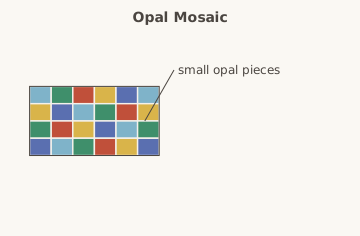
An opal mosaic is an assembled product built from small opal pieces laid out in a mosaic pattern, not a single natural gemstone. Its constituent material, opal, is amorphous silica containing water; when the water content is high it can craze and crack if allowed to dry. The cited authoritative sources provide no dedicated formation or manufacturing account for the opal mosaic as an assembled product; only the general properties of the constituent opal (composition, stability) can be confirmed. By nature it is a man-made assembled product, and its appearance is determined by the colour and pattern arrangement of the opal pieces.
Scope: Applies to defining opal mosaic as an assembled product, and explains the general composition and stability properties of its component material, opal; it does not constitute a conclusion on a formation mechanism specific to this assembled product (the cited sources have no specific content).
Sources CIBJO Gemstone Book 2022 · G&G Fall 2019 · G&G Winter 2023
Where it forms
(Assembly setting) A workshop, where small opal pieces are arranged and bonded into a pattern.
Sources G&G Winter 2023
(Constituent material origin) Natural opal forms in sedimentary-type or volcanic-type environments.
Sources G&G Winter 2023
How it forms, step by step
Small opal pieces (possibly of different colors and body tones) are selected.
Sources G&G Winter 2023
The opal pieces are arranged into a mosaic pattern and bonded together.
Sources G&G Winter 2023
(Optional) The assembled piece may be stabilized to address the risk of opal crazing and cracking.
Sources G&G Winter 2023
It enters the market as an assembled opal product and must be distinguished from a single natural opal.
Sources G&G Winter 2023
Link to appearance
The appearance of an opal mosaic is determined by the color, play-of-color and pattern arrangement of the many opal pieces, not by a single gemstone; the mosaic pattern itself is a result of human arrangement.
Sources G&G Fall 2019
Timescale
The cited sources give no fabrication date for opal mosaic or formation age/duration for its constituent opal.
Sources CIBJO Gemstone Book 2022 · G&G Fall 2019 · G&G Winter 2023
Related base materials
- Opal (hydrated amorphous silica): assembled-from | Opal mosaic is pieced together from small pieces of opal; opal is its constituent material
Supporting findings
Specialists separate opal of the 'sedimentary type', found in many Australian fields of the Great Artesian Basin, from opal of the 'volcanic type', such as that near Tintenbar in New South Wales and in a number of other countries.
Evidence grade AScope: A general classification of opal (the constituent material) settings; not specific to the mosaic product.
Sources G&G Winter 2023
Recorded localities
This is a manufactured, assembled or treated product that contains natural material. No locality is given for the finished product; see the parent material's entry for where the natural component is recorded.
Other research findings
An opal mosaic is an assembled product made of small opal pieces arranged in a mosaic pattern, not a single natural gemstone.
Evidence grade CScope: An identity-boundary statement; the source set does not specifically document this assembled product, so it is a grade-C inference from the definition.
Sources G&G Fall 2019
Opal, the material that makes up an opal mosaic, is amorphous silica containing water; when the water content is high it can craze and crack if allowed to dry.
Evidence grade AScope: A general property of opal material applicable to the opal used in a mosaic; not specific to the assembled product.
Sources G&G Fall 2019
Opal may be stabilized through a structural-integrity test: material is held under controlled temperature and humidity for a period, and material that fails due to cracking, crazing or water loss is excluded; assembled pieces may involve such stabilization too.
Evidence grade CScope: The stabilization process comes from a Slovak opal processing report; it illustrates the general approach to opal stability and does not prove mosaic products use it.
Sources G&G Winter 2023
An opal mosaic is a composite stone: the term 'mosaic' replaces 'composite' when the parts are placed side by side, e.g. to create a picture or pattern.
Evidence grade AScope: CIBJO naming rule; does not cover placement technique or adhesive.
Sources CIBJO Gemstone Book 2022
Limits of this research
- Research status: Formation, occurrence or other material-specific findings found in authoritative sources
- The source set provides no dedicated formation or manufacturing account for opal mosaic as an assembled product; related statements are largely grade-C inference from the definition.
- The sources dedicated to assembled/doublet opal provide no opal-mosaic-specific content (the opal-doublet text is actually about wet opal storage, unrelated to assembly).
- Fabrication date and constituent opal age/duration are lacking.
Methodology
- Origin determination and its limits
- Quality grading and value factors
- How gemmology became a technical discipline
Evidence grades
- A
- Standards bodies, government geological surveys, peer-reviewed research and museum records
- B
- Institutional educational material
- C
- Specialist databases or cautious readings
A statement is never graded above its strongest source.
This section is LumaLark's own factual restatement of public authoritative sources, credited item by item; it contains no verbatim excerpts, images or third-party logos.
DecideListing name, disclosure, care and treatments
- Suggested listing name
- Opal mosaic (an assembled product)
16 CFR Part 23 §23.25(a), §23.25(d)
This page cannot answer
Natural? · Origin · Price
A lab report settles these; this wiki covers naming and disclosure.
Related:What this page can answer
Answer at a glance
"Opal Mosaic" is a market name rather than a mineral species name; before using it, verify: Not a mineral: man-made or non-mineral material.
Evidence
What this means for you
Before buying, check the recommended listing name "Opal mosaic (an assembled product)" and any disclosed treatments on this page, and ask the seller for a grading report if in doubt.
Known uncertainty
- This entry's exact material identity is not fully settled.
- See “Disclosure and cautions” above
- Last reviewed
- 2026-09-01
Trade-name ruling
- Not a mineral: man-made or non-mineral material.
- Suggested listing name
- Opal mosaic (an assembled product)
VerifyNames, standards, technical facts, clauses and sources
Names
Besides Opal Mosaic, the name register records "Opal chip mosaic" and "Opal inlay", for which no restriction on use as a name is recorded.
Standard and listing namesOpal Mosaic is a type of man-made product; under GB/T 16552—2017 the corresponding national-standard name is composite stone, and the name itself is not listed in the original; the suggested listing name is opal mosaic composite product. Names in four languagesNames are given in Simplified Chinese, Traditional Chinese, English (Opal Mosaic) and Japanese (a katakana transliteration). The entry's own Japanese name is that same katakana form, and Japan's GSJ wording for opal mosaic is unchecked. Trade and mineralogical namesMarket names include Opal inlay and Opal chip mosaic; the mineralogical name refers to a composite product made by arranging small pieces of opal as a mosaic. Institution usageAmong GIA, FTC, CIBJO and Gem-A, the FTC text on file has been checked and has no wording for Opal Mosaic; GIA, CIBJO and Gem-A wording has not yet been checked. The English name Opal Mosaic shown for unchecked bodies is the entry's own English name and does not represent their position.
Name register
Every name recorded for this entry, with how it is classified, whether it may be matched to this entry automatically, whether it may be used as a product name, and the clause it rests on.
This table scrolls sideways on narrow screens.
| Name | Type | Matching | Use as a name | Basis |
|---|---|---|---|---|
| no restriction recorded (2) | ||||
| Opal chip mosaicEnglish | market name | matched automatically | no restriction recorded | editorial ruling (no clause cited) |
| Opal inlayEnglish | market name | matched automatically | no restriction recorded | editorial ruling (no clause cited) |
How each authority words this name: see Names › Authority wording.
- GSJ (Japan) formal name
- オパール・モザイク (not yet checked for this body — the entry's own Japanese name is shown)
- GB/T naming counterpart (this name is not in the standard)
- 拼合石 (GB/T 16552—2017 §5.1.3.3 a))
- Mineralogical name
- Assembled product made of small opal pieces arranged in a mosaic pattern
- Trade names and synonyms
- Opal inlay (market name) · Opal chip mosaic (market name)
Four-language names
- 简体中文
- 蛋白石马赛克
- 繁體中文
- 蛋白石馬賽克
- English
- Opal Mosaic
- 日本語
- オパール・モザイク
See also: Misleading and prohibited trade names · Supplementary name index
Classification
- Origin
- Artificial products / Manufactured products
- Material domain
- Artificial products / Manufactured products
- Browsing family
- Assembled gem products
- Identity tier
- Artificial product type
- Mineral chemical class
- Mixed / composition-dependent
- Construction or treatment status
- Assembled / composite product
What it is and how it's identified
Opal Mosaic is an assembled product whose parts are placed side by side to form a picture, pattern or other design; under CIBJO trade rules, for assembled products whose parts are placed side by side, the word "mosaic" replaces "assembled", but the product must still meet CIBJO's requirements for assembled stones. This definition comes from the CIBJO Blue Book — Official Gemstone Book (Coloured Stone Commission 2022), which is a CIBJO institutional handbook and set of trade rules, not a national standard; the original clause sets out the conditions for the name substitution.
Registered material facts
Each row carries its own source and check date and can be cited on its own; “—” means the cited source gives no value, not “none”.
Definition
Opal Mosaic: The word “composite” shall be replaced by the word “mosaic”, when the various parts of the composite are placed side by side (to create a picture or pattern or otherwise) providing that the application of this term adheres to the requirements regarding the term ”composite” in clause 5.18.
CIBJO Gemstone Book 2022
- Qualification
CIBJO trade rule from an institutional manual, not a national standard; the clause itself states when the name is to be changed.
Source & check 2026-09-28
- Source
- CIBJO Blue Book — Official Gemstone Book (Coloured Stone Commission 2022) (CIBJO): §4.3.2.1.3 Opal mosaic, p.18 (locator checked 2026-09-28)
- Fact checked on
- 2026-09-28
Each row's “Source & check” expands to the full source; the date beside it is the fact check date.
Evidence and sources
Authority basis and clause sources
Sources
- CIBJO – The World Jewellery Confederation. Gemmological Laboratories Book (Blue Book), Gemmological Commission 2024-1.
- CIBJO – The World Jewellery Confederation. The Gemstone Book (Blue Book), 2022.
- SAMR / SAC (China). GB/T 16552—2017 Gems — Nomenclature.
- GIA – Gemological Institute of America (United States). Gem Encyclopedia.
- eCFR (United States). 16 CFR Part 23 — Guides for the Jewelry, Precious Metals, and Pewter Industries.
- LMHC – Laboratory Manual Harmonisation Committee. Information Sheets.
- Federal Trade Commission (United States). In the Loupe: Advertising Diamond, Gemstones and Pearls.
- eCFR (United States). 16 CFR § 23.25 — Misuse of the words “ruby,” “sapphire,” “emerald,” “topaz,” “stone,” “birthstone,” “gem,” “gemstone,” etc. In: 16 CFR Part 23 — Guides for the Jewelry, Precious Metals, and Pewter Industries.
Further reading
Related entries and topic cluster
Parent entry and related pages on this site. Rows marked “Planned” are suggested new content and have no link yet.
This table scrolls sideways on narrow screens.
| Page | Content | Status |
|---|---|---|
| Browsing family | Assembled gem products | Live |
| Related articles | To be added (placeholder) | Planned |
Who maintains this page
The material facts in the Opal Mosaic entry are maintained by the LumaLark wiki and matched one by one to the standard clauses or institutional sources they cite: every fact carries its source (with a clause or page locator) and a check date, so it can be traced back to the original. The entry exists so that buyers and sellers can check naming, disclosure and material facts item by item.