On this page
UnderstandWhat it is, what people ask, how far this page goes
Artificial products / Manufactured products · Artificial product type · Assembled / composite product
Opal Doublet
An assembled stone made by bonding a thin opal slice to a dark backing; the backing material must be disclosed as prominently as the opal. This page compares how the major standards and institutions name it, what must be disclosed when selling it, whether it can be worn every day, how it is treated and identified, and which source each conclusion comes from.
Price, rarity and origin are outside the scope of this wiki.
What this page can answer
This page covers
- How Opal Doublet forms and what gives its colourFormation setting, process and timescale; where its colour and optical effects come from, each finding graded and sourced
- How to identify Opal DoubletIdentification points from the research literature
- Caring for and wearing Opal DoubletCleaning, heat, chemicals and light, as the cited sources give them
- Opal Doublet in English, Chinese and Japanese; national standard namesNames in four languages, the GB/T standard name and the suggested listing name; and: Has any of GIA, FTC, CIBJO or Gem-A put a name for it on record here?
- Listing and disclosing Opal DoubletThe listing name to use; what must be disclosed before sale
- Standard clauses that define Opal DoubletWhich clause defines it, each cross-checked
What we cannot conclude
- Whether one particular bead is natural, treated or synthetic — only a laboratory report can settle that.
- Geographic origin, unless an origin report accompanies the item.
- Price, rarity or investment value: this wiki covers naming and disclosure only.
Material research: formation, causes and history
What authoritative sources say about how this material forms, what causes its colour and optical effects, where its name comes from and how people have used it. Each statement carries an evidence grade and its sources; it describes the material in general, not any specific piece.
How it forms
Layers, top to bottom:
- opal layer
- dark backing
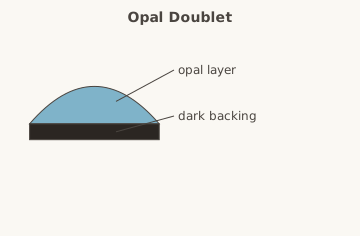
An opal doublet is an assembled gem product in which a layer of opal (normally a thin slice) is cemented to another material (usually a dark backing), the aims being to improve appearance, bring out play-of-color and economise on material; it is an artificial assembly, not a natural formation. The cited authoritative sources give no description of how doublets are assembled, so the construction is taken from the trade/terminology definition and no process detail is invented from unverified sources. Related facts that can be cited are these: opal of high water content tends to craze and crack when left to dry, and immersing a specimen in liquid does not stabilise it or heal its internal cracks, only slowing deterioration—context for why thin slices are combined with a backing to improve workability and durability; and a finished opal gem may itself combine opal with another material (fragments of host rock, i.e. matrix, as in boulder opal).
Scope: Used to describe an assembled opal product made by artificially cementing an opal layer to a dark backing; emphasises its man-made assembled nature, which is not how natural opal forms; the assembly process follows terminology / trade definitions.
Sources GIA Opal Description · G&G Fall 2019 · CIBJO Gemstone Book 2022
Where it forms
Non-natural setting: a doublet is assembled by hand during lapidary processing and does not occur in a geologic environment.
Sources CIBJO Gemstone Book 2022
The natural origin of its opal layer can be a sedimentary or volcanic host-rock setting (e.g. Australia, Ethiopia and others).
Sources GIA Opal Description
How it forms, step by step
Natural opal is selected and often cut into a thin slice to serve as the play-of-color/appearance layer (per the terminology definition).
Sources CIBJO Gemstone Book 2022
Another material is prepared as a dark backing to set off the play-of-color of the opal layer (per the terminology definition).
Sources CIBJO Gemstone Book 2022
The opal layer and the backing are cemented together by hand to form a complete assembled gem (per the terminology definition; the authoritative sources do not describe this process).
Sources CIBJO Gemstone Book 2022
As an assembled material, its construction must be confirmed by a gem laboratory and cannot be treated as natural opal.
Sources CIBJO Gemstone Book 2022
Link to appearance
A layer of opal (possibly with play-of-color) sits on a dark backing that increases the contrast and darkness; the join may be visible from the side or base.
Sources CIBJO Gemstone Book 2022
Timescale
A doublet is an artificial assembly with no natural geologic timescale; the cited sources give no relevant numeric values.
Sources CIBJO Gemstone Book 2022
Related base materials
- Opal (hydrated amorphous silica): part-of | The doublet uses a layer of opal (usually a thin slice) as the play-of-colour/appearance layer
- Dark backing material / cement: assembled-with | The doublet is artificially cemented from an opal layer and another material (usually a dark backing)
Recorded localities
This is a manufactured, assembled or treated product that contains natural material. No locality is given for the finished product; see the parent material's entry for where the natural component is recorded.
Causes of colour and optical effects
In an opal doublet the play-of-color originates inside its natural opal layer: that layer keeps opal's ordered packing of submicroscopic silica spheres (a volumetric photonic crystal, in effect a diffraction grating), so white light traveling among the spheres is diffracted and split into spectral colors whose hue shifts with viewing angle. The backing is not the origin of the colors; it is simply another material placed beneath the opal layer to give the effect contrast.
Evidence grade AScope: Applies to assembled products containing a natural opal layer; it states that the physics of the play-of-color matches natural opal, but does not prove that any particular specimen's opal layer is natural, untreated, or from a given locality.
Sources GIA Opal Description · G&G Summer 2025
As in natural opal, the range of hues in a doublet's play-of-color is set by the diameter and spacing of the silica spheres: spheres around 0.1 micron across yield violet, around 0.2 micron yield red, and intermediate sizes give the remaining spectral colors; the strong angle dependence of diffraction is why the color moves with viewing direction. In a doublet this diffracting medium is merely a thin opal layer, and its optics is no different from solid opal.
Evidence grade AScope: Concerns assembled products whose play-of-color layer is a thin opal slice; the sphere-size to color relation is a general property of opal and is not an analysis of a specimen's origin or treatment.
Sources GIA Opal Description
How it is identified
An opal doublet is made by cementing a thin opal layer to a dark or ordinary backing, and it can resemble a solid opal, with the junction not always visible to the eye. Recognising such an assembled structure and separating natural opal from synthetic or imitation opal relies on laboratory testing, typically microscopic examination of the junction and adhesive layer and compositional analysis such as checking for water content; whether a stone is assembled and how it was treated must be judged by an accredited laboratory, and this entry provides no self-test threshold.
Evidence grade AScope: Appearance is insufficient to decide assembled or synthetic status; determination requires testing by an accredited laboratory, and this entry gives no self-test method.
Other research findings
A finished opal gem can combine opal with another material, for example the host-rock fragments (matrix) that become part of a boulder opal.
Evidence grade AScope: The example is natural boulder opal, not an artificial composite; it only shows that a finished opal gem can be a composite.
Sources GIA Opal Description
Certain opal with a high water content is liable to craze and crack when allowed to dry out, and immersing a specimen in liquid neither stabilises it nor heals the internal cracks—it merely postpones eventual deterioration.
Evidence grade BScope: Concerns high-water-content opal specimens (e.g. Virgin Valley 'wet' opal); it is not a statement about doublets.
Sources G&G Fall 2019
An opal doublet is an assembled material combining an opal layer with a dark backing; it is not naturally formed, and this construction rests on the trade/terminology definition—the cited authoritative sources do not describe its assembly process.
Evidence grade CScope: Graded C: the quotes support only that a finished gem can be a composite and that high-water opal crazes easily; no authoritative source found so far supports the assembly process itself.
Sources GIA Opal Description · G&G Fall 2019
By definition, an opal doublet is a two-piece composition in which a slice of natural opal has been bonded onto a base material; it counts as a composite stone.
Evidence grade AScope: CIBJO naming definition; does not specify base material types or adhesive composition.
Sources CIBJO Gemstone Book 2022
Limits of this research
- Research status: Only partial material-specific findings found; gaps are stated as gaps
- The cited authoritative sources do not describe the assembly process of an opal doublet; the construction rests on the trade/terminology definition.
- The cited opals-revisited source discusses crazing and liquid storage of high-water opal specimens, not doublets.
- The cited boulder-opal source shows only that a finished opal gem can be an opal + host-rock composite; it is not equivalent to an artificial doublet.
- A doublet is an artificial assembly with no natural geologic timescale.
Methodology
- Origin determination and its limits
- Quality grading and value factors
- How gemmology became a technical discipline
Evidence grades
- A
- Standards bodies, government geological surveys, peer-reviewed research and museum records
- B
- Institutional educational material
- C
- Specialist databases or cautious readings
A statement is never graded above its strongest source.
This section is LumaLark's own factual restatement of public authoritative sources, credited item by item; it contains no verbatim excerpts, images or third-party logos.
DecideListing name, disclosure, care and treatments
- Suggested listing name
- Opal Doublet (opal slice plus backing)
GB/T 16552—2017 5.1.3.3 · CIBJO Gemstone Book 2022 4.3.2.1.1
This page cannot answer
Natural? · Origin · Price
A lab report settles these; this wiki covers naming and disclosure.
Related:What this page can answer
Answer at a glance
"Opal Doublet" is a market name rather than a mineral species name; before using it, verify: Not a mineral: man-made or non-mineral material.
Evidence
- GB/T · 5.1.3.3
What this means for you
Before buying, check the recommended listing name "Opal Doublet (opal slice plus backing)" and any disclosed treatments on this page, and ask the seller for a grading report if in doubt.
Known uncertainty
- This entry's exact material identity is not fully settled.
- See “Disclosure and cautions” above
- Last reviewed
- 2026-09-01
Trade-name ruling
- Not a mineral: man-made or non-mineral material.
- Suggested listing name
- Opal Doublet (opal slice plus backing)
Care and wear
Care
Opal Doublet — care (cleaning): Leaving an opal doublet in water for long periods can weaken its glue, so avoid soaking it.
GIA Gem Encyclopedia
- Treatment state
- any treatment state
Source & check 2026-10-06
- Source
- GIA, “October Birthstones: Opal & Tourmaline Birthstone Information”, gia.edu web page: Section: main text (locator checked 2026-10-06)
- Fact checked on
- 2026-10-06
Opal Doublet — care (chemicals): AGTA classes opal doublets as assembled (ASBL) goods needing special care: keep them from household chemicals, cosmetics, abrasives and sudden knocks.
AGTA Gemstone Information Manual, 17th ed.
- Treatment state
- any treatment state
Source & check 2026-10-06
- Source
- AGTA Gemstone Information Manual, 17th edition (August 2026) (AGTA): p.XIX, Tag Codes and Definitions, ASBL care sentence (locator checked 2026-10-06)
- Fact checked on
- 2026-10-06
Each row's “Source & check” expands to the full source; the date beside it is the fact check date.
Common care questions and matching entries
Each question links to the matching entries on this page; whether they answer it fully, go by the entry wording.
This table scrolls sideways on narrow screens.
| Question | Matching entries |
|---|---|
| Can it go in an ultrasonic or steam cleaner? | Leaving an opal doublet in water for long periods can weaken its glue, so avoid soaking it |
| Contact with acids, alkalis and household chemicals | AGTA classes opal doublets as assembled (ASBL) goods needing special care: keep them from household chemicals, cosmetics, abrasives and sudden knocks |
VerifyNames, standards, technical facts, clauses and sources
Names
Standard and listing namesThe name Opal Doublet does not appear in GB/T 16552—2017, and its naming counterpart is composite stone; the suggested listing name is Opal Doublet (opal slice plus backing). Names in four languagesNames are registered in Simplified Chinese, Traditional Chinese, English (Opal Doublet) and Japanese; the Japanese name is also the entry's own, and the wording used by the GSJ (Japan) for this name is not yet verified by this site. Institution usageThe English Opal Doublet is likewise the entry's own English name: the wording of GIA, CIBJO and Gem-A is not yet verified by this site, and the FTC text on file has no wording for this name (checked); bodies without a recorded wording show the entry's own English name, which does not represent their position. The English description is a thin slice of opal cemented onto a dark backing material.
- GSJ (Japan) formal name
- オパールダブレット (not yet checked for this body — the entry's own Japanese name is shown)
- GB/T naming counterpart (this name is not in the standard)
- 拼合石 (GB/T 16552—2017 §5.1.3.3 a))
- Mineralogical name
- Opal slice cemented to a dark backing material
Four-language names
- 简体中文
- 欧泊二层石
- 繁體中文
- 歐泊二層石
- English
- Opal Doublet
- 日本語
- オパールダブレット
See also: Misleading and prohibited trade names · Supplementary name index
Classification
- Origin
- Artificial products / Manufactured products
- Material domain
- Artificial products / Manufactured products
- Browsing family
- Assembled gem products
- Identity tier
- Artificial product type
- Mineral chemical class
- Mixed / composition-dependent
- Construction or treatment status
- Assembled / composite product
What it is and how it's identified
An Opal Doublet is an assembled product made of two parts: a slice of natural opal cemented to a base, which under CIBJO trade rules (from an organisation's handbook, not a national standard) should be called “opal doublet” (opal doublet or doublet opal). In construction, an Opal Doublet is a very thin slice of natural opal cemented to a strong black backing, such as black-dyed chalcedony. In composition (phase), the backing is commonly obsidian, black-dyed chalcedony, black glass, natural common opal or plastic; the cited material lists common backings rather than all of them, and which backing a given Opal Doublet uses depends on the actual piece.
Registered material facts
Each row carries its own source and check date and can be cited on its own; “—” means the cited source gives no value, not “none”.
Definition
Opal Doublet: A composition of two pieces where a slice of natural opal is bonded to a base material.
CIBJO Gemstone Book 2022
- Qualification
CIBJO trade rule from an institutional manual, not a national standard. Only the first half of the sentence (what it is made of) is quoted; the second half sets the name to be used. Full text at §4.3.2.1.1 of the Official Gemstone Book 2022.
Source & check 2026-09-28
- Source
- CIBJO Blue Book — Official Gemstone Book (Coloured Stone Commission 2022) (CIBJO): §4.3.2.1.1 Opal doublet, p.18 (locator checked 2026-09-28)
- Fact checked on
- 2026-09-28
Opal Doublet — composition (phase): backing often of obsidian, black-dyed chalcedony, black glass, natural common opal or plastic.
GIA Gem Encyclopedia
- Qualification
The source lists common backings, not every possible one; what a given piece uses has to be checked on the piece itself.
Source & check 2026-09-28
- Source
- GIA Gem Encyclopedia — Opal Quality Factors (Gemological Institute of America): Section “ASSEMBLED OPALS” (locator checked 2026-09-28)
- Fact checked on
- 2026-09-28
Structure
Opal Doublet — structure (overall): a thin slice of natural opal glued onto a strong black backing, for example black-dyed chalcedony.
CIBJO Retailers' Reference Guide (2021)
Source & check 2026-09-28
- Source
- CIBJO Retailers' Reference Guide — Gemstones (November 2021) (CIBJO): p.39, Opal chapter, Treatments (locator checked 2026-09-28)
- Fact checked on
- 2026-09-28
Each row's “Source & check” expands to the full source; the date beside it is the fact check date.
Clause-level definitions
In the clause-level definition for Opal Doublet, the registered term is Opal Doublet, the clause is GB/T 16552-2017 Annex A, and the definition is an opal slice cemented to a dark backing material. The cross-check result is that it is listed directly by GB/T, and CIBJO carries no standalone entry under the same name.
This table scrolls sideways on narrow screens.
| Term | Clause | Definition | Cross-check |
|---|---|---|---|
| Opal Doublet | GB/T 16552-2017 Annex A | Opal slice cemented to a dark backing material | Listed directly by GB/T; CIBJO carries no standalone entry under the same name. |
Evidence and sources
Authority basis and clause sources
Sources
- CIBJO – The World Jewellery Confederation. Gemmological Laboratories Book (Blue Book), Gemmological Commission 2024-1.
- CIBJO – The World Jewellery Confederation. The Gemstone Book (Blue Book), 2022.
- SAMR / SAC (China). GB/T 16552—2017 Gems — Nomenclature.
- RRUFF Project, in partnership with the IMA – International Mineralogical Association. IMA Mineral List.
- Geological Survey of Japan, AIST (Japan). Museum mineral specimens, browse by classification.
- Federal Trade Commission (United States). In the Loupe: Advertising Diamond, Gemstones and Pearls.
Further reading
Related entries and topic cluster
Parent entry and related pages on this site. Rows marked “Planned” are suggested new content and have no link yet.
This table scrolls sideways on narrow screens.
| Page | Content | Status |
|---|---|---|
| Browsing family | Assembled gem products | Live |
| Related articles | To be added (placeholder) | Planned |
Who maintains this page
The material facts in the Opal Doublet entry are maintained by the LumaLark wiki and matched one by one to the standard clauses or institutional sources they cite: every fact carries its source (with a clause or page locator) and a check date, so it can be traced back to the original; clause-level definitions also carry a cross-check result. The entry exists so that buyers and sellers can check naming, disclosure and material facts item by item.