On this page
UnderstandWhat it is, what people ask, how far this page goes
Artificial products / Manufactured products · Artificial product type · Assembled / composite product
Mabe Assembled Cultured Blister
Also known asHalf cultured pearl (conditional name) · Half-pearl · Hankei (conditional name) · Mabe assembled blister
Assembled from a cultured nacre blister, a filler and a mother-of-pearl backing; it is not a whole nacreous pearl, and its construction must be disclosed. Also known as Mabe assembled blister, Half-pearl. This page compares how the major standards and institutions name it, what must be disclosed when selling it, whether it can be worn every day, how it is treated and identified, and which source each conclusion comes from.
Price, rarity and origin are outside the scope of this wiki.
What this page can answer
This page covers
- How Mabe Assembled Cultured Blister forms and what gives its colourFormation setting, process and timescale, each finding graded and sourced
- How to identify Mabe Assembled Cultured BlisterIdentification points from the research literature
- Caring for and wearing Mabe Assembled Cultured BlisterCleaning, heat, chemicals and light, as the cited sources give them
- Mabe Assembled Cultured Blister in English, Chinese and Japanese; national standard namesNames in four languages, the GB/T standard name and the suggested listing name, names in national standards; and: Has any of GIA, FTC, CIBJO or Gem-A put a name for it on record here?
- Listing and disclosing Mabe Assembled Cultured BlisterThe listing name to use; what must be disclosed before sale
What we cannot conclude
- Whether one particular bead is natural, treated or synthetic — only a laboratory report can settle that.
- Geographic origin, unless an origin report accompanies the item.
- Price, rarity or investment value: this wiki covers naming and disclosure only.
Material research: formation, causes and history
What authoritative sources say about how this material forms, what causes its colour and optical effects, where its name comes from and how people have used it. Each statement carries an evidence grade and its sources; it describes the material in general, not any specific piece.
How it forms
Vertical section, top to bottom:
- nacre
- man-made material
- shell backing
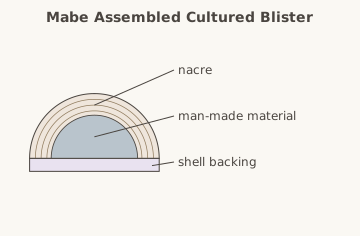
Mabe pearls are cultured half-pearls (blister pearls) grown on the inner shell wall of a mollusc—'cultured blister pearls'. Unlike round gonad culture, a bead nucleus (for example a 17 mm resin nucleus) is glued with an ethyl-2-cyanoacrylate adhesive to the inner shell near the adductor muscle, and the mollusc then secretes and deposits nacre over it, forming a half-dome. Nacre thickens with cultivation time; for the best quality they should be harvested during the seventh month, by which point the nucleus and pearl layer together reach about 19.4 mm (roughly 1.2 mm of nacre). Mabe pearls are cultured, not imitation—the nacre is genuinely secreted by the mollusc—but the finished product is typically assembled with a filled dome and a mother-of-pearl backing, so it is an assembled product and must be distinguished from natural pearls.
Scope: Applies to explaining the cultivation method and form of cultured half (blister) pearls, i.e. mabe pearls; finished mabe pearls are often filled and assembled with a backing, a post-processing step not described in this source.
Sources CIBJO Pearl Book 2024 · G&G Fall 2019
Where it forms
Marine farms (e.g., Phuket, Thailand); hosts include Pteria penguin.
Sources CIBJO Pearl Book 2024 · G&G Fall 2019
On the inner shell wall near the adductor muscle (where the half-nucleus is attached), not in the gonad.
Sources CIBJO Pearl Book 2024 · G&G Fall 2019
How it forms, step by step
A bead nucleus (e.g., a 17 mm resin nucleus) is glued to the inner shell wall near the adductor muscle using an ethyl-2-cyanoacrylate adhesive.
The mollusc secretes and deposits nacre over the nucleus, forming a half-dome (blister) pearl.
Nacre thickens over time; harvesting them during the seventh month yields a combined nucleus and pearl layer of about 19.4 mm (roughly 1.2 mm of nacre).
(Finishing step) Mabe are typically assembled by filling and adding a mother-of-pearl backing to form an assembled cultured-pearl product.
Link to appearance
A mabe is a half-dome with nacre covering its surface; its colour varies with mollusc species, nacre thickness, water quality, plankton (food) and the genetics of the mollusc population.
Sources G&G Fall 2019 · GIA Pearl Description · CIBJO Pearl Book 2024
Timescale
Half-pearls (mabe) should be harvested in the seventh month after implantation for best quality; the experiment observed nacre deposition over 10 months.
Sources G&G Fall 2019
Related base materials
- Blister pearl: cultured-variant | Blister (half) pearls can form either naturally or through culturing; Mabe is a cultured half pearl grown by artificially implanting a nucleus
- Cultured pearl: product-category | A cultured pearl category grown by artificially implanting a nucleus
Supporting findings
Half-pearls (mabe / cultured blister pearls) are produced by pearl mollusks such as Pteria penguin.
Evidence grade AScope: Concerns the mollusc of the studied farm; traditional mabe may use other hosts not covered here.
A mabe pearl is cultured by gluing a resin nucleus to the inner shell wall near the adductor muscle, after which the mollusc deposits nacre to form a half-pearl.
Evidence grade AScope: Mechanism from a Phuket (Thailand) Pteria penguin study; the 17 mm nucleus is that farm's standard.
Best quality is obtained by harvesting mabe half-pearls during the seventh month, at which point the nucleus and pearl layer together measure about 19.4 mm (roughly 1.2 mm of nacre).
Evidence grade AScope: Optimal harvest timing from that experimental farm for buttons and button-shaped jewelry; not universal to all farms.
Recorded localities
This is an organic material; its localities are the harvest or culture areas (waters or species ranges) recorded by authoritative sources.
Africa
- SeychellesAppendix: production starting 1998
Sources CIBJO Pearl Book 2024
- CIBJO Blue Book — Pearl Book (Pearl Commission 2024-1)
- MayotteRecently appeared on the market
Sources Gems & Gemology Fall 2021
Asia
- JapanAppendix: culturing in Japan since 1908
Sources CIBJO Pearl Book 2024
- CIBJO Blue Book — Pearl Book (Pearl Commission 2024-1)
- Phuket, Thailand
Sources CIBJO Pearl Book 2024 · G&G Fall 2019
- CIBJO Blue Book — Pearl Book (Pearl Commission 2024-1)
- Effects of Mollusk Size on Growth and Color of Cultured Half-Pearls from Phuket, Thailand (Gems & Gemology, Fall 2019, Vol. 55, No. 3)
- Vietnam
Sources CIBJO Pearl Book 2024
- CIBJO Blue Book — Pearl Book (Pearl Commission 2024-1)
Oceania
- Solomon Islands
Sources CIBJO Pearl Book 2024
- CIBJO Blue Book — Pearl Book (Pearl Commission 2024-1)
- Tonga
Sources CIBJO Pearl Book 2024
- CIBJO Blue Book — Pearl Book (Pearl Commission 2024-1)
These are localities recorded by authoritative sources, not an origin finding for any individual piece. The CIBJO Gemstone Book (2022, §4.2.3) says a place of origin names where a gem was mined or harvested, is a matter of opinion, does not imply a level of quality, and that cutting, processing or exporting centres must not be used to imply origin. See the origin determination guide and the overview of recorded localities.
How it is identified
Mabe pearls are half or assembled cultured pearls, and they can resemble natural half pearls or imitations, so the eye cannot readily judge their structure or origin. Determination relies on laboratory testing such as real-time X-radiography and microradiography to examine internal structure and nacre, UV-visible reflectance spectroscopy, X-ray fluorescence, and computed micro-tomography (μCT). Structure and category must be judged by an accredited laboratory, and this entry provides no self-test threshold.
Evidence grade AScope: Appearance is insufficient to settle structure and category; determination requires testing by an accredited laboratory, and this entry gives no self-test method or threshold.
Sources GIA: How GIA Identifies Pearls · CIBJO Pearl Book 2024
Other research findings
Mabe pearls are cultured blister pearls grown with an implanted nucleus; CIBJO's Pearl Book 2024 defines 'Mabe' (5.112) as a Japanese trade term for an assembled cultured blister (5.14) grown in Pteria penguin (mabe-gai): blisters are cut away from the shell, the bead they grew on is taken out, and the hollow is packed with man-made material and given a shell backing, the parts being joined with adhesive; the nacre is genuinely secreted by the mollusc, so they are cultured, not imitation, and must be distinguished from natural pearls and natural blister pearls.
Evidence grade AScope: CIBJO 5.14/5.112 give the naming definition of the finished Mabe Assembled Cultured Blister; the GIA source describes half-pearl cultivation. The two are complementary.
Sources G&G Fall 2019 · GIA Pearl Description · CIBJO Pearl Book 2024
Pearl quality is usually assessed through lustre, nacre thickness, surface, shape, colour and matching (GIA summarises the pearl value factors as seven: size, shape, colour, nacre, lustre, surface and matching). Mabe pearls are half or semi-formed pearls grown as blister (attached) cultured pearls and are normally united with a backing, so evaluation emphasises the lustre, surface and colour of the domed face and the soundness of the assembled structure and its underside, rather than the evenness of a whole free round pearl. Because it is an assembled or composite structure, its nature (blister, assembled) must be clearly stated, and its evaluation must be distinguished from that of a whole round pearl. Grading of a specific specimen must be issued by an accredited laboratory.
Evidence grade AScope: This describes the pearl quality characteristics the market generally prizes; it is not a grade for any specific specimen and is neither price nor investment advice; pearl category (natural or cultured) and any treatment must be determined by an accredited laboratory on the specific specimen.
Sources GIA: How GIA Identifies Pearls · CIBJO Pearl Book 2024
Limits of this research
- Research status: Formation, occurrence or other material-specific findings found in authoritative sources
- The GIA source covers half-pearl cultivation only; the filling and shell-backing assembly of the finished Mabe is now defined by CIBJO 5.14/5.112.
- The studied mollusc is Pteria penguin; other hosts traditionally used for mabe are not covered.
- Colour cause is only at the qualitative level of mollusc species, nacre thickness, water quality, plankton and genetics.
Methodology
- Origin determination and its limits
- Quality grading and value factors
- How gemmology became a technical discipline
Evidence grades
- A
- Standards bodies, government geological surveys, peer-reviewed research and museum records
- B
- Institutional educational material
- C
- Specialist databases or cautious readings
A statement is never graded above its strongest source.
This section is LumaLark's own factual restatement of public authoritative sources, credited item by item; it contains no verbatim excerpts, images or third-party logos.
DecideListing name, disclosure, care and treatments
- Suggested listing name
- Mabe Assembled Cultured Blister
16 CFR Part 23 §23.20(a), §23.19(a), §23.20(b)
This page cannot answer
Natural? · Origin · Price
A lab report settles these; this wiki covers naming and disclosure.
Related:What this page can answer
Answer at a glance
"Mabe Assembled Cultured Blister" is a market name rather than a mineral species name; before using it, verify: Not a mineral: man-made or non-mineral material.
Evidence
What this means for you
Before buying, check the recommended listing name "Mabe Assembled Cultured Blister" and any disclosed treatments on this page, and ask the seller for a grading report if in doubt.
Known uncertainty
- This entry's exact material identity is not fully settled.
- See “Disclosure and cautions” above
- Last reviewed
- 2026-09-01
Trade-name ruling
- Not a mineral: man-made or non-mineral material.
- Suggested listing name
- Mabe Assembled Cultured Blister
Care and wear
The normal and special care that applies to all natural and cultured pearls, and so to Mabe Assembled Cultured Blister (CIBJO Pearl Book §7.1, §7.2; the source says this advice counts as normal across the whole range and should be passed on to the buyer), is set out in full under care on the Pearl entry.
Care
Mabe Assembled Cultured Blister — care (light): may fade or revert to its original colour, so it should not be left for long periods in strong natural or artificial light or under strong display lighting.
CIBJO Pearl Book 2024
- Treatment state
- treated
- Only after these treatments
- dyeing
Source & check 2026-09-26
- Source
- CIBJO Blue Book — Pearl Book (Pearl Commission 2024-1) (CIBJO): §8.2 Annex C, Mabe / Saltwater Cultured Blister, p.53; §7.2, §7.2.2 (locator checked 2026-09-26)
- Fact checked on
- 2026-09-26
Mabe Assembled Cultured Blister — care (wear): breaks easily, so it is not meant for everyday wear and should not be worn during heavy work.
CIBJO Pearl Book 2024
- Treatment state
- treated
- Only after these treatments
- bleaching
Source & check 2026-09-26
- Source
- CIBJO Blue Book — Pearl Book (Pearl Commission 2024-1) (CIBJO): §8.2 Annex C, Mabe / Saltwater Cultured Blister, p.53; §7.2, §7.2.1 (locator checked 2026-09-26)
- Fact checked on
- 2026-09-26
Mabe Assembled Cultured Blister — care (special care): mabé (an assembled material): special care (SC), with extra caution; keep it away from household chemicals, cosmetics and abrasives, and protect it from sudden knocks.
AGTA Gemstone Information Manual, 17th ed.
- Treatment state
- any treatment state
Source & check 2026-09-26
- Source
- AGTA Gemstone Information Manual, 17th edition (August 2026) (AGTA): p.XIII, Gemstone Information Chart, Mabe “Pearl”, CARE REQUIRED / SPECIAL ADVICE (locator checked 2026-09-26)
- Fact checked on
- 2026-09-26
Each row's “Source & check” expands to the full source; the date beside it is the fact check date.
Common care questions and matching entries
The care conclusions for Mabe Assembled Cultured Blister come from CIBJO, the World Jewellery Confederation, and the American Gem Trade Association (AGTA). LightOn light, CIBJO states that treated Mabe (dyed only) may fade or revert to its original colour and should not be left for long under strong natural light, strong artificial light or strong display lighting. WearOn wear, CIBJO states that treated Mabe (bleached only) breaks easily, is not suited to everyday wear, and should not be worn during heavy physical work. Special careOn special care, AGTA states that Mabe is an assembled material and, in any treatment state, needs extra special care (marked SC), kept away from household chemicals, cosmetics, abrasives and sudden knocks. The general and special care applying to all natural and cultured pearls also applies to Mabe, and is listed in full in the care section of the Pearl entry.
This table scrolls sideways on narrow screens.
| Question | Matching entries |
|---|---|
| Light and display | may fade or revert to its original colour, so it should not be left for long periods in strong natural or artificial light or under strong display lighting |
| Wearing limits (knocks, settings) | breaks easily, so it is not meant for everyday wear and should not be worn during heavy work |
Care entries by treatment state
The same entries grouped by the treatment state each applies to; each links to its full wording and source. Letters are CIBJO special-care codes, explained on the gemstone care page.
any treatment state
treated (Only after these treatments: dyeing)
treated (Only after these treatments: bleaching)
VerifyNames, standards, technical facts, clauses and sources
Names
Besides Mabe Assembled Cultured Blister, the name register records "Half cultured pearl", "Half-pearl", "Hankei" and "Mabe assembled blister", for which no restriction on use as a name is recorded (CIBJO Pearl Book 2024 §5.93 “Half cultured pearl”; CIBJO Pearl Book 2024 §5.95 “Hankei or Mabe”); one further name in a non-Latin script is listed in the name register below (1 with no restriction recorded on use as a name).
Standard and listing namesThe national-standard name corresponding to Mabe Assembled Cultured Blister is assembled stone, based on GB/T 16552—2017, which does not list the name itself; the suggested listing name is Mabe Assembled Cultured Blister. Names in four languagesThe four-language names cover Simplified Chinese, Traditional Chinese, English (Mabe Assembled Cultured Blister) and Japanese; trade names and synonyms include Mabe assembled blister and Half-pearl. Trade and mineralogical namesHalf cultured pearl and Hankei are market names, matched to Mabe only once their conditions are confirmed, based on the CIBJO Pearl Book 2024; penguin wing oyster saltwater pearl is a narrower name (variety/subtype), likewise matched only once its conditions are confirmed, based on GB/T 18781—2023. Institution usageOn authority wording, the FTC text on file has no wording for this name (checked); the wording of GIA, CIBJO and Gem-A is unchecked; bodies without a record show the entry's own English name, which does not represent their position. Japanese namesThe GSJ (Japan) wording for the entry's own Japanese name is not yet verified by this site. National standard namesGermany (RAL) writes Mabé-Perle (assemblierte Blisterperle) and the European Union writes Mabé Pearl, noting that the construction must be disclosed.
Name register
Every name recorded for this entry, with how it is classified, whether it may be matched to this entry automatically, whether it may be used as a product name, and the clause it rests on.
This table scrolls sideways on narrow screens.
| Name | Type | Matching | Use as a name | Basis |
|---|---|---|---|---|
| no restriction recorded (5) | ||||
| Half cultured pearlEnglish | market name | matched only once the condition is confirmed | no restriction recorded | CIBJO Pearl Book 2024 §5.93 “Half cultured pearl” |
| Half-pearlEnglish | market name | matched automatically | no restriction recorded | editorial ruling (no clause cited) |
| HankeiEnglish | market name | matched only once the condition is confirmed | no restriction recorded | CIBJO Pearl Book 2024 §5.95 “Hankei or Mabe” |
| Mabe assembled blisterEnglish | market name | matched automatically | no restriction recorded | editorial ruling (no clause cited) |
| 企鹅珍珠贝海水珍珠Simplified Chinese | narrower name (variety or subtype) | matched only once the condition is confirmed | no restriction recorded | GB/T 18781—2023 3.2.1 |
How each authority words this name: see Names › Authority wording.
- GSJ (Japan) formal name
- マベ真珠 (not yet checked for this body — the entry's own Japanese name is shown)
- GB/T naming counterpart (this name is not in the standard)
- 拼合石 (GB/T 16552—2017 §5.1.3.3 a))
- Mineralogical name
- Assembled cultured blister pearl with a filled dome and mother-of-pearl backing
- Trade names and synonyms
- Mabe assembled blister (market name) · Half-pearl (market name) · Half cultured pearl (market name; conditional name) · Hankei (market name; conditional name)
Four-language names
- 简体中文
- 马贝珍珠
- 繁體中文
- 馬貝珍珠
- English
- Mabe Assembled Cultured Blister
- 日本語
- マベ真珠
National and regional formal names
- Germany (RAL)
- Mabé-Perle (assemblierte Blisterperle)
- European Union
- Mabé Pearl (assembled blister pearl; EU: disclose structure)
See also: Misleading and prohibited trade names · Supplementary name index
Classification
- Origin
- Artificial products / Manufactured products
- Material domain
- Artificial products / Manufactured products
- Browsing family
- Assembled gem products
- Identity tier
- Artificial product type
- Mineral chemical class
- Mixed / composition-dependent
- Construction or treatment status
- Assembled / composite product
What it is and how it's identified
Mabe is a Japanese trade term for an assembled cultured blister from Pteria penguin; locally that oyster is called mabe-gai, i.e. the Mabe oyster. Nowadays the word mabe is also widely applied to assembled cultured blisters grown in other bivalves. The CIBJO trade definition comes from an institutional manual, not a national standard. An assembled cultured blister is made from a specially grown cultured blister: it is cut from the shell, the original nucleus is removed, the cavity is filled with various artificial materials and backed with a layer of shell, and the parts are joined with adhesive; it is commonly called Mabe or Hankei, and should not be confused with cut cultured pearls. A nacreous cultured blister is attached to the shell of the mollusc and forms when nacreous or non-nacreous material is inserted by hand and the mantle tissue secretes layers of nacre over its surface, so that the shell, the material and the new nacre layers become one; after harvest it is cut from the shell with the material still in place.
Registered material facts
Each row carries its own source and check date and can be cited on its own; “—” means the cited source gives no value, not “none”.
Definition
Mabe Assembled Cultured Blister: Japanese trade term designating an assembled cultured blister (5.14) from Pteria penguin (9.68) locally known as mabe-gai, the Mabe oyster (9.39). Today the term mabe is often used to describe assembled cultured blisters produced in other bivalves.
CIBJO Pearl Book 2024
- Qualification
CIBJO trade definition from an institutional manual, not a national standard. The English text quotes the full definition at §5.112 of the Pearl Book 2024.
Source & check 2026-09-25
- Source
- CIBJO Blue Book — Pearl Book (Pearl Commission 2024-1) (CIBJO): §5.112, p.33 (locator checked 2026-09-25)
- Fact checked on
- 2026-09-25
Each row's “Source & check” expands to the full source; the date beside it is the fact check date.
Related CIBJO terms
- Abalone Cultured Blister
a cultured blister (5.57) from an abalone (5.2).
CIBJO Blue Book — Pearl Book (Pearl Commission 2024-1) (CIBJO): §5.1, p.22
- Assembled cultured blister
assemblages of a purpose-grown cultured blisters (5.57) which have been cut from their shell, the original bead (5.144) upon which they grew being removed and the cavity filled with various types of man-made materials, and backed by a layer of shell, the assemblages being held together by an adhesive; commonly known as Mabe (5.112) or Hankei (5.95) and occur in both fresh and saltwater environments. Not to be confused with cut cultured pearl (5.58).
CIBJO Blue Book — Pearl Book (Pearl Commission 2024-1) (CIBJO): §5.14, p.23
- Hankei or Mabe
Japanese trade term for cultured blister (5.57).
CIBJO Blue Book — Pearl Book (Pearl Commission 2024-1) (CIBJO): §5.95, p.31
- Nacreous cultured blister
a nacreous cultured blister attached to the shell of a mollusc. A cultured blister is formed following the insertion by human hand of a nacreous or non-nacreous material that is or becomes attached to or lies against the inside of the shell of a mollusc. The mantle tissue (5.114) secretes layers of nacre on the material’s surface. These nacreous layers’ form over the inserted material and continue onto the interior of the shell, making one cohesive whole between the shell, the material and the newly formed nacreous layers. Following harvest, the cultured blister is cut from the shell, the material remaining in position.
CIBJO Blue Book — Pearl Book (Pearl Commission 2024-1) (CIBJO): §5.131, p.36
Entries in the source that only point to another clause: Cultured blister (§5.57, p.28) → §5.131 Nacreous cultured blister; Half cultured blister (§5.92, p.31) → §5.57 Cultured blister; Three quarter cultured blister (§5.200, p.45) → §5.57 Cultured blister
Definitions are quoted verbatim from the cited CIBJO Blue Book; […] marks an excerpt, and the full definition is at the cited clause.
Pearl-producing molluscs (CIBJO Annex D): §9.39 Mabe pearl oyster · §9.68 Pteria penguin
Evidence and sources
Authority basis and clause sources
Sources
- CIBJO – The World Jewellery Confederation. Gemmological Laboratories Book (Blue Book), Gemmological Commission 2024-1.
- CIBJO – The World Jewellery Confederation. The Gemstone Book (Blue Book), 2022.
- SAMR / SAC (China). GB/T 16552—2017 Gems — Nomenclature.
- GIA – Gemological Institute of America (United States). Gem Encyclopedia.
- Gem-A – The Gemmological Association of Great Britain (United Kingdom).
- Federal Trade Commission (United States). In the Loupe: Advertising Diamond, Gemstones and Pearls.
- eCFR (United States). 16 CFR § 23.20 — Misuse of the word “pearl.” In: 16 CFR Part 23 — Guides for the Jewelry, Precious Metals, and Pewter Industries.
Further reading
Related entries and topic cluster
Parent entry and related pages on this site. Rows marked “Planned” are suggested new content and have no link yet.
This table scrolls sideways on narrow screens.
| Page | Content | Status |
|---|---|---|
| Browsing family | Assembled gem products | Live |
| Related articles | To be added (placeholder) | Planned |
Who maintains this page
The material facts in the Mabe Assembled Cultured Blister entry are maintained by the LumaLark wiki and matched one by one to the standard clauses or institutional sources they cite: every fact carries its source (with a clause or page locator) and a check date, so it can be traced back to the original. The entry exists so that buyers and sellers can check naming, disclosure and material facts item by item.