On this page
UnderstandWhat it is, what people ask, how far this page goes
Artificial products / Manufactured products · Artificial product type · Assembled / composite product
Composite / Assembled Stone
A gem product made of two or more parts bonded together. Under GB/T 16552-2017 clause 5.1.3.3, it is named by adding "composite stone" after the names of its component materials. This page compares how the major standards and institutions name it, what must be disclosed when selling it, whether it can be worn every day, how it is treated and identified, and which source each conclusion comes from.
Price, rarity and origin are outside the scope of this wiki.
What this page can answer
This page covers
- How Composite / Assembled Stone forms and what gives its colourFormation setting, process and timescale, each finding graded and sourced
- Caring for and wearing Composite / Assembled StoneCleaning, heat, chemicals and light, as the cited sources give them
- Composite / Assembled Stone in English, Chinese and Japanese; national standard namesNames in four languages, the GB/T standard name and the suggested listing name; and: Has any of GIA, FTC, CIBJO or Gem-A put a name for it on record here?
- Listing and disclosing Composite / Assembled StoneThe listing name to use; what must be disclosed before sale
- Standard clauses that define Composite / Assembled StoneWhich clause defines it, each cross-checked
What we cannot conclude
- Whether one particular bead is natural, treated or synthetic — only a laboratory report can settle that.
- Geographic origin, unless an origin report accompanies the item.
- Price, rarity or investment value: this wiki covers naming and disclosure only.
Material research: formation, causes and history
What authoritative sources say about how this material forms, what causes its colour and optical effects, where its name comes from and how people have used it. Each statement carries an evidence grade and its sources; it describes the material in general, not any specific piece.
How it forms
Parts:
- two parts
- three parts
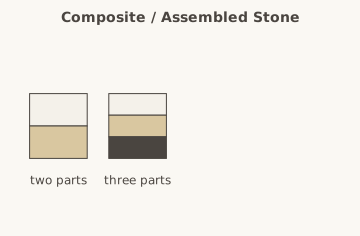
A composite (assembled) stone is not a material of its own but a category defined by structure. In CIBJO's terms it is an artificial product built from two or more parts or layers that were previously separate, joined by bonding or by other artificial means, with components that can be natural, artificial or both, provided at least one part is a gemstone. Counted by parts it subdivides into the doublet (two parts) and the triplet (three parts). GIA, too, terms the outcome an 'assembled or composite stone', produced by gluing or fusing at least two separate pieces of material into a faceted gemstone. This record therefore describes a structural template rather than a single mineral or material.
Scope: Applies to explaining the definition, construction and naming rules of composite stones as a product-structure category (doublets / triplets); it does not represent any single material and is not used to describe the natural origin of any particular assembled piece.
Sources CIBJO Gemstone Book 2022 · GIA Introduction to Imitation Gems
Where it forms
Natural occurrence environment does not apply: a composite stone is assembled by bonding/fusing separate parts under human-controlled conditions, not formed in nature.
Sources CIBJO Gemstone Book 2022
Assembly conditions: an adhesive or fusion joins the parts at a join plane, commonly kept parallel to the large table facet for more uniform face-up color.
Sources CIBJO Gemstone Book 2022
How it forms, step by step
Select two or more usable parts (natural and/or artificial, at least one a gemstone).
Sources CIBJO Gemstone Book 2022 · GIA Introduction to Imitation Gems
Prepare the surfaces to be joined parallel to the finished large table facet for more uniform face-up color.
Sources CIBJO Gemstone Book 2022
Bond (or fuse) the parts together into a doublet or triplet.
Sources CIBJO Gemstone Book 2022
Name/disclose it per CIBJO as 'doublet/triplet/composite' together with the correct names of its components.
Sources CIBJO Gemstone Book 2022
Link to appearance
Composite stones are often used to gain a larger, more uniformly colored face-up appearance from a thin layer of precious material (e.g. opal doublets/triplets); the face may closely resemble a natural gem, and the join plane, bubbles and assembled structure are seen from the side or under immersion.
Sources GIA Introduction to Imitation Gems · G&G Summer 2022 · G&G Fall 2013
Timescale
The cited authorities give no timescale or date of origin for composite-stone assembly.
Sources CIBJO Gemstone Book 2022
Recorded localities
This is a manufactured, assembled or treated product that contains natural material. No locality is given for the finished product; see the parent material's entry for where the natural component is recorded.
Other research findings
In CIBJO's usage, a composite stone is an artificial product built from two or more parts or layers that were previously separate, joined together by bonding or by other artificial means; the components can be natural, artificial or both, but at least one part has to be a gemstone.
Evidence grade AScope: A terminology definition of the composite category; not the specific components of any one piece.
Sources CIBJO Gemstone Book 2022
CIBJO states that assembled stones are composite stones; a composite stone is a structure category, not a specific material.
Evidence grade AScope: A terminology equivalence, used to distinguish it from a single material.
Sources CIBJO Gemstone Book 2022
By number of parts, a doublet consists of two parts and a triplet consists of three parts.
Evidence grade AScope: Defines only the parts-count classification; it does not restrict the materials used.
Sources CIBJO Gemstone Book 2022
GIA's account runs as follows: if manufacturers glue or fuse at least two separate pieces of material together into a faceted gemstone, the outcome is termed an assembled (or composite) stone, and those pieces may be either natural or manmade.
Evidence grade AScope: A description of the assembly method; it does not infer the material of any specific product.
Sources GIA Introduction to Imitation Gems
A composite stone is not necessarily an imitation: for example, natural opal occurring in very thin layers may be reinforced as a composite for legitimate structural reasons.
Evidence grade AScope: Shows the variety of composite-stone purposes; not applicable to pieces made to deceive.
Sources GIA Introduction to Imitation Gems
A composite stone must be named with 'doublet/triplet/composite' preceded or followed by the correct names of its components, e.g. 'garnet/glass doublet'.
Evidence grade AScope: A naming rule; not about physical properties or value.
Sources CIBJO Gemstone Book 2022
Examples: GIA identified an 11.30 ct triplet of a colorless glass crown, quartz pavilion and green cement imitating emerald, and an assemblage of quartz, gypsum and plastic imitating rainbow moonstone.
Evidence grade AScope: Individual examined examples illustrating structural variety, not all composite stones.
Sources G&G Summer 2022 · G&G Fall 2013
Limits of this research
- Research status: Only partial material-specific findings found; gaps are stated as gaps
- A composite stone is a product-structure category/naming template, not a specific material: this record describes no single mineral or material origin.
- The cited authorities give no timescale for composite assembly, and the chemistry and durability of adhesives are not quantified in the cited sources.
- The nature of a composite depends on its specific components and must be determined per piece; the category name 'composite stone' does not imply a material.
Methodology
- Origin determination and its limits
- Quality grading and value factors
- How gemmology became a technical discipline
Evidence grades
- A
- Standards bodies, government geological surveys, peer-reviewed research and museum records
- B
- Institutional educational material
- C
- Specialist databases or cautious readings
A statement is never graded above its strongest source.
This section is LumaLark's own factual restatement of public authoritative sources, credited item by item; it contains no verbatim excerpts, images or third-party logos.
DecideListing name, disclosure, care and treatments
- Suggested listing name
- Composite stone (itemise the component materials)
GB/T 16552—2017 5.1.3.3 · CIBJO Gemstone Book 2022 4.3.2.1
This page cannot answer
Natural? · Origin · Price
A lab report settles these; this wiki covers naming and disclosure.
Related:What this page can answer
Answer at a glance
"Composite / Assembled Stone" is a market name rather than a mineral species name; before using it, verify: Not a mineral: man-made or non-mineral material.
Evidence
- GB/T · 5.1.3.3
What this means for you
Before buying, check the recommended listing name "Composite stone (itemise the component materials)" and any disclosed treatments on this page, and ask the seller for a grading report if in doubt.
Known uncertainty
- This entry's exact material identity is not fully settled.
- See “Disclosure and cautions” above
- Last reviewed
- 2026-09-01
Trade-name ruling
- Not a mineral: man-made or non-mineral material.
- Suggested listing name
- Composite stone (itemise the component materials)
Care and wear
Care
Composite / Assembled Stone — care (cleaning): GIA cautions that leaving opal doublets or triplets in water for long periods can loosen the glue holding them together.
GIA Gem Encyclopedia
- Treatment state
- any treatment state
Source & check 2026-10-06
- Source
- GIA, “October Birthstones: Opal & Tourmaline Birthstone Information”, gia.edu web page: Section: main text (locator checked 2026-10-06)
- Fact checked on
- 2026-10-06
Composite / Assembled Stone — care (chemicals): Under AGTA's manual, assembled (ASBL) stones need special care: no contact with cleaning products, makeup or abrasive materials, and no sharp knocks.
AGTA Gemstone Information Manual, 17th ed.
- Treatment state
- any treatment state
Source & check 2026-10-06
- Source
- AGTA Gemstone Information Manual, 17th edition (August 2026) (AGTA): p.XIX, Tag Codes and Definitions, ASBL care sentence (locator checked 2026-10-06)
- Fact checked on
- 2026-10-06
Each row's “Source & check” expands to the full source; the date beside it is the fact check date.
Common care questions and matching entries
Each question links to the matching entries on this page; whether they answer it fully, go by the entry wording.
This table scrolls sideways on narrow screens.
| Question | Matching entries |
|---|---|
| Can it go in an ultrasonic or steam cleaner? | GIA cautions that leaving opal doublets or triplets in water for long periods can loosen the glue holding them together |
| Contact with acids, alkalis and household chemicals | Under AGTA's manual, assembled (ASBL) stones need special care: no contact with cleaning products, makeup or abrasive materials, and no sharp knocks |
VerifyNames, standards, technical facts, clauses and sources
Names
Chinese standard nameThe Chinese formal name of Composite / Assembled Stone is the Chinese term for assembled stone, based on GB/T 16552—2017. The entry's own English name is Composite / Assembled Stone, and the English mineralogical description means a gem product assembled from two or more parts. Names in four languagesThe Simplified and Traditional Chinese names are written the same way, the English is Composite / Assembled Stone, and there is also a Japanese name. Recommended listing nameThe suggested listing name is assembled stone (with details of the component materials). Institution usageOn authority wording, the wording of GIA, FTC, CIBJO and Gem-A for this material is not yet verified by this site; the English name shown is the entry's own and does not represent the position of GIA, FTC, CIBJO or Gem-A. Japanese namesThe entry has its own Japanese name, and the wording of Japan's GSJ for this material is not yet verified by this site.
- GSJ (Japan) formal name
- 複合石/アセンブルドストーン (not yet checked for this body — the entry's own Japanese name is shown)
- Chinese formal name
- 拼合石 (GB/T 16552—2017 §5.1.3.3 a))
- Mineralogical name
- Gem product assembled from two or more parts joined together
Four-language names
- 简体中文
- 拼合石
- 繁體中文
- 拼合石
- English
- Composite / Assembled Stone
- 日本語
- 複合石/アセンブルドストーン
See also: Misleading and prohibited trade names · Supplementary name index
Classification
- Origin
- Artificial products / Manufactured products
- Material domain
- Artificial products / Manufactured products
- Browsing family
- Assembled gem products
- Identity tier
- Artificial product type
- Mineral chemical class
- Mixed / composition-dependent
- Construction or treatment status
- Assembled / composite product
What it is and how it's identified
The material facts for Composite / Assembled Stone are registered from the CIBJO trade definition: a composite stone is an artificial product made of two or more previously separate parts or layers joined by bonding or other artificial means; at least one of the components has to be a gemstone, while the others may be natural, artificial or both. The cited CIBJO Blue Book (Coloured Stone Commission 2022) is an organisation's handbook, and its definition of composite stones is a trade definition, not a national standard; the English page quotes the original definition in full, and the Chinese page gives a full translation. In the CIBJO original, assembled gemstones only point to other clauses and have no definition of their own.
Registered material facts
Each row carries its own source and check date and can be cited on its own; “—” means the cited source gives no value, not “none”.
Definition
Composite / Assembled Stone: artificial products (5.3) composed of two or more previously separate parts or layers assembled by bonding (5.10) or other artificial methods. Their components may be natural and/or artificial but at least one part must be a gemstone.
CIBJO Gemstone Book 2022
- Qualification
CIBJO trade definition from an institutional manual, not a national standard. The English text quotes the full definition at §5.18 of the Official Gemstone Book 2022.
Source & check 2026-09-25
- Source
- CIBJO Blue Book — Official Gemstone Book (Coloured Stone Commission 2022) (CIBJO): §5.18, p.22 (locator checked 2026-09-25)
- Fact checked on
- 2026-09-25
Each row's “Source & check” expands to the full source; the date beside it is the fact check date.
Related CIBJO terms
Entries in the source that only point to another clause: Assembled stones (§5.5, p.20) → §5.18 Composite stones
Definitions are quoted verbatim from the cited CIBJO Blue Book; […] marks an excerpt, and the full definition is at the cited clause.
Clause-level definitions
In the clause-level definitions, Composite / Assembled Stone corresponds to the term Composite / Assembled Stone, based on GB/T 16552-2017 Annex A. The definition given in GB/T 16552-2017 Annex A is a gem product made of two or more parts joined together. The cross-check result is that it is listed directly in GB/T, and no standalone entry titled Composite / Assembled Stone was found in CIBJO.
This table scrolls sideways on narrow screens.
| Term | Clause | Definition | Cross-check |
|---|---|---|---|
| Composite / Assembled Stone | GB/T 16552-2017 Annex A | Gem product assembled from two or more parts joined together | Listed directly by GB/T; CIBJO carries no standalone entry under the same name. |
Evidence and sources
Authority basis and clause sources
Sources
- CIBJO – The World Jewellery Confederation. Gemmological Laboratories Book (Blue Book), Gemmological Commission 2024-1.
- CIBJO – The World Jewellery Confederation. The Gemstone Book (Blue Book), 2022.
- SAMR / SAC (China). GB/T 16552—2017 Gems — Nomenclature.
- RRUFF Project, in partnership with the IMA – International Mineralogical Association. IMA Mineral List.
- Geological Survey of Japan, AIST (Japan). Museum mineral specimens, browse by classification.
- Federal Trade Commission (United States). In the Loupe: Advertising Diamond, Gemstones and Pearls.
Further reading
Related entries and topic cluster
Parent entry and related pages on this site. Rows marked “Planned” are suggested new content and have no link yet.
Related-entry tree for Composite / Assembled Stone on this site: 2 entries listed by this site's parent-entry links; synthetic, treated and similar entries carry their recorded state after the name; this page (Composite / Assembled Stone) is marked.
- Composite / Assembled Stone (Assembled / composite product)
Sub-entries (1)
- Sapphire Composite Stone (Assembled / composite product)
This table scrolls sideways on narrow screens.
| Page | Content | Status |
|---|---|---|
| Browsing family | Assembled gem products | Live |
| Related articles | To be added (placeholder) | Planned |
Who maintains this page
The material facts in the Composite / Assembled Stone entry are maintained by the LumaLark wiki and matched one by one to the standard clauses or institutional sources they cite: every fact carries its source (with a clause or page locator) and a check date, so it can be traced back to the original; clause-level definitions also carry a cross-check result. The entry exists so that buyers and sellers can check naming, disclosure and material facts item by item.